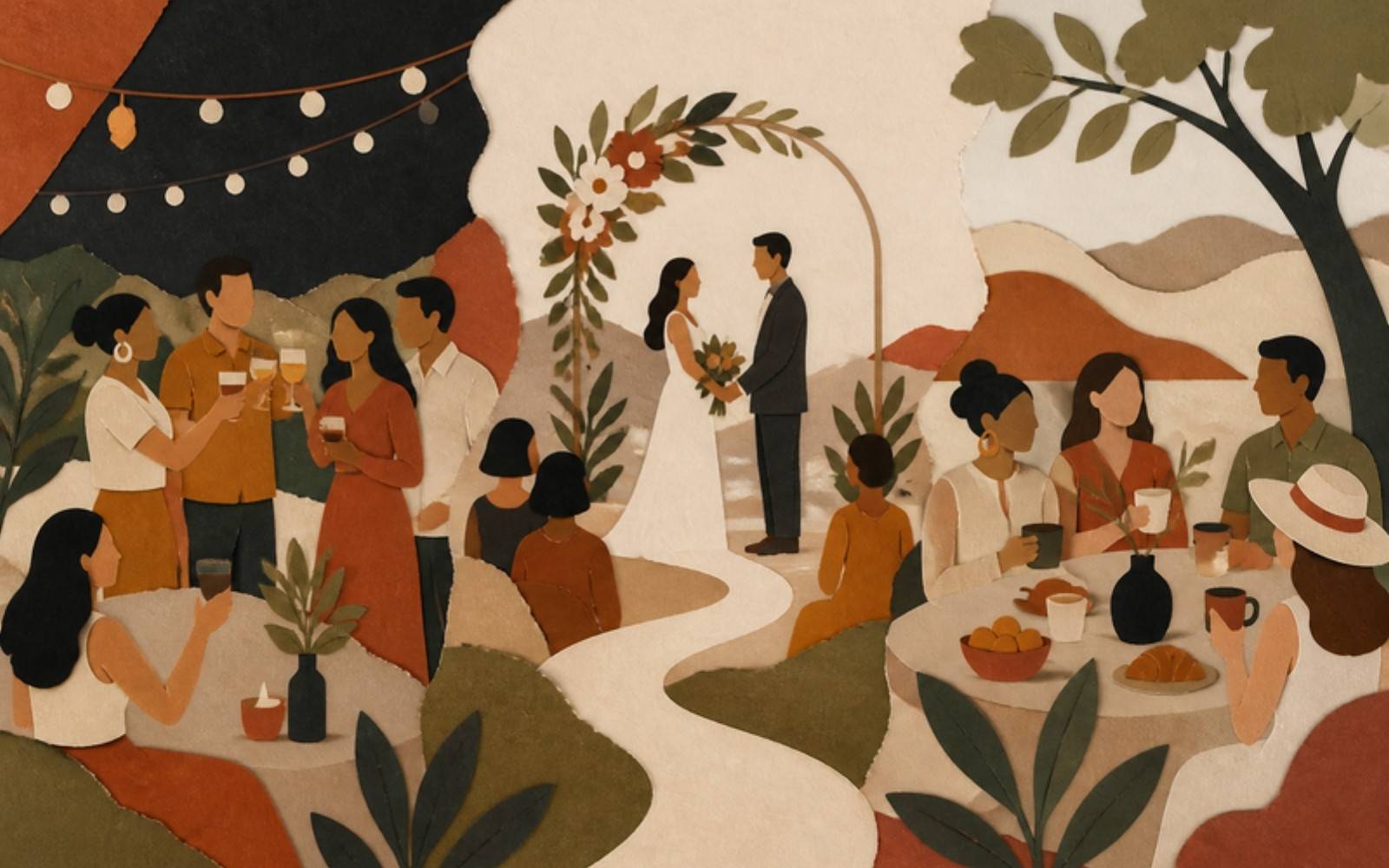
Quick answer: The big 2027 wedding trends are longer weddings (nearly 1 in 3 now span three days or more), coastal Italian beach-club styling (searches up 315%), silver over gold (up 133%) and interactive food like burrata bars, per The Knot's 2027 report. Meanwhile, wedding spending is up 8.5% year on year, per Bank of America, and AI planners are going mainstream. So: more events, more style, bigger bills. Your budget spreadsheet has entered its villain era.
So which of the trends filling your feed are couples actually booking, and which are just pretty Pinterest boards?
This month gave us real answers. The Knot published its 2027 Wedding Trends Report, built on search, save and spend data from 1.7 million US couples. Bank of America's payment data showed what weddings now cost. And David's Bridal announced it wants to spin its AI planner off as a public company. Put together, they paint a pretty clear picture of what planning looks like for anyone marrying in late 2026 or 2027.
Here's the hub: every major trend, what's driving it, and a link to the deeper guide when you want the how-to.
Weddings are turning into weekends
The headline stat from The Knot: nearly 1 in 3 weddings now span three days or more. Searches for "weekend-long storytelling" doubled year on year. Think welcome drinks on Friday, the main event Saturday, a recovery brunch Sunday. And more and more often, a pickleball tournament or boat day squeezed in between.
The Knot's editors frame it as couples prioritizing the guest experience, and vendors are following. Some photographers and caterers now cover welcome parties and morning-after events as standard, not as add-ons.
The catch is communication. Three events means three sets of times, places and dress codes, and guests who are invited to some events but not others. Our guide to wording invitations for a multi-day wedding covers who gets invited to what, plus copy-paste wording for each event.
The beach club is the venue of the year
Searches for coastal Italian "beach club" weddings are up 315%, and Italian-themed suites are up 167%, per The Knot. Its venue editors put beach clubs at the top of the 2027 list, alongside members clubs, townhomes, spas and even sports arenas.
You don't need the Amalfi Coast to pull it off, though. Cabana stripes, lemons, a spritz bar and a long sun-washed lunch table do most of the work, whether you're on a lake in Michigan or a rooftop in Austin. The full playbook, from palette to menu, is in our breakdown of how to do the beach club look anywhere.
Silver is replacing gold
Searches for silver flatware, platinum jewelry and cool-toned decor rose 133%. The Knot ties it to two things: rising global gold prices, and a wave of '90s and Y2K nostalgia. Antique lace and Victorian details are also up a huge 280%, so the overall mood is less "boho meadow," more "grandmother's silver chest, but make it fashion."
It's a trend that's easy to overdo. Too much silver reads cold, especially under evening lighting. Our guide to using silver wedding decor without the room feeling icy has the ratios that actually work.
Weddings cost more than last year (again)
Here's the less fun trend. A Bank of America Institute analysis of card and transfer data found wedding-related spending per customer was up 8.5% year on year through May 2026. That covers venues, catering, photography, florists and apparel. The report pointed to broad inflation (4.2% annualized in May) plus tariffs on imported goods like flowers. It also cited Zola's figure for the average 2025 wedding: $36,000, up $3,000 on the year before.
Couples are adjusting in very practical ways. NPR's Here & Now reported this week on couples buying their cakes from the grocery store bakery aisle. Lab-grown diamonds keep gaining share. And more guests are re-wearing outfits. We dug into why weddings cost more in 2026 and where couples are cutting without anyone noticing.
AI planners are going mainstream
On October 22, David's Bridal announced plans to spin off Pearl, its AI wedding-planning platform, into a separate public company. The proposed SPAC deal values it at about $350 million, and it isn't final yet. Pearl's pitch is that it builds your plan, budget and vendor list within minutes of signing up.
For couples, the takeaway isn't "use AI" or "avoid AI." It's to keep control of your own data and know when a recommendation is really an ad. We broke down what the Pearl spinoff means for couples planning now, including the fine print on the deal.
Who's driving these trends
Gen Z is now the generation getting married. Bank of America's data shows Gen Z weddings have tripled since 2019, while millennial weddings fell about 20% over the same period. That helps explain the nostalgia (Y2K silver), the social-first moments (interactive food stations made for video) and the weekend formats that feel more like a group trip than a single party.
Where people marry is shifting too. The same analysis found wedding spending by couples in the South grew five times faster than in the Midwest. And culture matters more than ever: 60% of couples tell The Knot that including their ethnicity, religion or culture is important.
The smaller trends worth knowing
- Interactive food and drink (up 66%): caviar service, martini sidecars, burrata bars and late-night comfort food stations.
- Experiential stationery (up 77%): ceremony program fans, pop-up menus, and paper guests actually use.
- Custom crests and monograms (up 100%): a personal "logo" that runs across invites, napkins and signage.
- Fine-art references (up 195%): Monet, Klimt and stained-glass color palettes.
- Balletcore (up 106%): Swan Lake-inspired tulle, satin bows and soft pinks.
- Cash registries: 72% of couples register for some form of cash, with honeymoon funds the most popular.
One trend that isn't in any report but shows up in every planner's inbox: digital invitations and online RSVPs. With three events and a mixed guest list, chasing replies by text gets old fast. Our guide to digital wedding invitations covers the etiquette, and a free RSVP tracker keeps per-event headcounts in one list.
How these trends fit together
Read the report and the spending data side by side and one theme jumps out: couples want weddings that feel like an experience, and they're paying for it. The three-day format, the beach club look, interactive food stations and "weekend-long storytelling" are all the same idea. Guests shouldn't just watch a wedding. They should spend a weekend inside one.
That's also why costs are climbing faster than inflation alone would explain. More events means more meals, more drinks, more rentals and more staff hours. And with most cut flowers imported and hit by tariffs, the floral side of an expanded weekend gets pricier too.
The silver trend is the outlier, and the helpful one. It's partly a reaction to expensive gold, and silver decor is easy to rent, borrow or thrift. If you want one trend that fits a tighter budget, this is it.
Which 2027 trends fit your budget?
| Trend | Cost level | The easiest way in |
|---|---|---|
| Three-day wedding | High | Add one casual welcome drink instead of two extra events |
| Beach club styling | Low to medium | Striped linens, lemons and a spritz at cocktail hour |
| Silver decor | Low | Thrifted or rented candlesticks and flatware |
| Interactive food stations | Medium | One station (burrata or late-night bites) instead of a full extra course |
| Experiential stationery | Low to medium | Ceremony program fans, which double as decor |
| Custom crest or monogram | Low | One design reused on invites, napkins and signs |
Notice the pattern: the cheapest trends are the visual ones. The expensive ones add time, food and people.
Trends worth skipping (my honest take)
Not every rising search deserves a slot in your budget. A few I'd think twice about:
- Doing every trend at once. Beach club stripes, Victorian lace and Klimt gold leaf in one room is a lot. Pick one lead idea and let the rest support it.
- A third event you can't staff. If your venue or caterer can't cover Friday and Sunday comfortably, a rushed brunch is worse than no brunch.
- Anything that makes guests spend more. Three dress codes plus travel adds up for guests too, and with costs up for everyone, a relaxed dress code is a kindness.
Trends date fast. The parts guests remember, like good food, a comfortable room and a clear plan, never do.
What this means if you're planning right now
Trends are fun. Budgets are real. If you're booking for 2027, here's how I'd use this list:
- Decide your number of events first. A welcome party plus a brunch can add a third to your food and drink costs. Decide before you fall in love with a venue.
- Pick one trend to go big on. Beach club, silver or fine-art florals. Doing all three at once just makes the room look confused.
- Lock vendor prices early. With costs up 8.5%, a signed contract this fall is cheaper than a quote next spring.
- Plan your guest communication. Multi-day weddings live or die on clear invites and a single RSVP list.
- Keep your own copies. Whatever app you plan in, export your guest list and budget regularly.
If replies are your weak spot, our tips on getting guests to actually RSVP work for three-day weddings too. Just send the reminder earlier.
Here's hoping your wedding gets the best of 2027: the spritz bar, the good silver, the long weekend with your favorite people, and a budget that survives all of it.
People Also Asked
Explore common questions related to this blog.