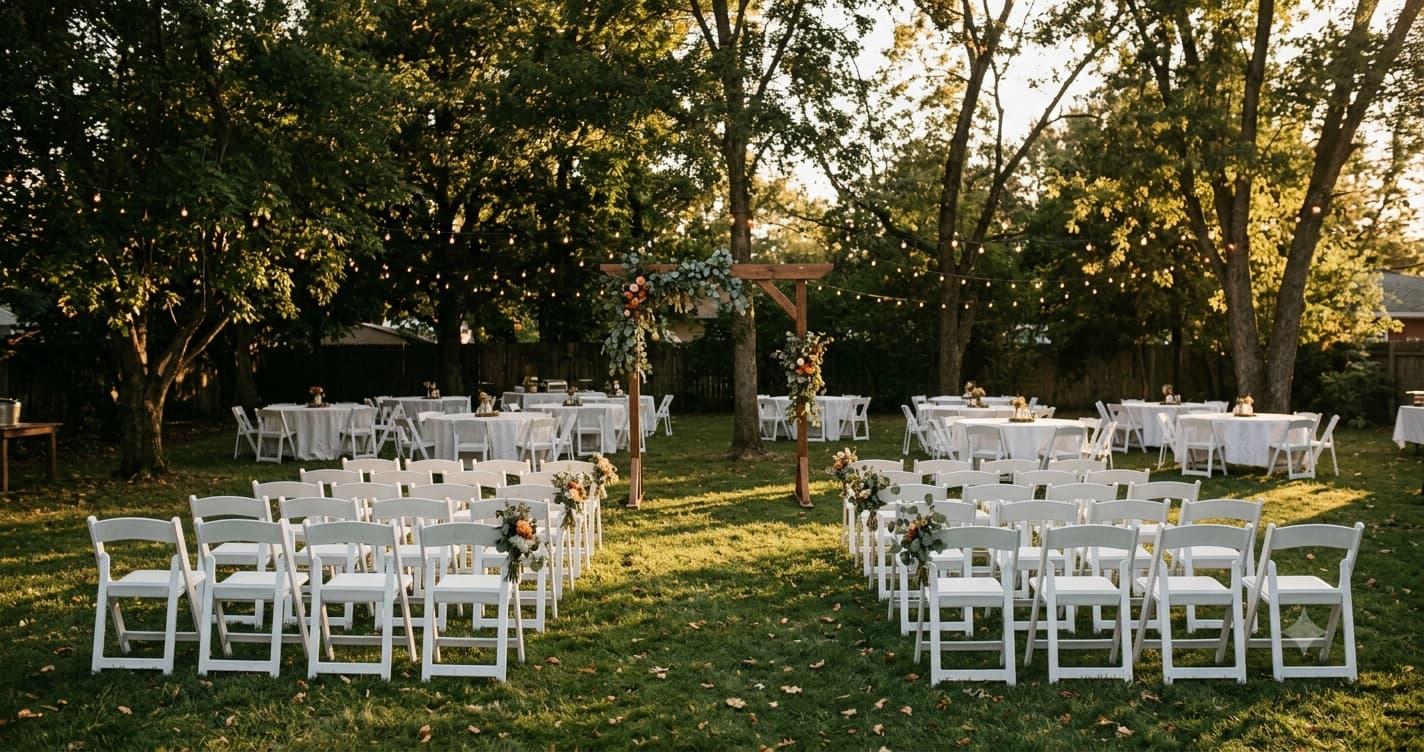
"We're eloping, it's just us and a witness" is the exact sentence that talks people out of insurance they might genuinely need — because small feels like low-risk, and sometimes it just isn't.
Elopement vs. micro wedding: different math, same question
These two get lumped together constantly, but they usually sit at opposite ends of the insurance-need spectrum.
A true elopement — typically just the couple, an officiant, and one or two witnesses — usually has minimal non-refundable spend. If it's a courthouse or a low-cost destination package, there's often genuinely very little to insure, and skipping coverage is a reasonable call.
A micro wedding — usually 15 to 50 guests with most of the traditional elements still intact: ceremony, dinner, toasts, maybe a first dance — carries real deposits. Venue, catering for dozens of people, and a photographer are all still in play, just at a smaller scale than a full wedding. The guest count dropped. The financial exposure often didn't drop nearly as much.
The three questions that actually decide it
How much have you paid that you can't get back? Add up every non-refundable deposit. If it's under a few hundred dollars, cancellation coverage probably isn't worth the premium. If it's several thousand — a common number even for micro weddings — it starts making real financial sense.
Are you on private property, or somewhere requiring proof of insurance? A cliffside overlook you hiked to needs nothing. A boutique venue, an Airbnb, or a family member's backyard might. The backyard and DIY breakdown covers this exact scenario in more depth.
Is alcohol part of the day, and who's serving it? Even at an eight-person dinner after a courthouse ceremony, if someone's pouring champagne at a private residence, host liquor liability quietly becomes relevant again.
What it costs at this scale
Because premiums scale with your total wedding budget and guest count, micro weddings and elopements are usually at the cheap end of the range across the board — often landing near the lower bound of the $75–$550 combined-policy spread, sometimes lower still for liability-only coverage on a genuinely small guest list. The full cost breakdown has the specifics, but the short version: this is the wedding-size bracket where insurance is cheapest relative to what it's protecting, which flips the usual "not worth it for something small" instinct on its head.
When skipping it is genuinely fine
If you're eloping with no venue contract, no vendors beyond an officiant, and nothing non-refundable riding on the date, there's nothing here to insure. Buying a policy anyway isn't wrong — some people just like the $80 peace of mind — but it's not the miss that skipping insurance on a full 150-guest wedding would be. Match the decision to what you'd actually lose.
Once the size and the risk are sorted, the invites still need writing
If you're going the micro-wedding or elopement route and still need to get the word out to family who aren't attending, or send a small formal invite to the handful who are, the wording guide for micro weddings covers exactly that — wording that doesn't accidentally read as "we didn't want you there" when the truth is just that you wanted something small.
Small doesn't mean nothing to lose. It just means doing the actual math instead of assuming the guest count tells you the answer.
People Also Asked
Explore common questions related to this blog.
Rarely, unless it's happening on private property that requires it or involves a vendor-run reception afterward. A courthouse ceremony or a public-land elopement typically has nothing to insure.
Usually yes, in absolute dollars, since premiums scale with budget and guest count. It's not necessarily cheaper relative to what's at stake, though — a $6,000 deposit is still $6,000, whether it's protecting 20 guests or 200.