Halloween Costume Dress Code Wording: How to Say It Without Sounding Bossy
Decide how strict you actually are, then write one sentence that says exactly that. "Costumes required — no costume, no entry" for a hard rule. "Costumes strongly encouraged, and there's a prize" for the middle. "Come as you are or come as someone else" only if you genuinely don't mind. Put the line in the main body of the invitation, not at the bottom. Add any restrictions — no gore, no full masks, no weapons — in the same sentence rather than a separate note, and if you've set a theme, give one concrete example so people have a starting point.
This is the etiquette corner of the wider Halloween party invitations guide. For full invitation examples with the dress code already built in, the sixty Halloween wording examples cover every register.
Some links below are Amazon affiliate links. If you buy through them, Eventic earns a small commission at no extra cost to you — it doesn't change what gets recommended here.
There is a specific kind of party sadness that happens at about 8:40pm, when the host is in full prosthetic makeup and four guests have arrived in jeans holding a bottle of wine. Nobody did anything wrong. The invitation just said "costumes optional."
First, be honest about how strict you are
Most bad dress-code wording comes from a mismatch between what the host wants and what the host feels comfortable demanding. You want a room full of costumes. You don't want to sound like you're issuing rules to your friends. So you write "optional," and then you're quietly disappointed.
Say the real thing. Nobody has ever been offended by a clear dress code on a Halloween invitation. It's Halloween. Costumes are the entire premise.
Here's the spectrum, from hardest to softest, with wording for each point:
| Strictness | What it means in practice | Wording that matches |
|---|---|---|
| Hard rule | You'll actually say something at the door | "Costumes required. No costume, no entry — we're not kidding." |
| Strong expectation | You won't turn anyone away but you'll notice | "Costumes strongly encouraged. There's a prize, and there's a wall of shame." |
| Themed | Costume plus a brief | "Dress code: 1970s horror. Interpret loosely, commit fully." |
| Genuinely optional | You mean it | "Come as you are or come as someone else. Both welcome." |
| Anti-costume | A Halloween party without the dressing up | "No costumes needed — just come as a person who likes cocktails." |
Pick one row. Write that line. Don't hedge by combining two of them, which is what produces "costumes optional but strongly encouraged!!" — a sentence that tells the reader nothing except that you're conflicted.
How to word a hard costume requirement
Be direct, then undercut it slightly with humour so it lands as confidence rather than aggression.
The formula that works: the rule, then a joke about the rule.
- "Costumes required. This is the one rule and it is not negotiable."
- "No costume, no entry. Bedsheet with eye holes counts. Barely."
- "Costumes mandatory. We've all had a long year; put on a wig."
- "Full costume required. 'I'm a person who forgot' is not a costume, [Name]."
- "Dress up or don't come. Love you, mean it."
- "Costume required for entry — there will be a bin of spare accessories at the door for the unprepared, and using it is its own punishment."
That last one is genuinely the best trick in this whole article. A box of terrible spare accessories — cat ears, a bad wig, a pair of novelty glasses — solves the underdressed-guest problem completely, and mentioning it on the invitation makes the hard rule feel generous instead of severe. The guest who forgot doesn't feel excluded; they feel handled.
How to word "strongly encouraged"
Give people a reason, not just a request. The reason that works best is a prize.
Announcing a costume contest on the invitation raises the average effort across your entire guest list more than any amount of enthusiastic wording. It converts "should I bother?" into "what are my odds?"
- "Costumes strongly encouraged. Best one wins [prize], judged by a panel of the least sober."
- "Dressing up is encouraged and rewarded. Prizes for Best, Funniest and Most Concerning."
- "Costume contest at 10pm. Turning up in a shirt is allowed but you'll feel it."
- "There'll be a prize for the best costume and a smaller, sadder prize for the worst."
- "Costumes encouraged! Photos will be taken and they will resurface in years to come."
Two practical notes on contests. Name the categories on the invitation — people dress for a category far more readily than for a general "best costume," and three or four categories mean more winners and less of a single-victor anticlimax. And make the prize a physical object. A cheap trophy or sash outperforms a bottle of wine, because the point isn't the value, it's the photograph.
A set of costume contest sashes or novelty trophies costs very little and does a disproportionate amount of work on the night.

As an Amazon Associate, we may earn from qualifying purchases.
And if you're running the hard-rule version, the door box is what makes it humane: a cheap assorted costume accessories multipack — ears, wigs, novelty glasses, moustaches — means the guest who forgot gets handed something instead of getting a look. It's the single best twelve dollars you can spend on a costume party.

9 Pairs Halloween Faux Leather Earrings for Women
Pumpkin Ghost Witch Hat Dangle Earrings, Spooky Gifts Cosplay Party Accessories, Lightweight Faux Leather, Double Side
View on Amazon
Frienda 24 Pcs Hippie Costume Accessories Set Boho Peace Sign Necklaces Daisy Sunflower Headbands Retro Sunglasses 60s 70s Party Favors Decor for Groovy Party Girls Birthday Supplies
View on AmazonAs an Amazon Associate, we may earn from qualifying purchases.
Theme wording: be concrete or nobody will get it
A theme is easier for guests than open-ended fancy dress, but only if the brief is specific enough to act on.
"Come in fancy dress" makes a guest invent something from nothing. "Come as a character from a film released before 1990" gives them a decision path — they think of three films, pick one, and they're done. Constraints reduce effort, which is the opposite of what most hosts assume.
The rule: name the theme, then give one example. The example does more work than the theme.
- "Dress code: Gothic Glamour. Think Victorian ghost who went to a very good party."
- "Theme: Villains Only. No heroes. Not even ironically."
- "Dress code: Dead Celebrities. Tasteful ones. Use judgement. [Name], I'm looking at you."
- "Theme: Haunted Circus. Ringmaster, acrobat, or something that shouldn't be in a tent."
- "Dress code: Black and white only. One red accessory permitted, and only one."
- "Theme: Come as your nightmare. Interpret however you like. We're slightly worried."
- "Dress code: 1974. Everyone is from 1974. No modern shoes."
- "Theme: Monster Mash-Up — one costume, two references. Bonus points if nobody gets it."
If your theme is tied to a wider party aesthetic, keep the invitation design and the dress code in the same language. The 2026 Halloween party themes each come with a palette and a wording line, which saves you doing the translation twice.
How to word restrictions without killing the mood
Put the restriction in the same sentence as the encouragement. Splitting it into a separate line turns it into a policy notice.
Compare:
"Costumes encouraged! Please note: no gore, no masks covering the full face, and no weapon props of any kind."
versus:
"Costumes encouraged — keep it fun rather than gory, and leave the weapon props at home."
Same information. The second one doesn't sound like a venue hire agreement.
The restrictions worth actually stating:
No gore — for parties with children, elderly relatives, or anyone squeamish. "Friendly costumes please — nothing gory." Concrete and unarguable.
No full-face masks — genuinely practical if you're serving a sit-down meal. People can't eat in them, they take them off within ninety seconds, and then you find them behind the sofa in March. "Masks welcome, but you'll want to be able to eat."
No weapon props — most public venues and school halls ban these outright, and it's far easier to say so in the invite than at the door. "No weapon props, please — venue rules, not ours."
Nothing offensive — the awkward one. Don't write a list of banned costume types; it reads as a lecture and it gives people ideas. One line does it: "Use your judgement on the costume. If you're wondering whether it's okay, it isn't."
Nothing that sheds — glitter, feathers, fake blood on soft furnishings. "Glitter is banned in this house and I will be checking." Funny, true, and enforceable.
Practical warnings — worth including if relevant: "we're outside for part of the night, so plan for a coat over the costume," or "there are stairs and low light, so consider your shoes." These read as care rather than control.
Where the dress code line goes
Directly under the time and address, in the same type size as everything else.
The most common structural mistake is putting the costume rule last, after the RSVP, in smaller text. Half your guests read an invitation in about four seconds, and those four seconds cover the date, the time and the address. Anything after that is optional reading.
The shape that works:
The Coven Is Convening Saturday 31 October · 8pm till late 14 Marlowe Street
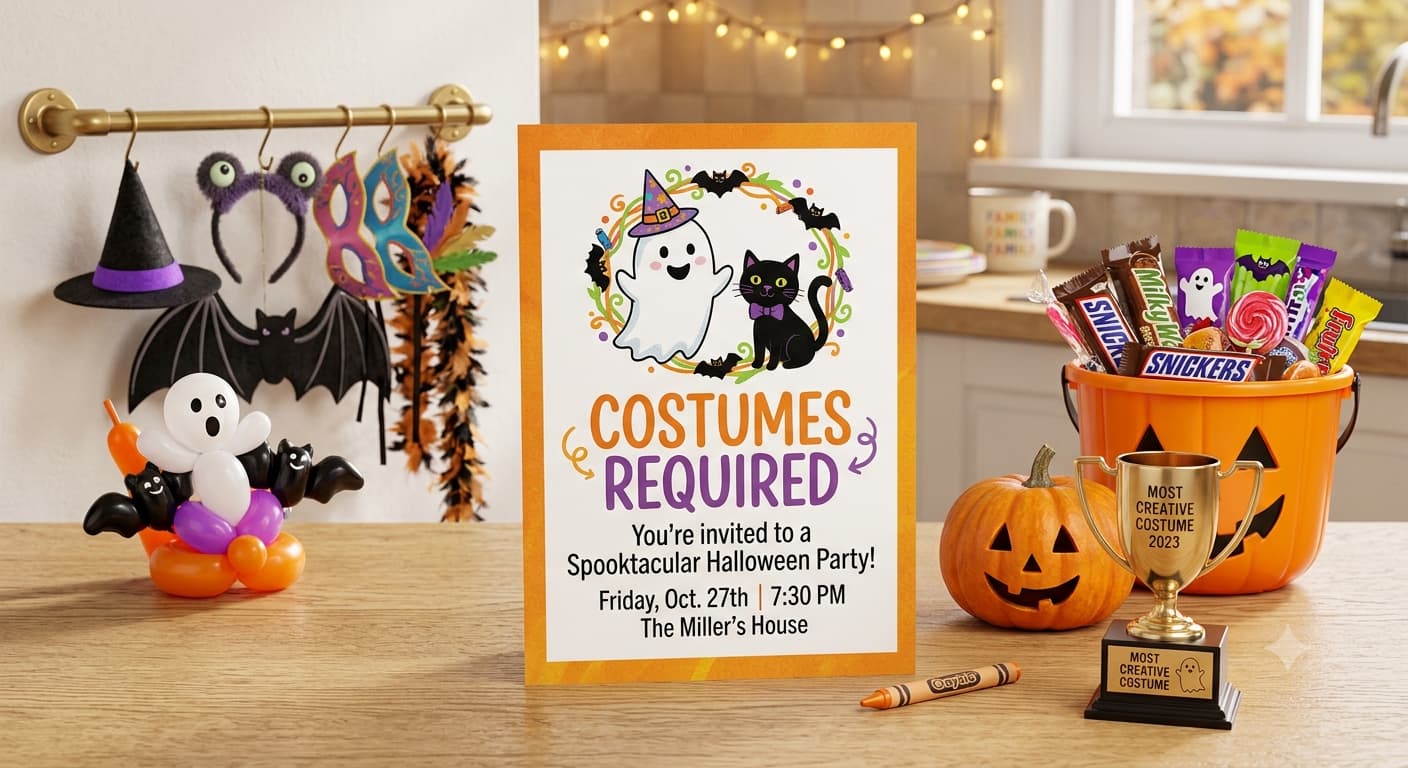
Costumes required. Effort will be judged, gently. Prize for the best.
RSVP by 24 October: [link]
Four lines, and the costume rule is impossible to miss. If you're building the invite digitally you also get the ability to fix it when you realise on 12 October that nobody's understood the theme — a digital invitation can be edited after sending, which paper very much cannot.
What to do about the guest who asks
Someone will text: "Is the costume thing serious?"
The answer that gets the result you want is warm and unambiguous: "Ha, yes — everyone's dressing up. Doesn't have to be elaborate, but do put something on." Note what that does: it confirms the rule, lowers the effort bar, and doesn't offer an exemption. The worst possible answer is "oh, don't worry about it if you don't want to" — because you do want them to, and now you've told them otherwise.
If you're expecting a lot of these questions, that's a signal the invitation wording was too soft. Firm up next year.
Write the line the way you actually feel, put it under the address, and add a prize. That's the whole method, and it's the difference between a room full of costumes and four people in jeans holding wine.
People Also Asked
Explore common questions related to this blog.
No. It's Halloween — the costume is the premise of the event, not an imposition on top of it. What's genuinely unfair is being vague and then being disappointed, because guests can only respond to what you actually wrote.
Name the theme and give one concrete example. "Gothic glamour — think Victorian ghost who went to a very good party" gets far better costumes than "gothic glamour" alone, because the example gives people a starting point instead of a category.
Attach it to the encouragement rather than isolating it: "Costumes encouraged — keep it fun rather than gory, we've got little ones." A separate italic note reads as a rule; the same words inside the friendly sentence read as context.
Yes, and name the categories. Announcing a contest raises costume effort across the whole guest list more than any wording, and named categories give people something specific to aim at. A physical trophy beats a bottle of wine, because the prize is really the photo.