Halloween Party Invitations 2026: Wording, Timing and Sending Them Right
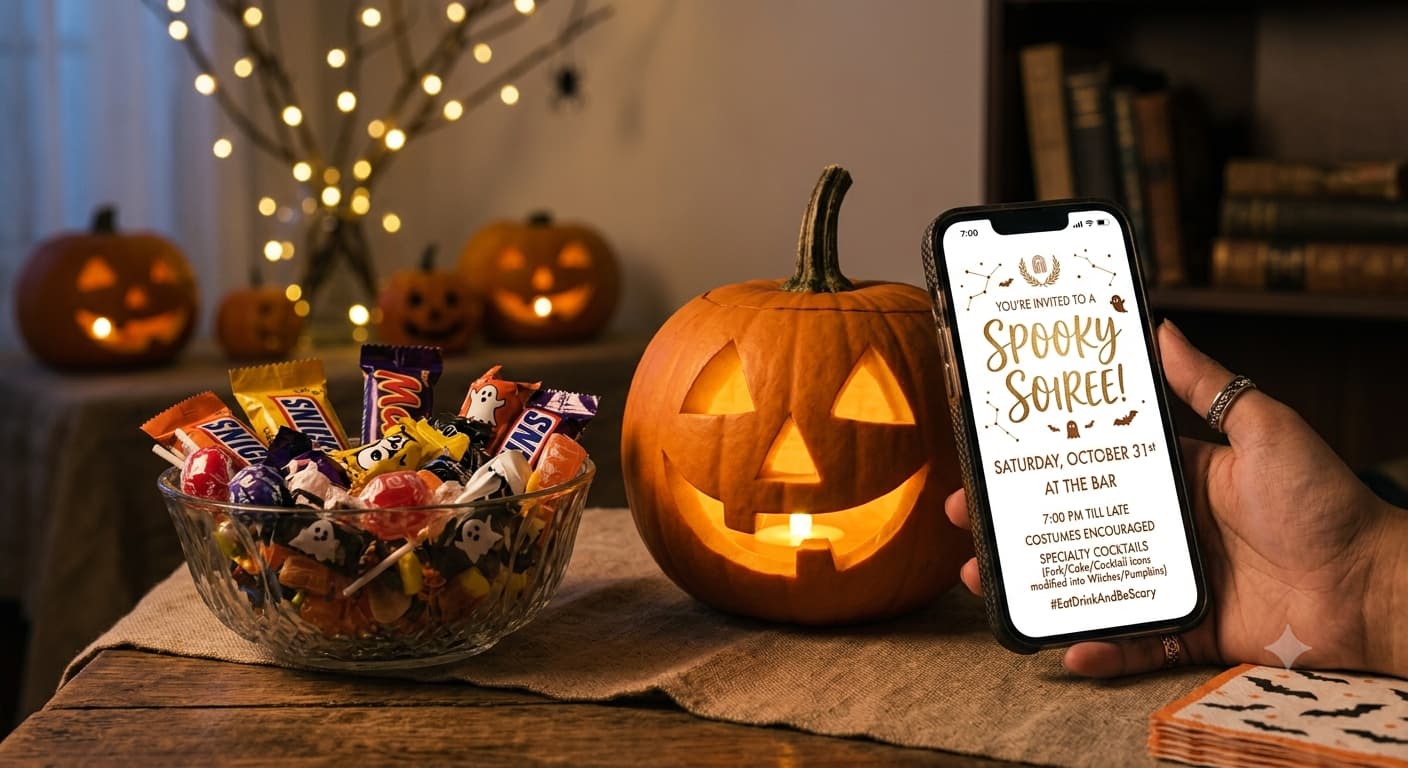
Send Halloween party invitations three to four weeks ahead — for 31 October 2026, that means they go out between 3 and 10 October. A good Halloween invite carries six things: the party name, date and start time, the end time, the address, the costume rule stated plainly, and an RSVP date about a week before. Costume instructions belong on the invite, not in a follow-up text — people need lead time to find or make one. And set your RSVP deadline for 24 October so you can buy candy and drinks with a real headcount instead of a vibe.
That's the whole thing in a paragraph. The rest of this guide is the detail — the wording that works, the timeline that stops the last-minute scramble, and the parts everyone forgets until the night itself.
Halloween 2026 lands on a Saturday. That one fact changes everything about your invite — because a Saturday Halloween means adults are actually free, your guest list just doubled, and half the people you want there are going to get invited to something else first.
What actually goes on a Halloween party invitation
Six pieces of information. Every single one earns its place, and skipping any of them creates a text message you'll have to answer forty times.
| Element | Why it matters | Common mistake |
|---|---|---|
| Party name | Sets the tone before anyone reads a word of detail | Naming it "Halloween Party" — forgettable, and it looks like every other invite in the group chat |
| Date + day | Halloween weekend has three viable party nights in 2026 | Writing "Halloween night" when you actually mean Friday the 30th |
| Start and end time | Adults need to plan sitters; parents need an exit | Leaving the end open, then wondering why people arrive at 11 |
| Address + parking note | Costumes make people late, parking makes them later | Assuming everyone's been to your place before |
| Costume rule | It's the single most-asked question about any Halloween party | "Costumes optional!" when you'll actually be annoyed if people don't dress up |
| RSVP + deadline | Candy, drink and food quantities all depend on it | No deadline, which reads as "reply whenever," which means never |
The one people fight me on is the end time. Put it on. An end time isn't rude — it's the thing that lets a guest say yes. Someone with a babysitter, an early shift, or a second party to hit needs to know whether your thing is a two-hour stop or an all-night commitment. Vague invitations get vague replies.
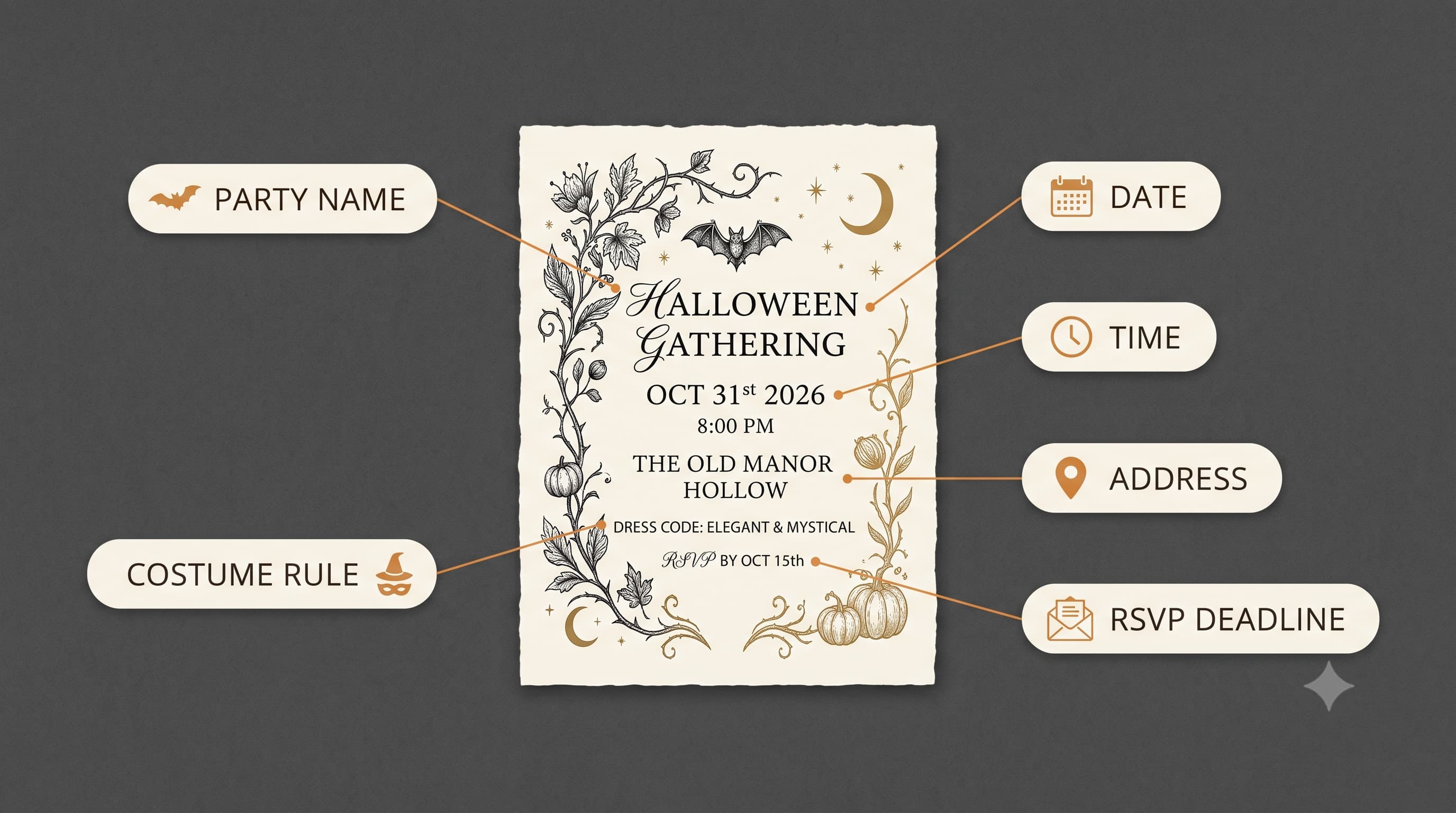
If you're staring at a blank screen right now, start with the full run of examples: I've collected sixty copy-paste Halloween invitation wordings sorted by vibe, from deeply corny to genuinely elegant, so you can lift one and edit two words.
How do you word a Halloween party invitation?
Pick a tone first, then write four lines: what it is, when, where, what to wear. Everything else is decoration.
Halloween is the one occasion where invitation formality is genuinely optional, so the wording splits into three families. Playful leans into the puns and the rhymes — it's the most common register and the easiest to get right. Atmospheric drops the jokes and goes for mood, which suits a cocktail-style party where the aesthetic matters more than the gags. Straight is just the facts with a single Halloween touch, which is what you want for a work party, a neighbourhood thing, or any invite that's going to people you don't know well.
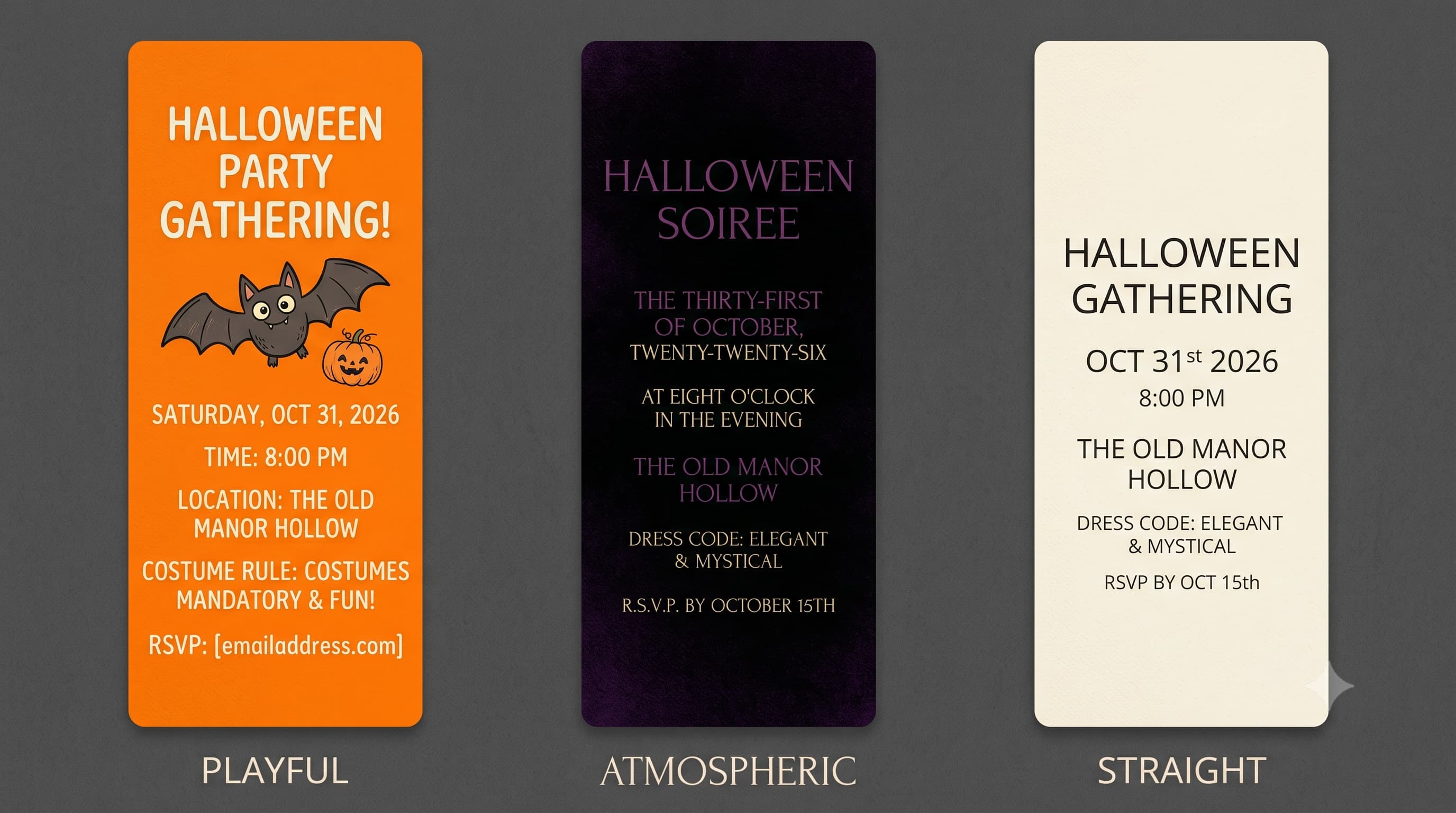
A playful one:
The Coven Is Convening Saturday 31 October · 8pm till late 14 Marlowe Street Costumes non-negotiable. Effort will be judged, gently. RSVP by 24 Oct so we know how much punch to make.
An atmospheric one:
A Night at Marlowe House Saturday, the thirty-first of October Eight o'clock in the evening Drinks, dancing, and something warm on the stove Black tie or black magic — dress accordingly Kindly reply by 24 October
A straight one:
Halloween Get-Together at the Reyes House Saturday 31 October, 7–11pm 22 Kestrel Lane · park on the street, not the drive Costumes welcome, not required. Kids welcome till 9. Let us know by 24 October: 555-0147
Notice what all three do: name, date, time window, address, costume line, RSVP with a date. The tone changes, the skeleton doesn't.
Two situations need their own careful wording, because both involve telling people something they might not want to hear. If your party is for grown-ups only, don't bury it — there's a right way to say adults-only that doesn't read as anti-child, and it's mostly about where you put the sentence. And if you're the one hosting the kids' version, the wording for a children's Halloween party or a trunk-or-treat has a completely different job: it's addressed to parents, and parents want logistics, allergy information and a pickup time, in that order.
Naming the party (this matters more than you think)
The name is the first thing anyone sees and the thing that gets screenshotted into the group chat.
"Halloween Party at Sam's" is fine. "Sam's Séance" gets a reply in ninety seconds. A name does real work: it sets expectations about how seriously to take the costume, it gives you a visual direction for the invite itself, and it makes your party a thing rather than an event. If you're running a costume contest, the name also gives you the category titles for free.
Good names are usually one of four shapes — a pun on your own name or street, a horror-movie riff, a two-word atmospheric phrase, or a deliberately over-the-top title. I put together a few hundred Halloween party name ideas grouped by vibe so you can find one in about a minute rather than spiralling for an hour.
Costume wording: how firm should you be?
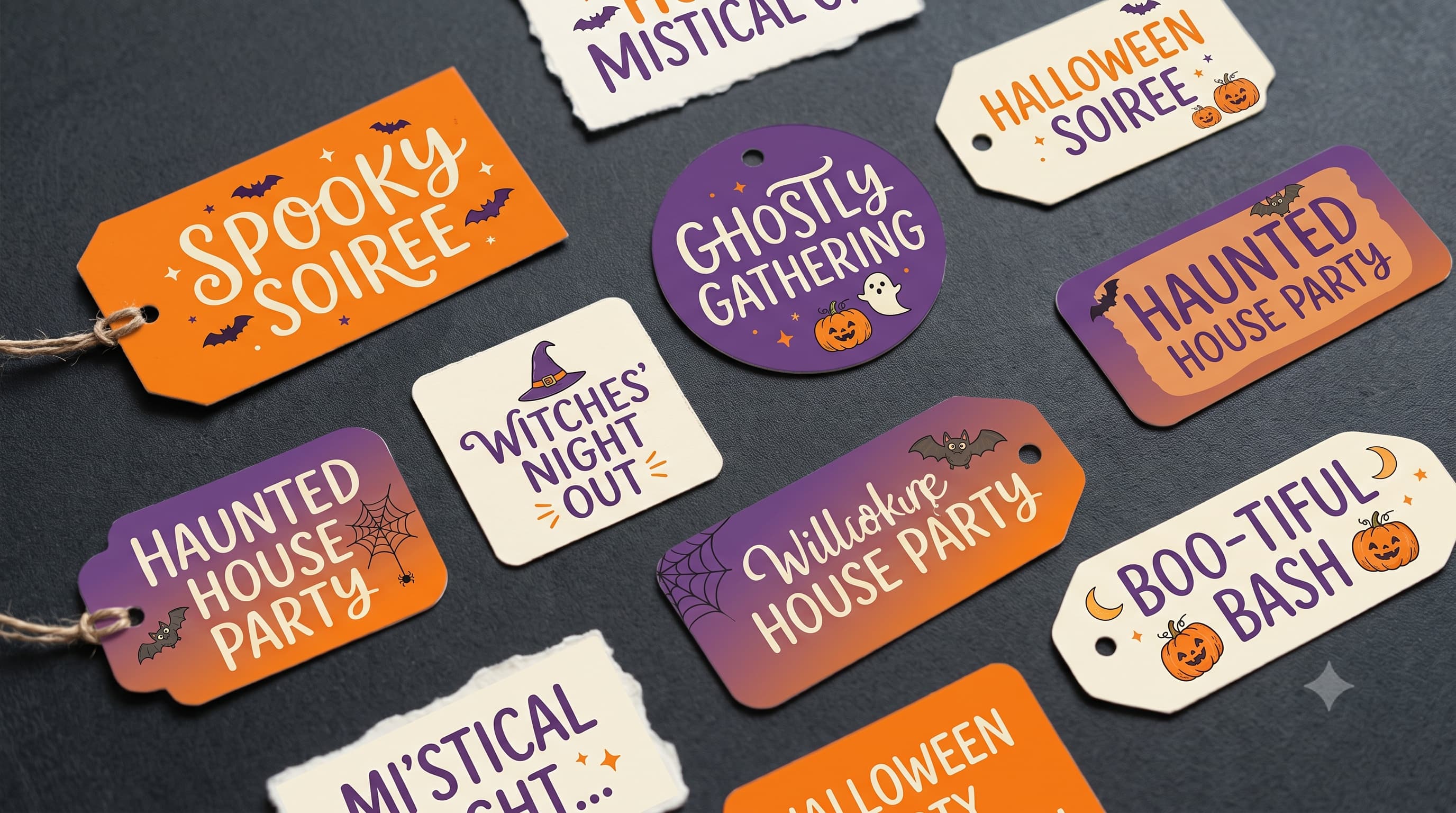
As firm as you actually feel. The failure mode is writing "optional" while privately expecting everyone to show up in full face paint.
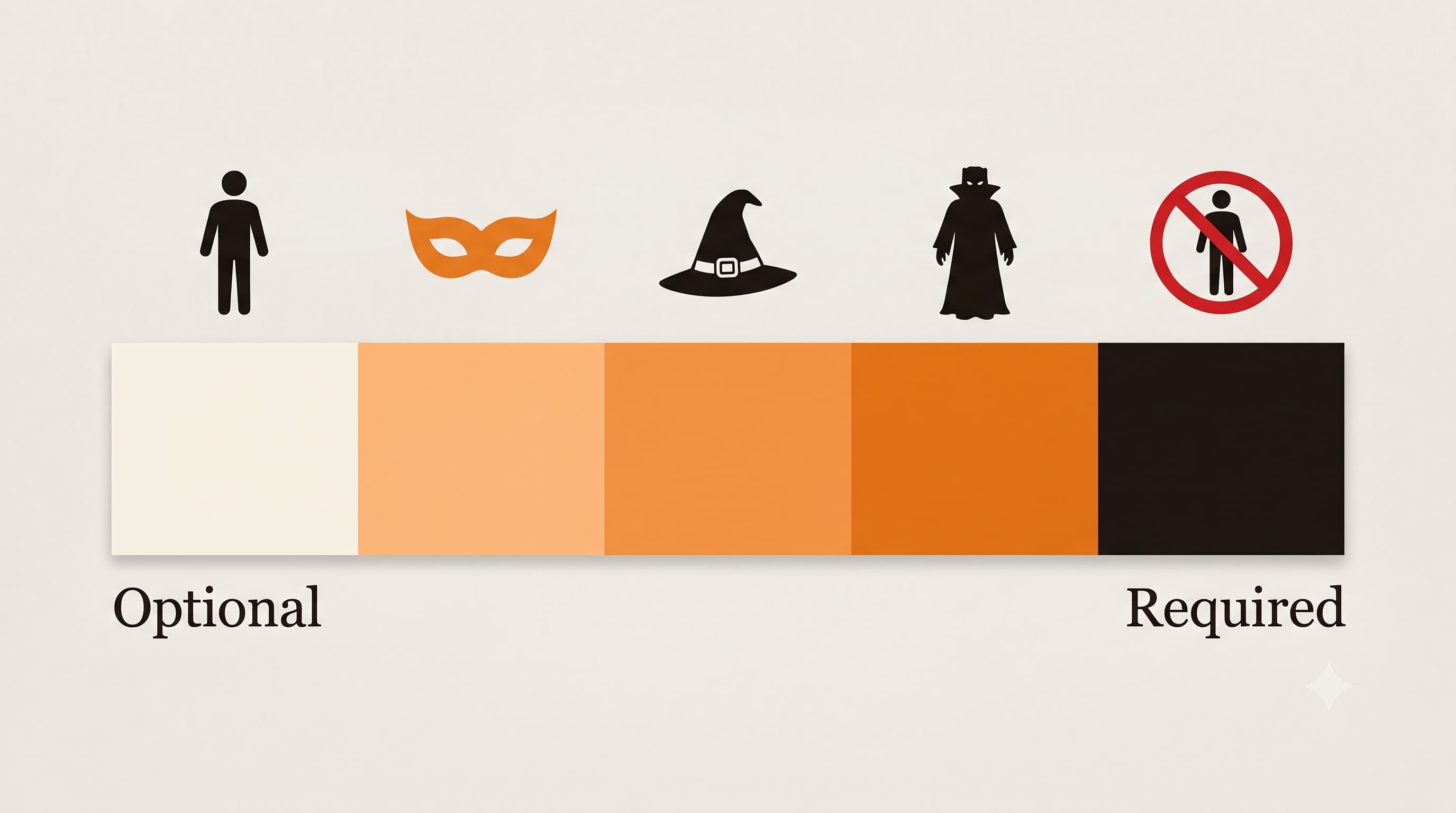
There's a real spectrum here, and each point on it needs different words:
- Required. "Costumes required — no costume, no entry, we're not kidding." Harsh in print, but it produces the party you're imagining.
- Strongly encouraged. "Costumes strongly encouraged. There is a prize. There is also a wall of shame."
- Themed. "Dress code: 1920s ghosts." A theme raises effort and lowers stress — people find it easier to dress to a brief than to invent something from scratch.
- Optional, genuinely. "Come as you are or come as someone else." Only write this if you mean it.
- Adults dressing, kids optional — common at family-friendly afternoon parties, and worth spelling out.
If you're going with a theme or a strict rule, phrase it so nobody has to text you for clarification. The full breakdown of how to word a costume dress code without sounding bossy covers the awkward ones too — the "no gore" request, the "no full masks at dinner" rule, and the perennial "please don't wear a costume that will offend my mother."
Themes are where Halloween invitations get genuinely fun, and 2026's aesthetic has moved on from the plastic-skeleton era. Vintage circus, haunted greenhouse, and a very specific washed-out gothic look are all over Pinterest right now. If you want the invite and the party to match, start from this year's Halloween party themes and the palettes that go with them and let the theme dictate the invite design, not the other way round.
When should Halloween invitations go out?
Three to four weeks before the party. For a 31 October 2026 party, send between 3 and 10 October, and send a save-the-date in mid-September if it's a big one.
Halloween has an unusual property: the guest list gets locked earlier than for almost any other party, because costumes need lead time and because everyone's competing for the same weekend. Send too late and the answer isn't "no," it's "I've already said yes to Priya's thing." Send too early — like August — and it slides out of memory entirely.
| Timing | What to send | Why |
|---|---|---|
| 6–8 weeks out (early–mid Sept) | Save the date, if it's a 30+ person party or people are travelling | Locks the weekend before competing invites land |
| 3–4 weeks out (3–10 Oct) | The actual invitation | The sweet spot: enough costume lead time, close enough to remember |
| 2 weeks out (17 Oct) | Nothing — this is when you do the buying | Guest list should be roughly known by now |
| 1 week out (24 Oct) | RSVP deadline + a nudge to non-responders | You need the headcount before you shop |
| 2 days out (29 Oct) | Reminder with address, parking, timing | Prevents the "wait, what time?" texts |
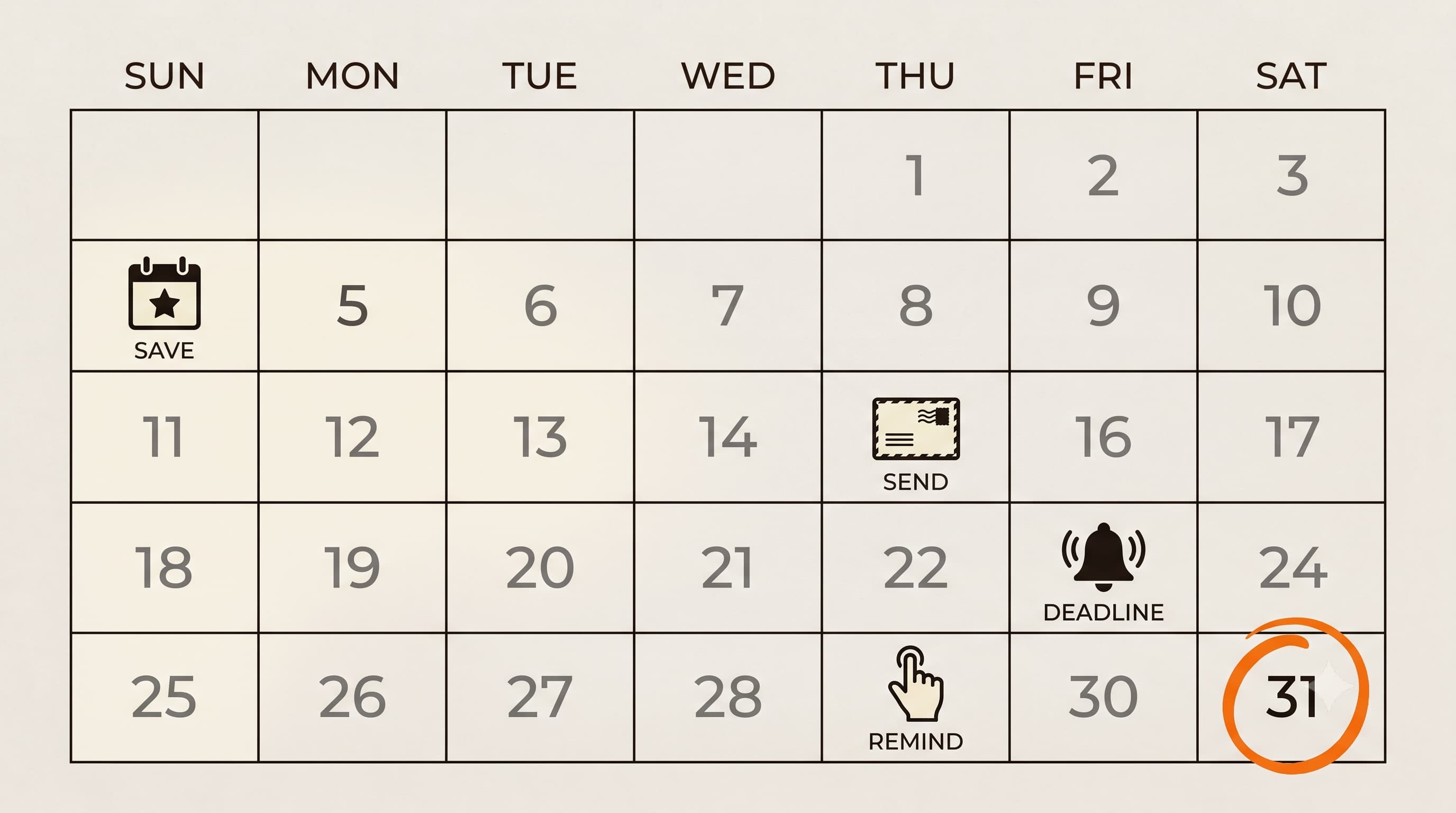
The full version of this, including what shifts if you're hosting on Friday the 30th instead of Halloween itself, is in the Halloween invitation timeline with the exact 2026 dates.
How to actually send them
Digital, for almost everyone. Paper only if the invite is part of the experience.
Halloween is the least traditional party on the calendar, which means the etiquette pressure to mail something is basically zero. A digital invitation gets you three things paper can't: it arrives instantly, it collects RSVPs in one place instead of across texts and DMs, and it lets you update the details when your plans change — which they will.
The practical ranking:
- A digital invitation page with RSVP built in. Best for anything over about fifteen guests. One link, one list of responses, no spreadsheet. You can build a Halloween invite free in Eventic's invitation templates and share the link straight into a group chat, and the responses land in one place instead of scattered across four apps.
- A group text with an image. Fine for under fifteen close friends. Terrible for headcounts — you'll be scrolling to count yeses.
- Email. Works for office parties and neighbourhood events where you already have a list.
- Printed cards. Genuinely lovely for a formal Halloween dinner, and a waste of money for anything else.
Whichever route you take, the invite needs a live link or a phone number for replies. An invitation with no reply mechanism is a poster.
Getting a real RSVP count (the part everyone underestimates)
Set a deadline, then chase the silent ones once. That's the entire method.
Halloween RSVPs are worse than wedding RSVPs, because the stakes feel low and everyone assumes they can decide on the day. Expect somewhere between 60 and 80 percent of your yeses to actually show up, and expect a handful of people who never replied to appear at the door in a bedsheet. Both are survivable if you've planned for them.
The two rules that fix most of it: give a deadline that's a week before the party, not two days, and make replying a single tap. Nothing kills a response rate like a form. Chasing forty people over text is a part-time job — this is genuinely what an RSVP tracker fixes, since every reply lands on one list instead of in your DMs. The full method, including the exact nudge message that gets replies without being annoying, is in how to get a real Halloween party headcount.
Then: candy, food and the shopping list
Two separate problems, and people routinely confuse them.
Trick-or-treaters are a volume question that depends on your street, not your guest list. A quiet cul-de-sac might see fifteen kids; a house on a known trick-or-treat route can see three hundred, and running out at 7:30pm is the most preventable disaster in Halloween. Work out your number with the Halloween candy calculator — it takes your street's traffic level and the hours you'll be answering the door and gives you a bag count. The reasoning behind the numbers, plus what to do if you badly over- or under-buy, is in how much candy you actually need.
Party food is a headcount question. Halloween parties skew late and snacky — people eat before they arrive, then graze for four hours, which means you need more small things and less of a main. The seasonal quantities, plus how much punch a bowl actually holds once the ice goes in, are in Halloween party food and punch amounts. For the general per-person maths that isn't Halloween-specific, the party food calculator and drink calculator do the arithmetic for any headcount.
Heads up: some links in this post are Amazon affiliate links — if you buy through them, Eventic earns a small commission at no extra cost to you.
One genuinely useful purchase, if you're running a costume contest: a cheap set of award sashes or novelty trophies. Having a physical prize raises costume effort across the entire guest list far more than announcing a prize does — people want the ridiculous object.

JOYIN 57 PCS Halloween Party Costume Contest Ballot Set of Boxes with Voting Ballots and Trophy Award Ribbons for Halloween Party Game Home Indoor Office Vote, Trick or Treat Trophy Awards Ribbons
View on AmazonAs an Amazon Associate, we may earn from qualifying purchases.
Whatever you send, send it before the first week of October ends. Halloween weekend fills up faster than any other night of the year, and the host who gets there first wins the guest list.
People Also Asked
Explore common questions related to this blog.
Three to four weeks. For Halloween 2026 (Saturday 31 October), that's the first week of October. Send a save-the-date in mid-September if your party is large, if guests are travelling, or if you know your friends are the type to double-book Halloween weekend.
You have to say something. Silence on costume is the most common Halloween invite mistake, and it produces a party where half the room is in full makeup and the other half is in jeans, and both groups feel weird. One clear sentence solves it.
A week before — 24 October for a 31 October party. That gives you time to buy food and drink for a real number and to chase the people who haven't replied without it becoming a panic.
Not at all, and in 2026 it's a legitimate strategic move. Halloween falls on a Saturday, which means competition. Hosting Friday the 30th means you get people before anyone else does, and trick-or-treating families can still keep Saturday free.
Yes, for a small group. For more than about fifteen people, use something that collects the replies for you — the counting is what breaks, not the sending.