Halloween Party Food and Punch: How Much to Actually Make
Some links below are Amazon affiliate links. If you buy through them, Eventic earns a small commission at no extra cost to you — it doesn't change what gets recommended here.
A Halloween party is not a dinner party wearing a wig. It starts later, people eat before they arrive, and the food has to survive four hours of being grazed at by adults in costumes that make cutlery difficult.
For the general per-person maths that isn't Halloween-specific, the party food calculator and how much food per person at a party handle any headcount. This page is about what changes because it's Halloween. And if you're still at the invitation stage, start with the Halloween party invitations guide.
The four things Halloween changes
It starts late. An 8pm or 9pm start means most guests have eaten. You're not providing dinner; you're providing four hours of grazing. That inverts the usual ratio — more small things, no centrepiece main.
Costumes make eating hard. Gloves, masks, face paint, elaborate sleeves. Anything requiring a knife and fork is going to sit untouched. Anything requiring two hands and a plate will end up on your sofa. Single-bite, one-handed food isn't a stylistic choice at Halloween, it's a practical necessity.
People drink more than they eat. Halloween skews toward a drinks-led evening, which means your food is doing a different job: soaking up alcohol and giving people something to do with their hands. Salt and starch outperform elegance.
The candy is competing with you. There's a bowl of chocolate on every surface. Sweet food gets ignored at Halloween parties because guests are already saturated with it, which is why the dessert table is the most commonly over-catered part of the night.
How much food per person
| Party length | Food per person | Shape |
|---|---|---|
| 2 hours, evening | 8–10 bites | Two or three savoury options, one sweet |
| 3–4 hours, evening | 12–16 bites | Four or five savoury, served in two waves |
| 5+ hours | 16–20 bites plus something hot late | Add a hot dish around 11pm |
| Afternoon kids' party | Light — they've usually eaten | Small savoury plus cake |
"Bites" means individual items: one sausage roll, one skewer, one slider, a small handful of crisps. The count sounds high until you watch someone at a standing party for three hours, at which point it sounds low.
If you're serving anything that resembles a meal — a chilli, a big pot of soup, a pasta bake at midnight — those per-person figures drop by roughly a third, and you're into general party catering territory, where how many appetizers per person and the food for 50 guests guide do the maths properly.
Serve it in waves
The single most useful hosting decision, and almost nobody does it.
Putting everything out at 8pm means: it's picked over by 9, it looks sad by 10, and there's nothing left when the late arrivals turn up at 10:30 — which at Halloween is a lot of people, because costumes make everyone late.
Instead:
- Wave one (start time): crisps, nuts, olives, something to graze on immediately. Low effort, holds well.
- Wave two (an hour in, once the room is full): the actual food. Hot things, the effortful things, the ones you want people to see.
- Wave three (late, around 11pm): something hot and salty. This is the wave that keeps a party going, and it's the one people remember. Pizza, sliders, a tray of anything.
Wave three is worth planning for even if it's just a frozen pizza. A party that produces unexpected hot food at 11pm becomes a story.
Halloween food that actually works
Skip the elaborate themed presentation. Nobody has ever enjoyed a mummy hot dog more than a normal hot dog.
What works at a costume party:
- Anything on a stick — skewers, satay, cheese and pickle
- Sausage rolls, mini pies, empanadas
- Sliders and small burgers
- Wings, if you provide a lot of napkins
- Crisps and dips, in more places than you think you need
- A cheese board, which requires no cooking and looks like effort
- Toasted flatbread with something orange on it, which reads as themed without you doing anything
What doesn't:
- Anything requiring a plate and a fork
- Salads. They will be untouched. Every time.
- Elaborate themed constructions that take three hours and get eaten in four minutes
- Multiple desserts, when there's already candy everywhere
- Anything that spoils out of the fridge over four hours
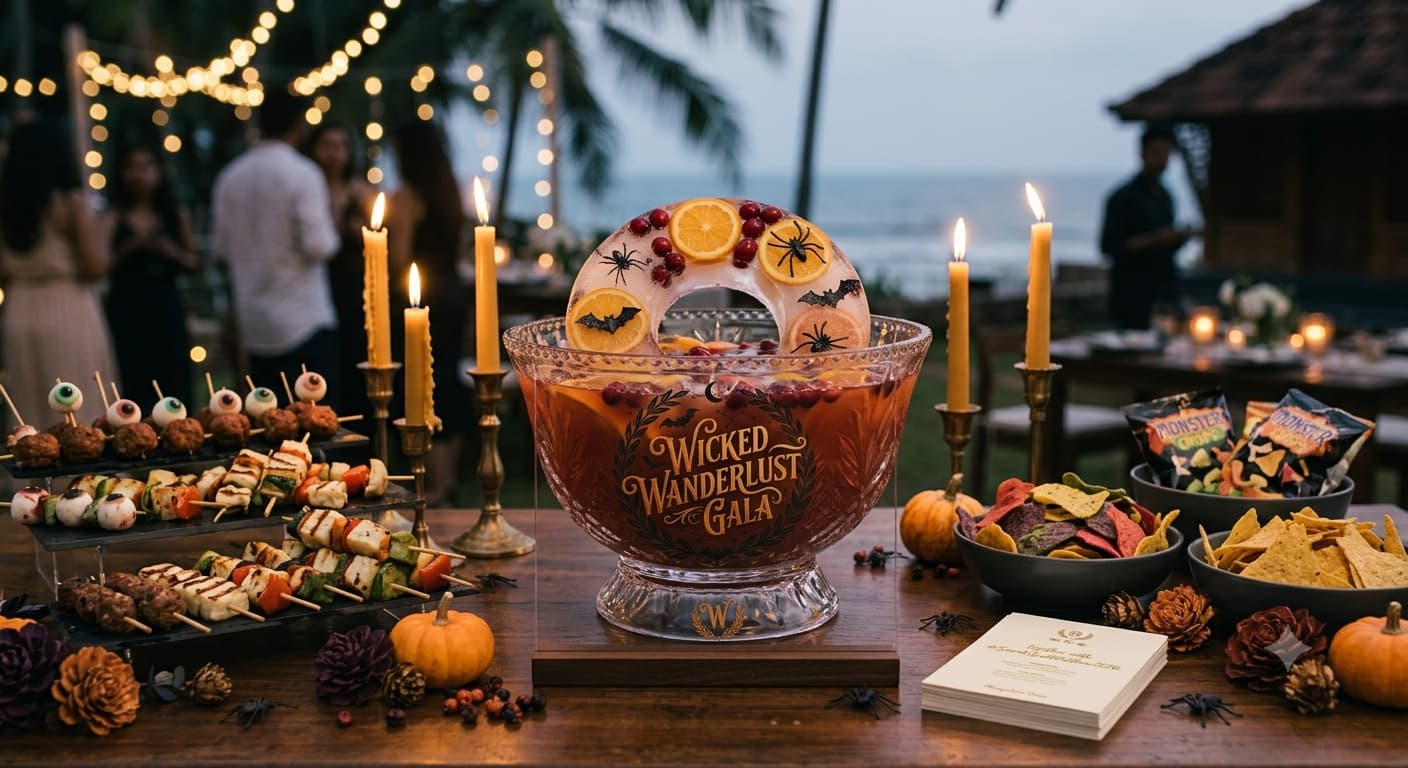
The one themed thing worth doing: colour rather than shape. Black, orange and deep red food reads as Halloween instantly with no effort — blood-orange anything, dark cherry, black grapes, purple tortilla chips, charcoal flatbread. It photographs well and takes no additional cooking. Shape-based themed food (spider cupcakes, finger biscuits) is charming and enormously time-expensive, and it's the first thing to cut when the day gets tight.
Punch: the volume maths nobody does
A punch bowl holds substantially less liquid than its stated capacity once ice is in it. Plan for about two-thirds of the nominal volume.
Working figures:
| Bowl size | Actual liquid with ice | Servings (250ml / 8oz cups) |
|---|---|---|
| 4 litres | ~2.7 L | ~11 |
| 6 litres | ~4 L | ~16 |
| 8 litres | ~5.3 L | ~21 |
| 10 litres | ~6.7 L | ~27 |
And consumption: one to one and a half cups per person per hour for the first two hours, dropping after that. Twenty guests over four hours is somewhere around 80–100 cups if punch is the only drink — which is four to six full refills of a large bowl. That is a lot of refilling.
Which leads to the two rules that matter:
Make it in batches and keep the spare in the fridge. One giant vat of punch goes warm, gets diluted as the ice melts, and tastes progressively worse across the night. Two or three batches, refrigerated, means the last cup tastes like the first.
Freeze your dilution. Make ice cubes or a large ice ring from the punch base itself — juice, tea, whatever's in it. As it melts it maintains the flavour instead of watering it down. A large ring in a bundt tin lasts far longer than cubes, and it looks better than it has any right to.
If you're serving alcohol beyond the punch, the party drink calculator handles bottles, mixers and ice for any headcount, and how much alcohol for a party covers the ratios in detail.
The non-alcoholic bowl
Make two punches, and make the non-alcoholic one first.
At a Halloween party this matters more than at most events, because the drivers, the pregnant guests, the non-drinkers and the teenagers all need something that isn't a lone bottle of lemonade next to the sink. A second bowl costs almost nothing and it's the detail that separates a hosted party from a supplied one.
The colour trick applies here too — a dark cherry or blood-orange non-alcoholic punch looks identical to the alcoholic one, which spares people from having to announce that they're not drinking. That's a genuinely thoughtful piece of hosting.
Timing: what to make when
| When | What |
|---|---|
| 3 days before | Anything freezable — sausage rolls, sliders, pastry. Freeze raw, cook from frozen |
| Day before | Punch bases (they improve overnight), dips, marinades, ice rings |
| Morning of | Chop, assemble, arrange platters and cover them. Set the table |
| 2 hours before | Wave one out, drinks chilling, ice bagged |
| On the night | Only wave two and wave three need cooking. Nothing else |
The aim is that from 6pm on the day, your job is decorating and getting into a costume, not cooking. Every dish you can move earlier in that table buys you an hour on the day you least have one.
Quantities for common headcounts
Rough starting points for a 4-hour evening party, drinks-led, no sit-down meal:
| Guests | Savoury items | Punch | Candy for the bowl |
|---|---|---|---|
| 10 | ~130 bites | 5–6 L | ~90 pieces |
| 20 | ~260 bites | 10–12 L | ~180 pieces |
| 30 | ~390 bites | 15–18 L | ~270 pieces |
| 50 | ~650 bites | 25–30 L | ~450 pieces |
Those bite counts look enormous written down, and they're roughly right — a "bite" is one crisp-sized to one sausage-roll-sized item, and a bag of crisps is a hundred of them. Don't panic-cook: a large proportion of that total is bought, not made.
The candy column is the party bowl only. If you're also answering the door to trick-or-treaters, that's a completely separate number driven by your street rather than your guest list — the candy calculator does both, and how much candy you actually need explains why the two figures have nothing to do with each other.
All of this assumes you know your headcount, which at Halloween is optimistic. Work from about 80% of your yeses plus a third of your maybes, plus five — the reasoning is in getting a real Halloween party headcount.
The one piece of equipment worth owning if you host regularly: a large punch bowl with a ladle. Dispensers with taps look convenient and clog with fruit within twenty minutes.

As an Amazon Associate, we may earn from qualifying purchases.
The second is a bundt tin, which is the ice-ring trick's entire equipment list. Fill it with the punch base plus some fruit, freeze it overnight, and turn it out into the bowl on the night — it lasts hours longer than cubes, keeps the flavour intact as it melts, and looks considerably more impressive than the four minutes of work involved.

As an Amazon Associate, we may earn from qualifying purchases.
Five mistakes that cost you
Everything out at once. Covered above, and it's the big one.
No late food. The party thins out at 11pm not because people are tired but because there's nothing left to do. Hot food at 11 resets the whole evening.
Under-icing. You need roughly 0.5kg of ice per person for a drinks-led party, and more if it's warm. Almost everyone buys a third of what they need.
Too much dessert. There is already candy on every surface. One sweet thing is plenty.
No surfaces near the food. People need somewhere to put a cup down while they pick something up. Two small side tables next to the food table will do more for the flow of your party than an extra dish will.
Finger food, three waves, two batches of punch, and something hot at eleven. That's a Halloween party that runs itself while you're busy being a vampire.
People Also Asked
Explore common questions related to this blog.
For an evening party where guests have eaten, plan on 8–10 individual bites per person for the first two hours and 4–6 per person per hour after that. Mostly finger food — costumes make cutlery impractical, so anything needing a plate and fork goes untouched.
Roughly 10–12 litres across a four-hour party, at one to one and a half cups per person per hour. A 6-litre bowl only holds about 4 litres of liquid once ice is in, so that's several refills — make it in batches and keep the spare in the fridge.
One-handed, single-bite savoury food: skewers, sausage rolls, sliders, wings, crisps and dips, a cheese board. Skip salads and elaborate themed constructions. For the Halloween look, use colour — black, orange and deep red food — rather than shape.
Freeze the punch base itself into cubes or a large ice ring in a bundt tin, so what melts into the bowl is more punch rather than water. Make several smaller batches and keep them refrigerated instead of one large bowl that sits out all night.
In three waves: something to graze on at the start, the real food about an hour in once the room is full, and something hot and salty around 11pm. Late food is what keeps a party going, and late arrivals are common when everyone's in costume.