How Much Candy Do You Actually Need for Trick-or-Treaters?
Plan on two pieces per child, and work out the number of children from your street, not from a national average. A quiet street sends roughly 12 children an hour, a normal suburban street about 30, a known trick-or-treat street around 70, and a genuinely famous one 130 or more. Multiply by the hours you'll answer the door, add about 15% as a buffer, and divide by the pieces in a bag (usually 80–100 for a US variety bag). For a typical street over 2.5 hours that's around 175 pieces — two bags. Halloween 2026 is a Saturday, so plan for the higher end of whatever you'd normally expect.
If you'd rather not do the arithmetic, the Halloween candy calculator does it in about fifteen seconds and gives you a bag count and a rough spend.
Some links below are Amazon affiliate links. If you buy through them, Eventic earns a small commission at no extra cost to you — it doesn't change what gets recommended here.
There are two Halloween failures. One is the porch light going off at 7:40pm because the bowl's empty. The other is eating fun-size chocolate at your desk in mid-December because you bought eleven bags for a street that sent you thirty children.
The number that actually varies is the children, not the candy
Every generic guide tells you "two pieces each." That part is easy and nobody gets it wrong. What people get wrong — by a factor of ten — is how many children will knock.
Trick-or-treat traffic is astonishingly local. Two houses a quarter-mile apart can see thirty children and three hundred, and the reasons are boring and predictable: whether the street is on a known route, how many houses participate, whether there's off-street parking for families driving in, and whether the local school or community group promotes a particular neighbourhood.
So the useful question isn't "how much candy do I need." It's "how many children will come to my door," and there are three ways to answer it:
Ask a neighbour who's lived there longer. This is by far the most accurate data available, and it takes one conversation. Someone three doors down has been running this experiment for a decade.
Count last year, if you were there. Even a rough tally beats a guess. Write it on the box of decorations for next year — genuinely, this is the single most useful thing you can do for future-you.
Read your street. Decorated houses are the strongest signal. If half the street has pumpkins out by the 28th, you're on a route. If you can count the decorated houses on one hand, you aren't.
Traffic levels, translated
| Your street | Children per hour | What it looks like |
|---|---|---|
| Quiet | ~12 | Cul-de-sac, apartment block, rural road, few families nearby |
| Steady | ~30 | Normal suburban street, some houses decorated, groups come in waves |
| Busy | ~70 | Known trick-or-treat street, most houses join in, doorbell rarely stops |
| Very busy | ~130+ | The street people drive to. There have been queues |
These are working figures, not survey data — they're the ranges that hold up when you talk to hosts about what they actually saw. The National Retail Federation runs an annual Halloween participation and spending survey if you want published national benchmarks, though national averages are exactly what mislead you here, because your street is not the average of all streets.
The maths, spelled out
children = children per hour × hours you'll answer the door
pieces   = children × pieces per child × 1.15
bags     = pieces ÷ pieces per bag, rounded up
Worked example: a steady street (30/hour), answering the door from 5:30 to 8pm (2.5 hours), two pieces each.
- 30 × 2.5 = 75 children
- 75 × 2 × 1.15 = 173 pieces
- 173 ÷ 90 = 2 bags
Reference table, at two pieces per child with the buffer, assuming 90 pieces per bag:
| Trick-or-treaters | Pieces | Bags |
|---|---|---|
| 25 | 58 | 1 |
| 50 | 115 | 2 |
| 75 | 173 | 2 |
| 100 | 230 | 3 |
| 150 | 345 | 4 |
| 200 | 460 | 6 |
| 300 | 690 | 8 |
| 400 | 920 | 11 |
Halving the pieces column gives you the one-piece-each version, which is entirely normal on a very busy street and which nobody has ever complained about.
Why the 15% buffer, and why it isn't optional
Because the two mistakes don't cost the same.
Running out of candy at 7:40pm means turning off the porch light while children are still walking past your house. It's the one Halloween outcome that actually feels bad, and it's completely preventable. Over-buying means you have leftover wrapped chocolate, which keeps for months, goes into lunchboxes, or gets donated.
Asymmetric costs, asymmetric planning. Round up, always.
When trick-or-treaters actually come
Earlier than you think, and in a sharp peak.
In most neighbourhoods the pattern runs like this:
- 5:00–5:30pm — the first wave, and it's mostly under-fives with parents. Large family groups, early because of bedtimes. If you're not home until 6, you may miss a third of your traffic.
- 6:00–7:30pm — the peak. This is where the bulk of your candy goes.
- 7:30–8:30pm — older children and teenagers, in bigger and faster-moving groups.
- After 8:30 — thins out fast in most areas, though a Saturday Halloween stretches this later than usual.
Two hours of answering the door captures most of it. Staying open until ten adds very little, and it's why "how many hours" matters less to the total than people assume.
A Saturday Halloween shifts everything up. Families who'd skip a school night come out, groups stay out longer, and the older-children window extends. If your street is normally steady, plan for busy in 2026.
The other variable that beats every other factor: weather. A dry evening can double a wet one. There's no planning for it beyond buying candy that you don't mind keeping.
How much to hand out per child
Two. One if you're on a very busy street. Three if you want the reputation.
The number matters less than the method. If you leave a bowl unattended, the first six children will take a handful each — not out of greed, but because a bowl with no instructions is ambiguous and a handful is a reasonable interpretation. Two fixes: hand pieces out yourself, or use a bowl small enough that a handful isn't catastrophic and refill it regularly.
The refill trick works better than it should. A bowl that's half full reads as "take a couple." A bowl piled high reads as "help yourself." Same total candy, completely different consumption.
What to buy
Three practical rules.
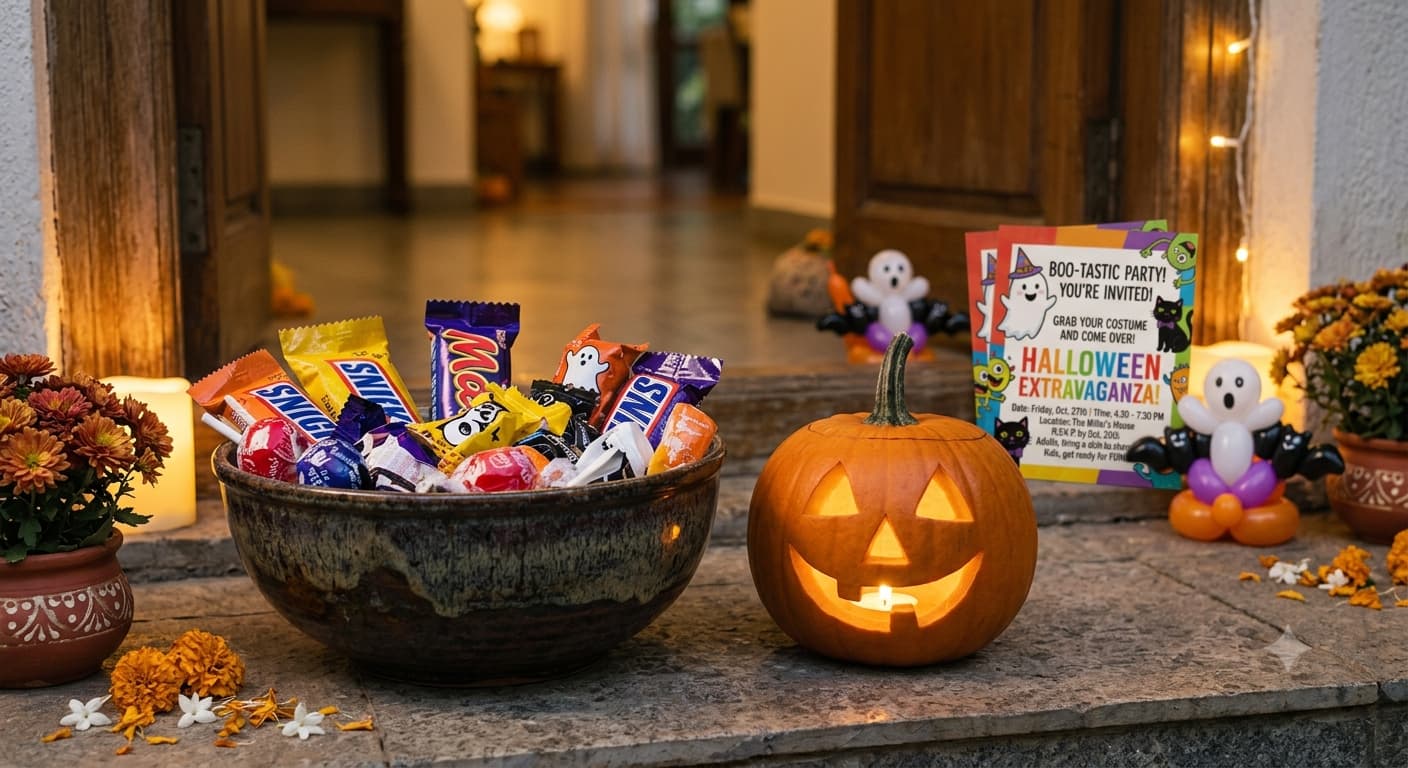
Buy variety, not a single type. A mixed fun-size variety pack handles the fact that children have preferences and one of them will be disappointed by whatever you chose. It also prevents the specific misery of having 200 of one thing left over.

As an Amazon Associate, we may earn from qualifying purchases.
Buy something you don't especially like. The most common cause of running out is the host eating the supply between 20 and 30 October. If you buy chocolate you're indifferent to, this problem solves itself.
Buy in the last week of October, not September. Both because of the above, and because the shelves are fullest then. But if you need a large quantity — six bags or more — order online in mid-October, because in-store stock of the popular stuff genuinely runs down in the final few days.
The allergy bowl (worth ten minutes)
Keep a small second bowl of non-food treats.
For children with serious food allergies, a doorstep full of chocolate is a doorstep they can't participate in. A handful of stickers, temporary tattoos, glow bracelets or small toys costs a few dollars and means every child gets something. This is the idea behind the teal pumpkin — a teal-painted pumpkin on the step signals that you've got non-food options.

As an Amazon Associate, we may earn from qualifying purchases.
It's a small thing that matters disproportionately to a small number of families on your street, and the children who need it recognise the signal instantly.
Safe Kids Worldwide publishes sensible, non-alarmist Halloween safety guidance covering visibility, route planning and the practical stuff — worth a skim if you're also sending children out rather than just answering the door.
Candy for a party is a different calculation
Don't conflate the two. They're separate numbers and separate shopping.
Party candy depends on your headcount, not your street. Children graze about three pieces an hour from an open bowl, adults about one and a half — adults eat less but far more steadily than anyone admits, and a bowl of fun-size chocolate at a grown-up party empties all night.
Take-home treat bags are where hosts under-buy. Eight pieces per bag is reasonable and not excessive, but twelve children means ninety-six pieces gone before anyone's touched the bowl. Buy for the bags first and treat the bowl as extra.
The candy calculator has a party mode that handles both halves. For everything else on the party shopping list, Halloween party food and punch amounts covers the seasonal quantities, and if you're still at the planning stage, the Halloween party invitations guide starts at the beginning.
What to do with the leftovers
Wrapped candy keeps for months, so nothing is wasted unless you decide it is.
- Lunchboxes, obviously, at a rate you can live with.
- Baking — chopped fun-size chocolate bars go into cookies and brownies, and a gingerbread house in December is largely built from October's leftovers.
- Donation — food banks and shelters often accept sealed, in-date sweets. Ring first; policies vary.
- Freeze the chocolate. It keeps for months and it stops the slow attrition of eating it at your desk.
- Buy-back programmes — some dental practices run these in early November, exchanging candy for a small payment or a prize.
Ask a neighbour, pick your traffic level, multiply by two, round up. Then buy something you don't like, so it's still there on the 31st.
People Also Asked
Explore common questions related to this blog.
Three bags, at two pieces each with a buffer, assuming about 90 fun-size pieces per bag — 230 pieces total. If you're handing out one piece each, two bags covers it comfortably.
Two pieces. One is completely acceptable on a very busy street and nobody complains. Three or more makes you the good house on the street, which is either the goal or a warning depending on your temperament.
Entirely dependent on your street. A quiet road might see 25 to 40 across the evening, a normal suburban street 60 to 100, a known trick-or-treat street 200 or more. Ask a neighbour who's lived there longer — it's the best data available.
Most traffic falls between 5:30pm and 8:30pm, peaking between 6 and 7. The youngest children come first, in large family groups; teenagers come last. After 8:30 it drops off sharply, though a Saturday Halloween stretches it later.
Yes, in most areas. Families who'd skip a school night come out, groups stay out longer, and the late window extends. If your street is usually steady, plan for busy in 2026.