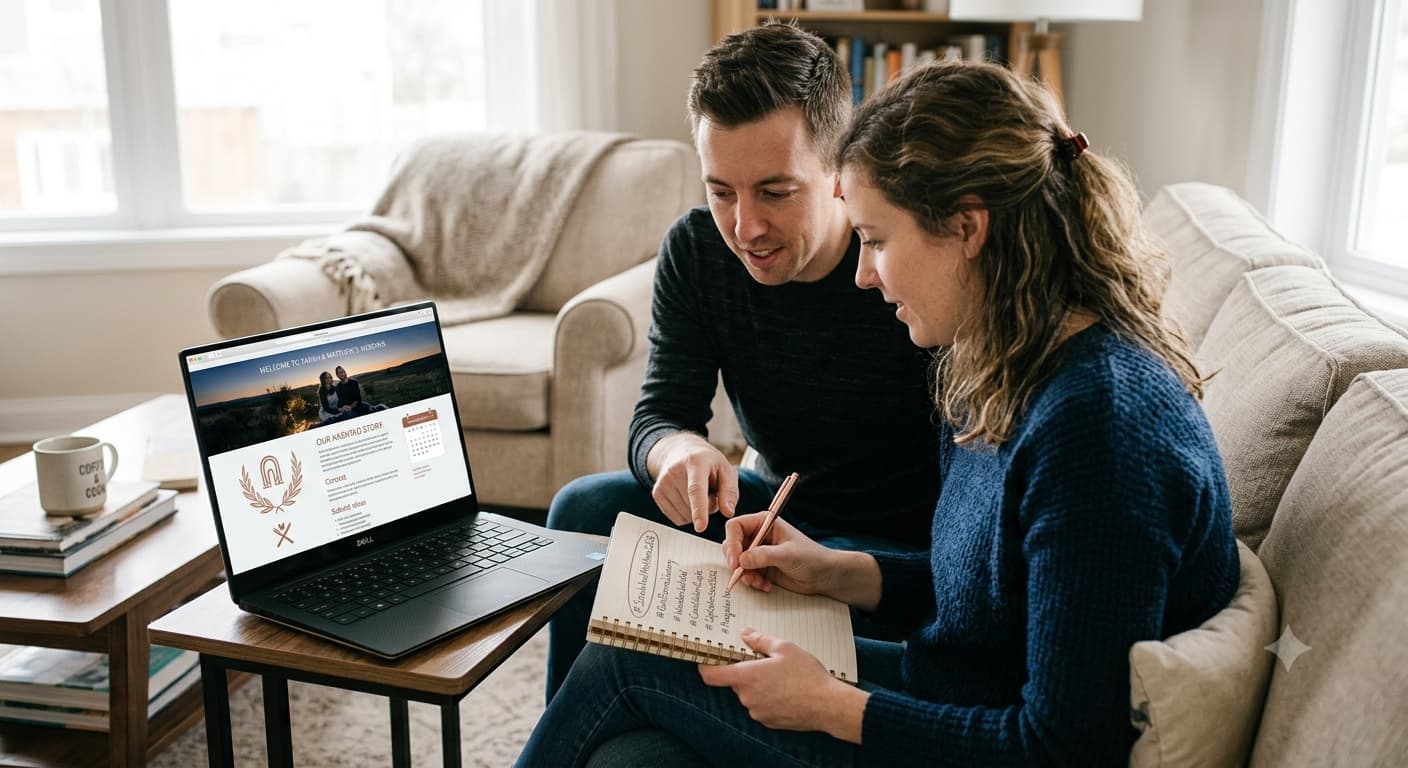
Making a wedding hashtag takes three rounds, not one. Round one, list your raw materials: both surnames, both first names, nicknames, the date, the venue, the city, and one running joke about you as a couple. Round two, push each ingredient through the standard patterns — pun, merge, date, phrase swap, place. Round three, cut fifteen candidates to three, read them aloud, and check availability. Total time about ten minutes, most of which is round one. The staring-at-a-blank-note approach is what takes forty.
This is part of our wider look at what wedding hashtags are actually for in 2026, which is worth two minutes if you haven't decided whether you want one at all.
It's Sunday night, the save-the-dates go to print Tuesday, and you and your partner have been passing a phone back and forth for forty minutes rejecting each other's ideas. Been there. The problem isn't that you're not clever — it's that you're trying to jump straight to the finished thing.
Round 1: Get your ingredients on the page (3 minutes)
You cannot pun on material you haven't written down. This step feels pointless and it's the entire trick.
Open a note and list:
- Both surnames — current, and the one you'll use after
- Both first names, plus every nickname either of you actually answers to
- The wedding date, in a few formats: 2026, June 2026, 06.20.26
- Venue name and city
- One thing your friends say about you two. The teasing one. That one.
- Any word already attached to your relationship — where you met, a shared obsession, the dog's name
Ten or twelve items. Messy is correct here.
Round 2: Run them through the patterns (4 minutes)
Now you've got material, apply shapes to it. Don't judge anything yet — judging while generating is why round one took you forty minutes last time.
Pattern A — surname pun. Look for words hiding inside the surname or rhyming with it. Reed → #ReedyForForever. Chen → #ChenginOurNames. Some surnames are generous, some are hostile. If yours refuses to cooperate after ninety seconds, skip it — we've worked through the awkward letters and what to do with names that don't pun separately.
Pattern B — the merge. Fuse the two surnames: Okafor + Bell → #TheOkabells. Fast, personal, sometimes accidentally sounds like a pharmaceutical. Say it out loud immediately.
Pattern C — the date anchor. #Martins2026, #IDoInJune, #TwoBecomeOkonkwo. No pressure, always available, never embarrassing.
Pattern D — the phrase swap. Take a phrase everyone knows and slot a name in. #TheGreatGatsbyGarcia, #FinallyFerreira, #ItTakesTuoyo. This pattern has the highest hit rate of the five.
Pattern E — the place. #MarriedOnMaui, #BrooklynIDo. Best if the location is genuinely part of the story.
Target fifteen candidates. You will hate eleven of them. That's the correct ratio and it's why volume matters more than inspiration.
If round two stalls — and with certain surnames it absolutely does — feed your names into a wedding hashtag generator and let it brute-force the pun and merge patterns for you. Treat the output as raw material rather than a verdict. The one you end up using is nearly always a twisted version of something a generator suggested, not the suggestion itself.
Round 3: Cut to one (3 minutes)
Four tests, in this order. Anything that fails is out — no appeals, no "but it's clever."
The read-aloud test. Say it. If your partner has to ask you to repeat it, guests will type it wrong.
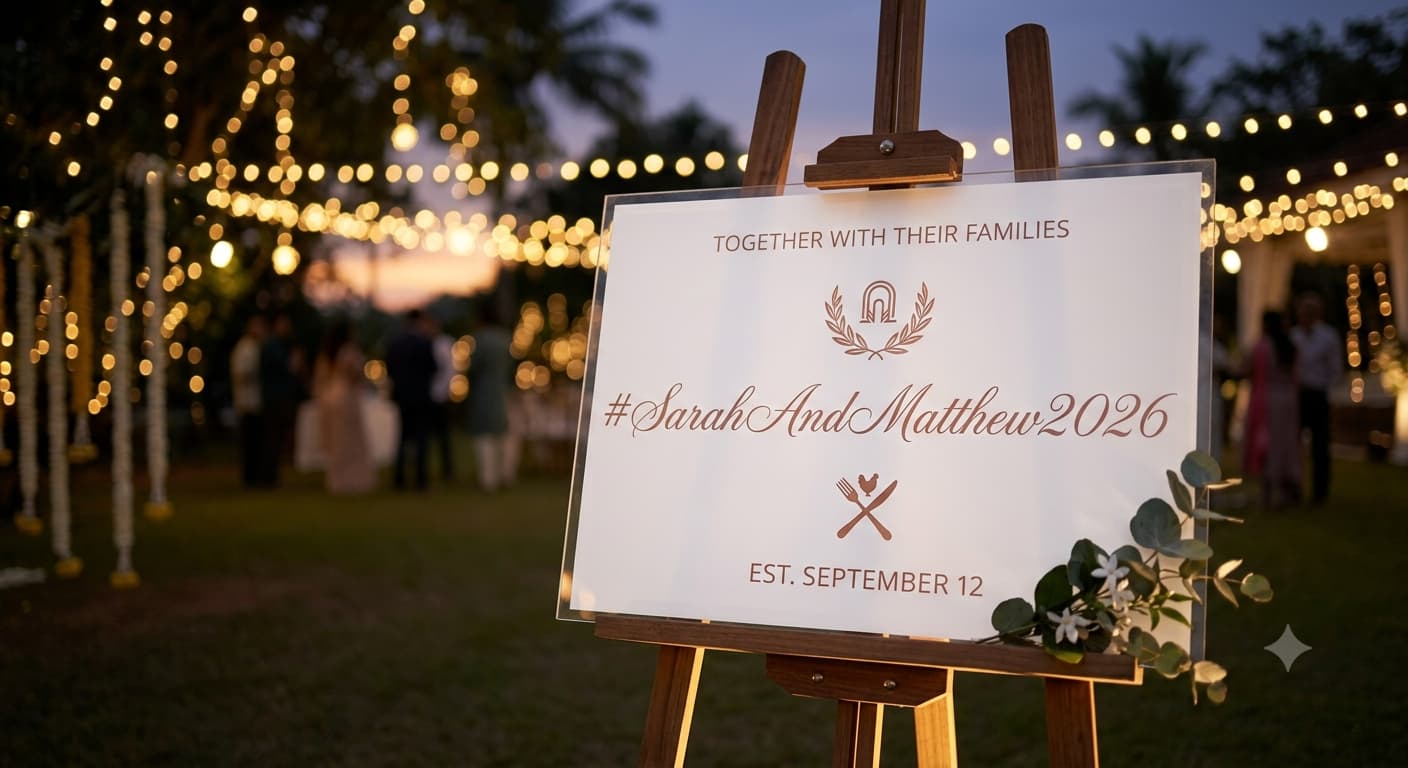
The lowercase test. Write it with no capitals. #tomandersonwedding contains a word you did not intend. This happens far more often than anyone expects, and it happens on printed signage, in front of your family.
The dad test. Would your father read it off a sign without confusion or a raised eyebrow? He is the median guest here, not your group chat.
The length test. Under about 20 characters. Count it. Long tags collect typos, and a typo'd photo is a lost photo.
Whatever survives all four, check that it's not already in use — searching Instagram and TikTok takes about ninety seconds, and the full availability check has a couple of steps people miss. Do this before anything goes to print. Reprinting 120 save-the-dates over a hashtag collision is a genuinely miserable way to spend a Saturday.
The rules that make a hashtag work in practice
A few things that separate the tags people actually use from the ones that die on the sign:
Capitalise every word. #SoonToBeSalvatore, not #soontobesalvatore. It's easier to read and it prevents the lowercase problem above. Capitalisation doesn't affect whether the tag works — it's purely for human eyes, and it matters more than people think.
No numbers except the year, no punctuation ever. Hyphens and apostrophes break the tag entirely. Emojis too.
One tag, used everywhere. Splitting across events scatters your photos and doubles what guests have to remember.
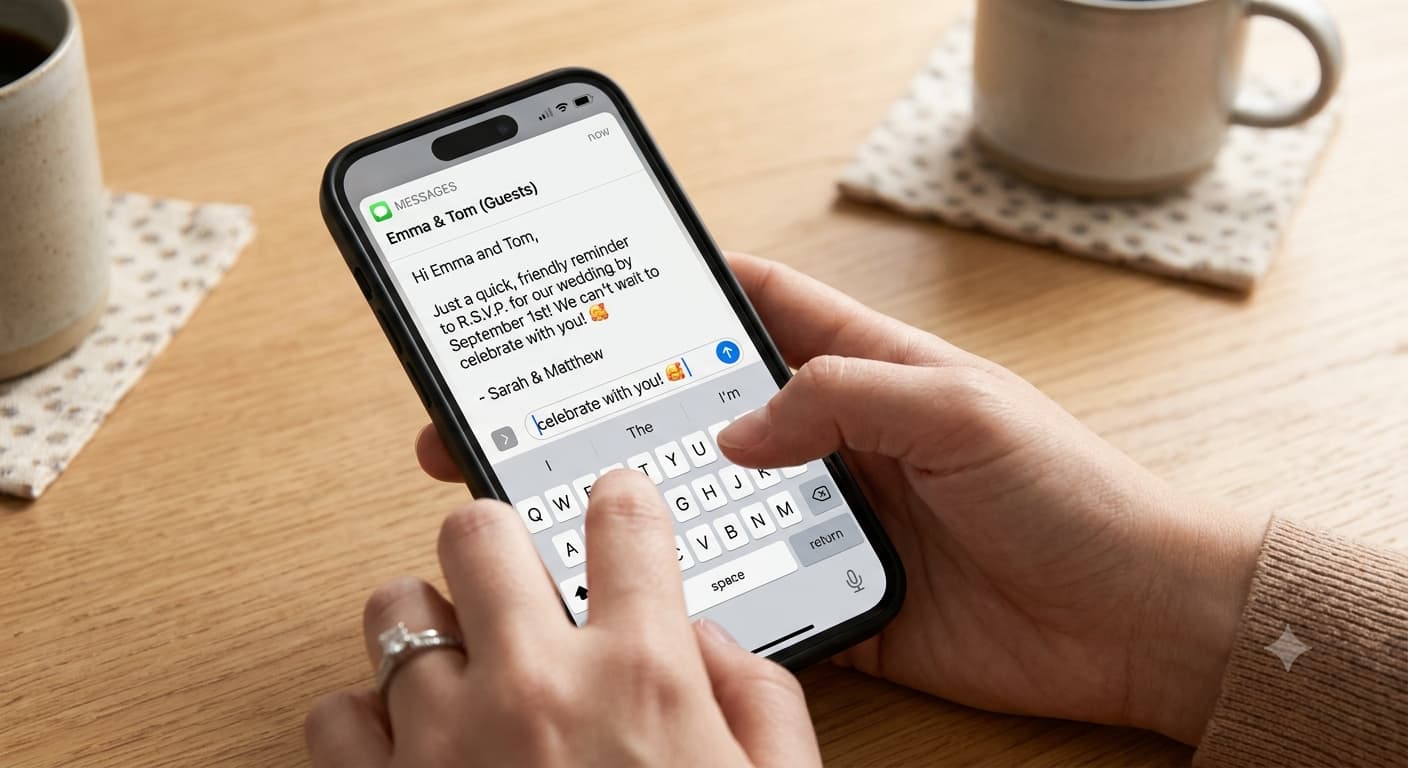
Decide it before the save-the-dates. The save-the-date is your first announcement and your best chance to plant the tag early. If you're sending digitally, Eventic's wedding designs put the hashtag line next to the RSVP so it's in front of guests from the first message rather than only on the day.
Common mistakes worth avoiding
- Trying to be clever when your surname won't allow it. Yarborough does not want to be a pun. Let it be #Yarborough2026 and go and eat dinner.
- Picking a phrase with an existing life. If it's also a song lyric or a brand, your photos are buried under strangers'.
- Making it a full sentence. Anything over about four words stops being typeable.
- Consulting too many people. Your hashtag by committee will end up as the blandest option nobody objected to. Two of you decide. That's the committee.
One exception on that last point, because it's a good one: crowdsourcing at an engagement party works. Not a group vote — a brainstorm. Put a pad of paper out, let people write suggestions, and take the raw material home. Friends spot the hidden word in your surname faster than you will, because they've been saying your names out loud for years and you've stopped hearing yours. Just keep the decision between the two of you afterwards.
Set a ten-minute timer and actually do it tonight — the version you pick under mild time pressure is almost always the one you'd have landed on anyway, three weekends later.
People Also Asked
Explore common questions related to this blog.
No. #SmithWedding and #smithwedding go to the same place. Capitalisation is purely readability — and readability is what stops the typos.
Technically yes, practically no. Once it's printed and posted, you'll spend the wedding correcting people. If you're unsure, delay the decision rather than committing and switching.