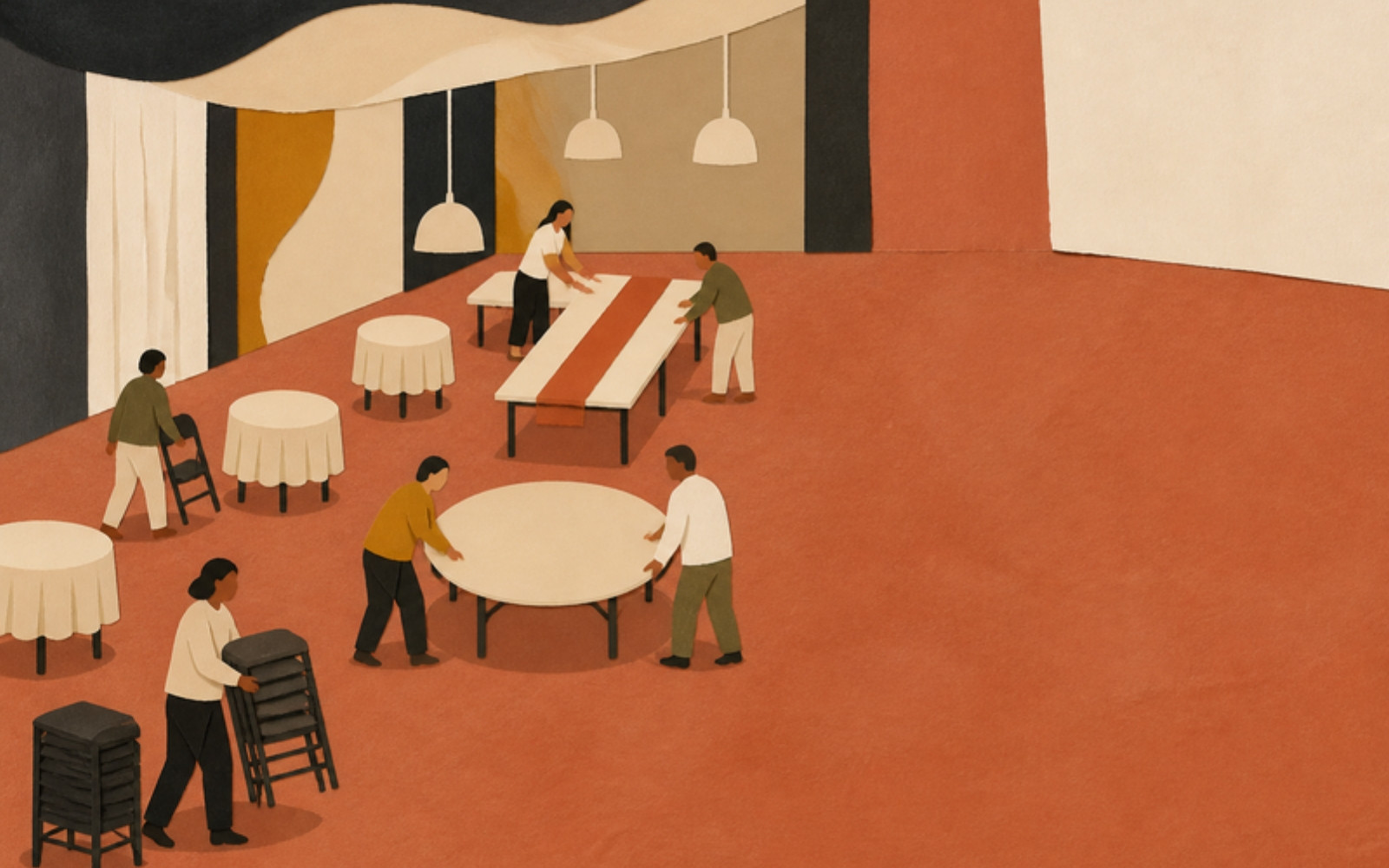
To plan a party for 100 guests, work out four numbers before anything else: seats (100 chairs and 13 sixty-inch rounds for a seated dinner, or 30–50 chairs for a cocktail party), space (about 1,000 sq ft standing, 1,200 seated, closer to 2,000 with dancing and a buffet), staff (8–10 servers plated, 4–5 for a buffet, plus 2 bartenders) and time (a 7pm start, 3–4 hours long). Food, drinks and ice all scale off those. Yes, even the number of trash bags. Especially the trash bags.
How do you get from "let's just invite everyone" to a room that actually holds 100 people, feeds them, and doesn't run out of chairs at 8:15pm?
You do the math first. Not the Pinterest board, not the playlist — the boring numbers. Seats, square feet, staff, hours. Get those four right and the party mostly runs itself. Get one wrong and you're the host dragging folding chairs out of the garage while your guests watch. (We've all been there. Some of us twice.)
This guide is the hub for that math. Every section gives you the number for 100 guests, the rule of thumb behind it so you can scale up or down, and a link to the deeper guide when you need the full breakdown. It works for a 40th birthday, an office holiday party, an engagement party or a very ambitious Friendsgiving. And with holiday season about to swallow every free weekend between now and New Year's, it's worth locking the numbers in early.
Start with the real headcount, not the invite list
Every number below multiplies off one figure, so get that figure right. Your invite list is not your headcount. Your "yes" list is closer, but it's still a little optimistic.
Here's how I'd plan it:
- Plan for confirmed yeses, not invites. If you invited 130 people hoping to land 100, plan for whoever actually replied yes.
- Expect a few no-shows. At casual parties a handful of yeses always bail — weather, babysitters, the flu that goes round every December. For catered events, give the caterer your confirmed number and keep any buffer in the food, not the guarantee.
- Count kids separately. They need chairs, they don't need wine, and they eat about half.
- Count your helpers. Photographers, DJs and anyone working the event need to eat too. Caterers call these vendor meals.
Lock the number about a week out, then stop changing it. Every recount after that is how you end up with 14 extra chicken plates and no idea who ordered them.
How many chairs and tables do 100 guests need?
It depends entirely on the format. A seated dinner needs a chair for every guest — 100 chairs, plus four or five spares for the plus-one nobody mentioned. A cocktail party doesn't. Standing is the point, so seating for roughly a third to a half of your guests (30 to 50 chairs) is plenty, mostly for older guests and anyone wearing shoes they regret.
Tables follow the chairs. A 60-inch round seats 8 comfortably, so 100 guests need 13 rounds. Squeeze 10 per table and you can do it with 10, but elbows will touch. Six-foot banquet tables seat 6 to 8, which works out to 13 to 17 tables. And don't forget the tables nobody sits at: buffet, bar, gifts, cake, the welcome table.
Every layout, plus highboys and the spare-chair buffer, is worked out in our guide to exactly how many chairs and tables 100 guests need.
| Format | Chairs | Tables |
|---|---|---|
| Seated dinner (rounds) | 100–105 | 13 × 60" rounds |
| Seated dinner (banquet) | 100–105 | 13–17 six-foot tables |
| Buffet with seating | 100–105 | 13 rounds + 2–3 buffet tables |
| Cocktail party | 30–50 | 10–12 highboys + a few low tables |
| Open house / drop-in | 25–40 | Scattered lounge seating |
How much space does a party for 100 people take?
More than your living room, less than a ballroom. The working rule of thumb planners use is around 8 to 10 square feet per guest for a standing cocktail party and 10 to 12 for a seated dinner. That covers the guest, their chair and a bit of walking room. So 100 guests standing need roughly 1,000 square feet; seated, about 1,200.
Then you add the extras: a dance floor, a buffet line, a bar, a DJ, a photo corner. Each one eats floor, and together they can push a seated dinner with dancing toward 2,000 square feet. The full breakdown, with a worked example and a method for measuring your own home, lives in our guide on how much room each guest really needs.
One non-negotiable: a venue's posted occupancy limit is the legal ceiling, set under fire codes like the NFPA 101 Life Safety Code. If your math says 120 and the sign says 100, the sign wins. Every time.
How many servers and bartenders for 100 guests?
Staffing is the line item people cut first and regret most. Too few servers and the food sits in the kitchen going cold while guests hover by the door, wondering if dinner is a rumor.
Rough ratios for 100 guests:
- Plated dinner: 1 server per 10 to 12 guests, so 8 to 10 servers.
- Family style: 1 per 12 to 15, so 7 or 8.
- Buffet: 1 per 20 to 25, so 4 or 5, mostly clearing and restocking.
- Cocktail party with passed bites: 1 passer per 25 to 30 guests, so 3 or 4.
- Bartenders: 1 per 50 to 75 guests — 2 for 100, or 3 if you're running a full cocktail bar.
Those ratios shift with the menu, the room and how fancy you're going. Our breakdown of staffing a 100-guest party by service style covers what each role does and where you can safely cut.
Food and drink for 100: let the headcount do the work
Once you know who's coming and how long they're staying, quantities are almost mechanical. The two things that move them most are the length of the party and whether it lands over a mealtime. A 7pm start means guests arrive hungry and expect dinner; a 2pm start means snacks will do.
Rules of thumb that hold up:
- Appetizers before a meal: 6 to 8 pieces per person. As the whole meal, more like 12 to 15.
- Drinks: 2 per guest in the first hour, then 1 per hour after that. A four-hour party for 100 means planning around 500 drinks.
- Ice: 1 to 2 pounds per guest, more if it's hot or you're chilling bottles in tubs.
For course-by-course numbers, our guide to how much food to serve per person is the one to bookmark, and the bar side is covered in how much alcohol to buy for a party. A "drink" there means a standard drink — the NIAAA's definition is 12 ounces of regular beer, 5 ounces of wine or 1.5 ounces of spirits.
Keep an eye on the buffet clock, too. The USDA says perishable food shouldn't sit in the temperature danger zone for more than two hours, so put platters out in batches instead of all at once. Lukewarm shrimp at hour three is not the vibe.
How long should a party for 100 people last?
Long enough for people to arrive late, eat, mingle and leave without feeling rushed. Short enough that you're not paying staff to watch three people finish the cheese board.
For most adult evening parties, 3 to 4 hours is the sweet spot. Cocktail parties land at 2 to 3 hours, wedding receptions at 4 to 5, and kids' birthdays should honestly stop at 2, for everyone's sake. Our guide on the right length for every kind of party breaks it down by party type and covers the polite way to put an end time on the invite.
Length matters for the budget, too. Venue rental, staff and bar packages are usually billed by the hour, and every extra hour adds roughly one more drink per guest. Going from 4 hours to 5 at a 100-person party is 100 more drinks — before anyone mentions an after-party.
What time should the party start?
For an evening party, 7pm is the safe default: late enough for people to get home from work and change, early enough that the party has a real peak before people fade. Dinner parties usually start at 7, cocktail parties anywhere from 6 to 8, and office parties straight after work, around 5:30 or 6.
The time you choose also decides the menu. Start at 7 and you're feeding people dinner. Start at 8:30 and heavy appetizers are fine. The reasoning, plus weeknight, weekend and winter tweaks, is in our guide to picking a start time that fills the room.
Quick seasonal note: daylight saving time ends on November 1, 2026, so it'll be properly dark by 5pm in much of the US through December. Great for string lights. Terrible for guests squinting at house numbers. Light the path.
A planning timeline for a 100-guest party
Big parties fall apart in the last two weeks, almost always because something that needed a month got left to the end. This is the order I'd lock things in:
| When | What to lock in |
|---|---|
| 8–10 weeks out | Date, budget and venue (check its posted capacity against your space math) |
| 6–8 weeks out | Caterer or menu plan, rentals (chairs, tables, linens), bartenders |
| 4–6 weeks out | Invitations out, with a clear RSVP date and an end time |
| 3 weeks out | Staffing plan confirmed; floor plan sketched with the table count |
| 2 weeks out | RSVP deadline; chase the non-responders |
| 1 week out | Final headcount to the caterer and rental company; drinks and ice ordered |
| Day before | Tables and chairs set, buffet labeled, speakers charged |
| Day of | Staff arrive 1–2 hours early; food goes out in batches |
The 100-guest cheat sheet
Every number from this guide in one place, for the two formats most 100-person parties use:
| Item | Seated dinner | Cocktail party |
|---|---|---|
| Chairs | 100–105 | 30–50 |
| Tables | 13 × 60" rounds | 10–12 highboys |
| Floor space | ~1,200 sq ft, plus extras | ~1,000 sq ft |
| Servers | 8–10 plated / 4–5 buffet | 3–4 passers |
| Bartenders | 2–3 | 2–3 |
| Length | 3–4 hours | 2–3 hours |
| Start time | 7pm | 6–8pm |
| Drinks | ~500 for 4 hours | ~400 for 3 hours |
Screenshot it, send it to whoever's helping, and save your arguing energy for the playlist.
Here's hoping your RSVPs come back honest, the ice lasts until the final song, and somebody else volunteers to stack the chairs.
People Also Asked
Explore common questions related to this blog.