There is no wording on earth that will make divorced parents happy about sharing a piece of cardstock. What good wording can do is remove every excuse for an argument.
For the full range of host-line options across every family setup, the complete wedding invitation wording guide covers the standard formats this one branches off from.
The one rule that governs everything
Two names on one line, joined by "and," means "these people are a couple." That's the entire grammar of an invitation host line. Break that rule and you've accidentally announced a reconciliation to 117 people.
So: separate lines. No "and." Mother's line above father's line, which is the traditional order regardless of who remarried first, who's paying more, or who you're closer to. Etiquette here is doing you a favor — when there's a fixed convention, nobody's ordering choice can be read as a statement.
The Emily Post Institute's formal invitation guidance treats this the same way, and it's worth quoting the convention to any parent who wants to relitigate the order. "That's just how it's done" is a remarkably effective sentence.
Format 1: Both parents hosting, neither remarried
Mrs. Priya Chen Mr. David Chen request the honour of your presence at the marriage of their daughter Amelia Rose to Mr. Jonah Patel
Note what's missing: the "and." Two lines, stacked, nothing joining them. Guests read it correctly without a single explanation.
If your mother uses her maiden name or a different surname now, use whatever she actually goes by:
Ms. Priya Raman Mr. David Chen request the honour of your presence…
Format 2: One or both parents remarried
The stepparent goes on their spouse's line. This is the part people get wrong most often — stepparents don't get a separate line of their own, because they're part of a couple.
Mr. and Mrs. David Chen Ms. Priya Raman and Mr. Alan Whitfield request the pleasure of your company at the marriage of Amelia Rose Chen to Jonah Patel
Notice the couple line changed slightly there. When stepparents are involved, "their daughter" gets ambiguous fast, so switching to the child's full name is cleaner than trying to write "his daughter and her stepdaughter," which nobody has ever done successfully.
More variations:
- "Mr. and Mrs. David Chen and Ms. Priya Raman request the pleasure of your company at the marriage of Amelia Rose Chen…"
- "Priya Raman and Alan Whitfield, together with David Chen and Sarah Chen, invite you to the marriage of Amelia and Jonah"
- "Mr. David Chen and Mrs. Sarah Chen, with Ms. Priya Raman, request the honour of your presence…"
Format 3: Only one parent is hosting
Straightforward, and there's no obligation to name a parent who isn't contributing.
Mrs. Priya Raman requests the pleasure of your company at the marriage of her daughter Amelia Rose Chen to Jonah Patel
But — and this is where I'd push back on strict etiquette — leaving a living parent off entirely is a permanent decision printed on paper. If the relationship is complicated but not severed, "together with their families" spares you a decade of "I wasn't even on the invitation." That line has ended more feuds than any wording guide.
Format 4: The escape hatch (recommended more often than people expect)
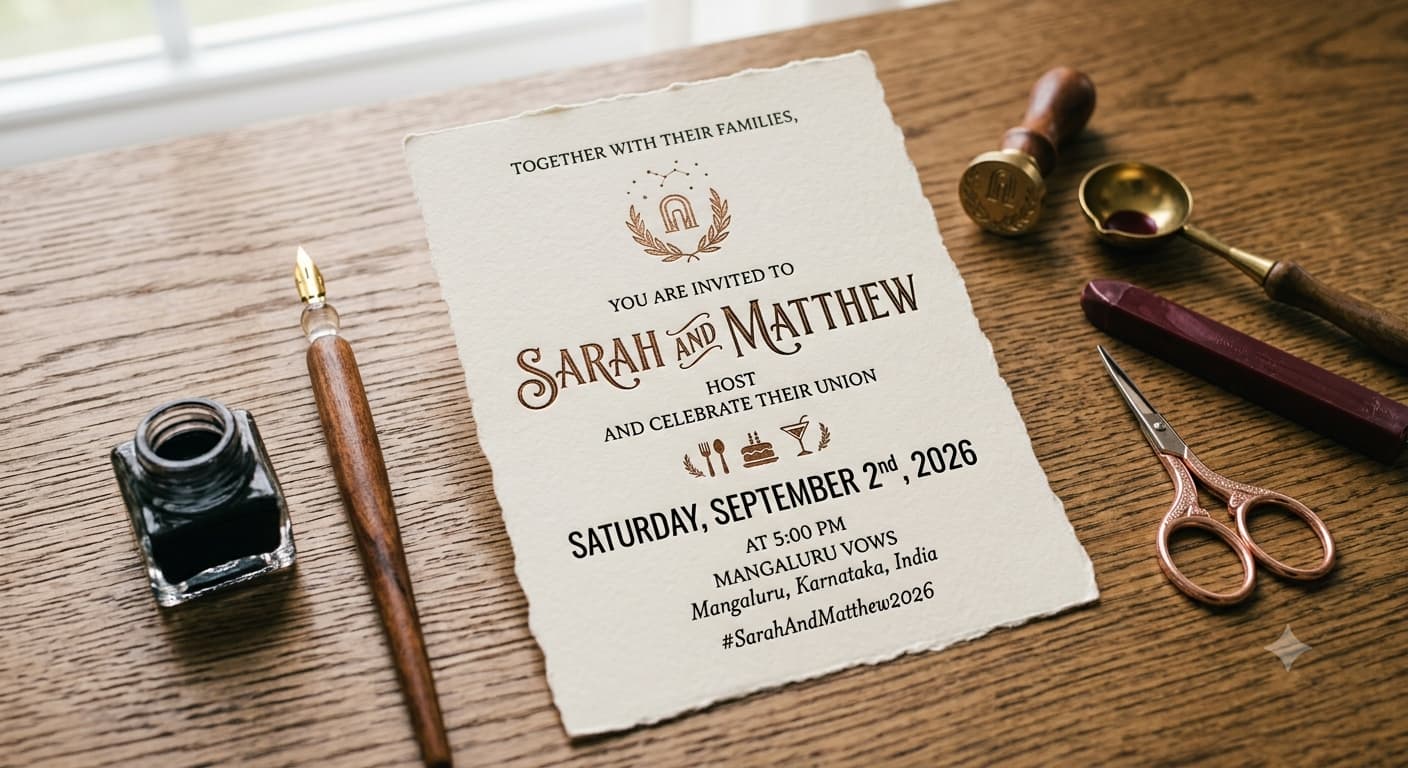
Together with their families Amelia Chen and Jonah Patel invite you to celebrate their marriage
Nobody is ordered. Nobody is omitted. Nobody's new spouse is or isn't mentioned. If you're funding a decent share of the wedding yourselves, this is available to you — the wording options when the couple hosts covers the full set, and honestly it's where most couples with complicated families end up landing after two weeks of drafts.
Format 5: Estranged parent, contested situations
Sometimes a parent genuinely shouldn't be on it. That's a real situation and you don't owe anyone an explanation printed on a card.
- Name only the hosting parent (Format 3).
- Or use "together with their families" and let it stay unspecified.
- Or drop the host line entirely and lead with your own names.
What not to do: leave a pointed gap, or write anything that hints at the conflict. An invitation is not the venue. Guests will notice a name is missing, they will not ask, and that's the correct outcome.
Quick reference
| Situation | Host line format |
|---|---|
| Divorced, both hosting | Two stacked lines, mother first, no "and" |
| Mother remarried | Mother + her spouse on one line; father on his own |
| Both remarried | Each couple gets one line, mother's couple first |
| One parent hosting | That parent alone |
| Too complicated | Together with their families |
| Couple hosting entirely | Couple's names only |
Ordering, and the argument you'll have about it
Mother's line goes first. That's the convention and it isn't about affection or money.
But if your father is hosting the majority and feels strongly about the order, this is a case where breaking convention is fine, because almost no guest will consciously register the ordering. Guests notice who is on it. They rarely notice sequence. Spend your negotiating capital on inclusion, not order.
One practical note that saves an actual fight: decide the host line before you decide anything else about the stationery. Couples who pick a design first end up trying to force five lines of complicated family names into a layout built for two, and the compromise always comes out of the wording. Lock the names, then choose the template — if you're building it digitally, Eventic's wedding invitation templates let you paste the host block in and see immediately whether it breathes or collapses.
Keep the same host block everywhere
Whatever you settle on, carry it identically across every piece of wedding paper. The invitation, the ceremony program, the wedding website's "our families" section, the thank-you cards, and any newspaper or social announcement.
The reason is simple: people compare. A parent who appears second on the invitation and first on the program will notice, and will wonder which one you meant. A stepparent named on the website but not the invitation will notice harder. Consistency removes every opportunity for someone to read a message into a difference that was actually just a formatting decision made at 1am.
Write your host block once, save it in a note on your phone, and paste it everywhere. That's the whole system.
There's one exception worth knowing about. The ceremony program has more room and a warmer register, so it's the right place to include people the invitation couldn't fit — stepparents you're close to, a parent who isn't hosting, grandparents. A program can say "Parents of the bride: Priya Raman and Alan Whitfield, David and Sarah Chen" without anyone reading a hierarchy into it, because programs are lists rather than invitations.
What about the wedding announcement and thank-you cards?
Announcements sent after the wedding follow the same host-line logic, with one change: once you're married, you can issue them yourselves. "Amelia Chen and Jonah Patel were married on the fourteenth of June" needs no host line at all, which quietly retires the whole problem.
Thank-you cards are signed by the two of you, so parents don't appear on them. If a parent hosted and paid, thank them separately and privately — a card that names them as hosts to guests they already know is doing nothing useful.
What about the envelopes?
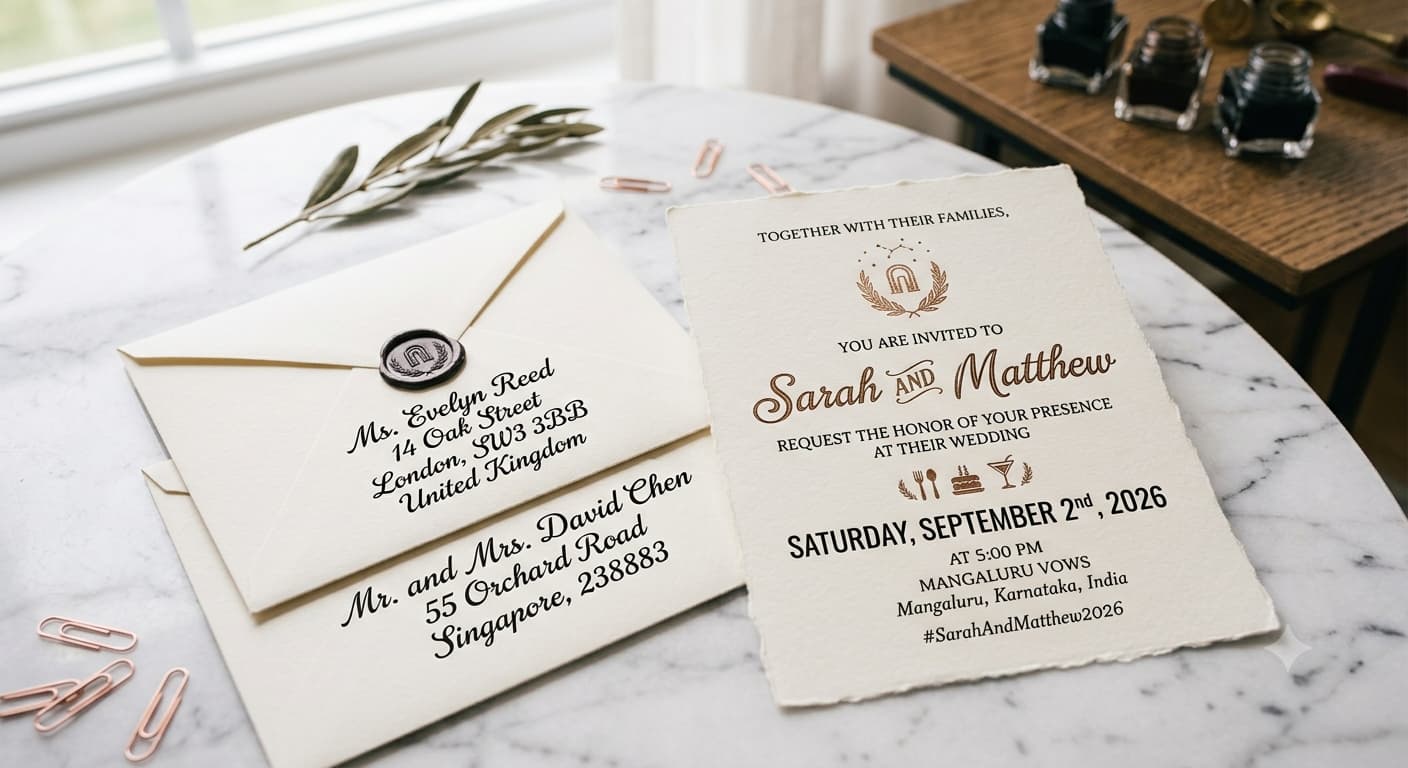
Separate households means separate invitations, even for parents. Both your mother and your father get their own invitation in the mail, addressed individually, even though they obviously know about the wedding.
It's a small thing that reads as respect, and skipping it is the kind of detail a parent remembers for years. Same rule applies to grandparents in separate homes and to any sibling who's moved out.
One last thing: whichever version you print, send your parents a photo of it the day it arrives, before guests see it. Surprises are the actual problem here — the wording almost never is.
People Also Asked
Explore common questions related to this blog.
On the same line as the parent they're married to. Stepparents never get a standalone line.
Yes, if you're hosting. Tell them before they see the printed version — the announcement is what stings, not the wording.
Then "together with their families" is your answer, and you stop negotiating. You are allowed to make this decision unilaterally; it's your wedding stationery, not a custody agreement.