Wedding Invitation Wording: 60+ Examples for Every Host, Tone and Situation
How do you fit an entire wedding onto five lines without sounding like a legal summons or a group text?
That's the whole problem. Every couple hits it around month four of planning, usually at 11pm, usually with a half-finished draft that starts "You are cordially invited" and immediately dies.
Heads up: some links in this post are Amazon affiliate links — if you buy through them, Eventic earns a small commission at no extra cost to you.
The five lines every invitation actually needs
Strip away tradition and an invitation is a piece of logistics with feelings attached. Guests scan it for about four seconds before deciding whether to check the calendar. So the information order matters more than the font.
| Line | What it does | Example |
|---|---|---|
| Host line | Names whoever is paying/inviting | Mr. and Mrs. David Chen |
| Request line | The actual invitation | request the honour of your presence |
| Couple line | Both names, bride/first-listed partner first traditionally | Amelia Rose Chen and Jonah Patel |
| Date and time | Spelled out for formal, numerals for casual | Saturday, the fourteenth of June, at half after four |
| Location | Venue name and city — full street address only if it's obscure | Ravenwood Barn, Hood River, Oregon |
Two rules that trip people up constantly. First, the request line changes with the venue: "the honour of your presence" is traditionally reserved for a house of worship, while "the pleasure of your company" covers everywhere else — a distinction the Emily Post Institute still holds to in its formal wording guidance. Second, the reception is a separate invitation, even when it's printed on the same card. "Dinner and dancing to follow" is doing real work there; it tells guests whether to eat beforehand.
Wording by who's hosting
This is the section people actually came for, because the host line is where family politics live.
When the couple hosts
Increasingly the default, and honestly the easiest to write, because you're not negotiating whose name goes first.
Together with full hearts Amelia Chen and Jonah Patel invite you to celebrate their marriage Saturday, the fourteenth of June, two thousand twenty-six at four thirty in the afternoon Ravenwood Barn, Hood River, Oregon
If you're paying for most of it yourselves but still want your parents named, there's a graceful middle path — we've broken down every variation for couples hosting their own wedding, including the ones that keep parents happy, with 25 samples you can lift directly.
When the bride's parents host
The traditional form. Note that the bride is named with first and middle name only — no surname, because it's already established by the host line.
Mr. and Mrs. David Chen request the honour of your presence at the marriage of their daughter Amelia Rose to Mr. Jonah Patel
When both families host
Mr. and Mrs. David Chen together with Mr. and Mrs. Ravi Patel request the pleasure of your company at the marriage of their children Amelia Rose and Jonah
When the parents are divorced, remarried, or no longer living
Here's where the templates on most sites quietly give up. Divorced parents get separate lines, never a shared one, and the order follows who's hosting rather than who married whom first — the full breakdown of divorced and remarried parent wording covers stepparents, estranged parents, and the "both parents but they cannot be on the same line" situation.
Honoring a parent who has died is a different problem entirely, and a badly worded line can land like a punch in the middle of a happy card. There's a right and wrong way to phrase it, which we cover gently in the guide to including a late parent's name without making the invitation feel like an obituary.
Formal, modern, or somewhere in the middle
Your wording sets the expectation for the entire event. Guests read tone before they read content, which is why a black-tie ballroom invitation written in Comic Sans lowercase confuses people at a physical level.
Formal spells out everything — numbers, dates, the year, the state. No abbreviations except Mr., Mrs., and Dr.
Semi-formal keeps the structure, drops the archaic bits. "Saturday, June 14, 2026, at 4:30 in the afternoon."
Casual talks like a person. "We're getting married! Come eat tacos with us." And it's genuinely harder to write well than the formal version, because there's no script to lean on — the casual and modern wording guide has 30 examples that stay warm without tipping into cringe.
One thing worth saying plainly: formality is about your event, not your worth as a couple. A backyard wedding written in ballroom language reads as borrowed. Match the wording to the day you're actually having.
Date, time and the numbers question
| Formality | Date | Time |
|---|---|---|
| Formal | Saturday, the fourteenth of June, two thousand twenty-six | at half after four o'clock |
| Semi-formal | Saturday, June 14, 2026 | at 4:30 in the afternoon |
| Casual | Saturday, June 14th | 4:30 pm |
"Half after four" is not a typo and not optional in the formal register — it's the traditional construction, and "four thirty" in an otherwise formal invitation is the kind of small mismatch that stationers notice. Also skip "p.m." in formal wording; "in the afternoon" and "in the evening" do that job.
Wording for the awkward stuff
Every couple has at least one line they rewrite eleven times. Usually it's one of these four.
No children. The invitation itself is not where you fight this battle — the envelope is, and the wording just backs it up. Getting it right saves you six phone calls, and the adults-only wording that doesn't offend anyone walks through the phrasing plus the envelope mechanics that actually enforce it.
No plus-ones. Related problem, different solution, and the fix is mostly about how you address the envelope rather than anything printed on the card. If you've already had one guest ask "can I bring someone?", read how to word a no plus-one policy and hold the line politely before you reply.
Dress code. Two to four words, bottom right corner, and never a paragraph explaining what "cocktail attire" means. The dress code wording chart by formality level matches each phrase to what guests will actually wear, which is not always what you think it means.
Reception only. Different card, different tone, and it must not read like a consolation prize. Reception-only and post-elopement wording handles the "we already got married, please still come celebrate" version too.
Five mistakes that cause real problems
- Registry information on the invitation. Still considered a gift grab, still awkward. Website or shower invitation only.
- No RSVP deadline. A date with no deadline gets responses in week eleven. Give a date three to four weeks before the wedding.
- Ambiguous host line. If guests can't tell who's inviting them, they don't know who to thank — or who to call with questions.
- Too much text. More than eight lines and the eye bounces. Push the shuttle schedule to a details card.
- Not proofreading the numbers. With the average US wedding running $34,200 and a guest count of 117 people according to The Knot's 2026 Real Weddings Study, a reprint over a wrong date is an expensive kind of painful.
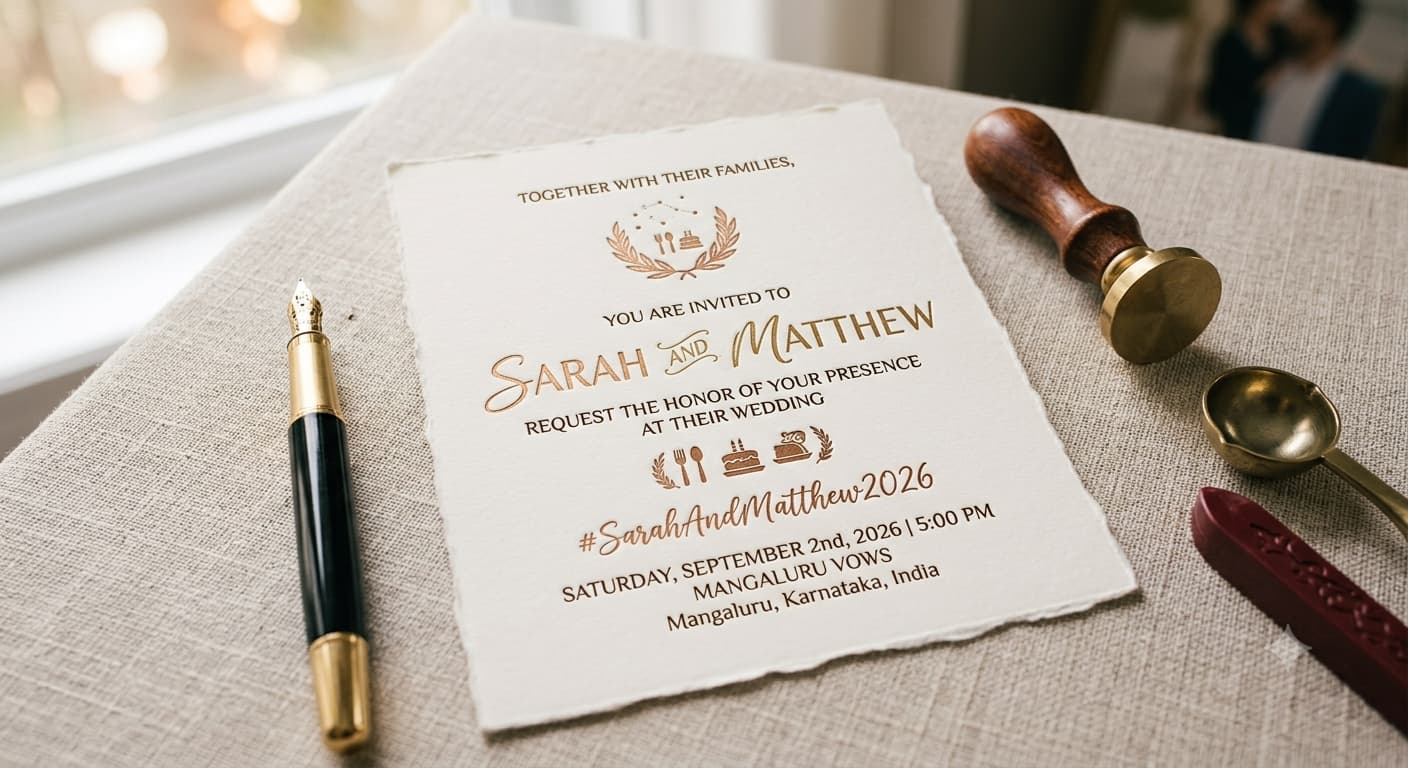
Once the wording's settled, sending it is the easy half. If you're going digital, Eventic's invitation wording generator will build the host line variations for you so you can compare three drafts side by side instead of retyping — and if you're printing, a decent wax seal stamp kit is the single cheapest way to make a simple flat-printed card feel like it cost triple. Ours arrived with a wonky letter, so order six weeks out, not six days.

As an Amazon Associate, we may earn from qualifying purchases.
Write the draft, sleep on it, then read it out loud to someone who isn't in your family. If they can tell you the date and the dress code afterwards without looking again, you're done — go book the cake tasting.
People Also Asked
Explore common questions related to this blog.
No. Name whoever is hosting. If you're paying yourselves and want to honor both families anyway, "together with their families" covers everyone without a hierarchy fight.
Formal invitations do. Casual ones usually skip it, since nobody's confused about which June you mean. Include it if you're sending save-the-dates more than a year out.
Traditionally the bride's. Same-sex couples typically go alphabetically or by whichever sounds better read aloud — genuinely, say both versions out loud and pick.
Yes, bottom right, two words. Anything longer belongs on the website.