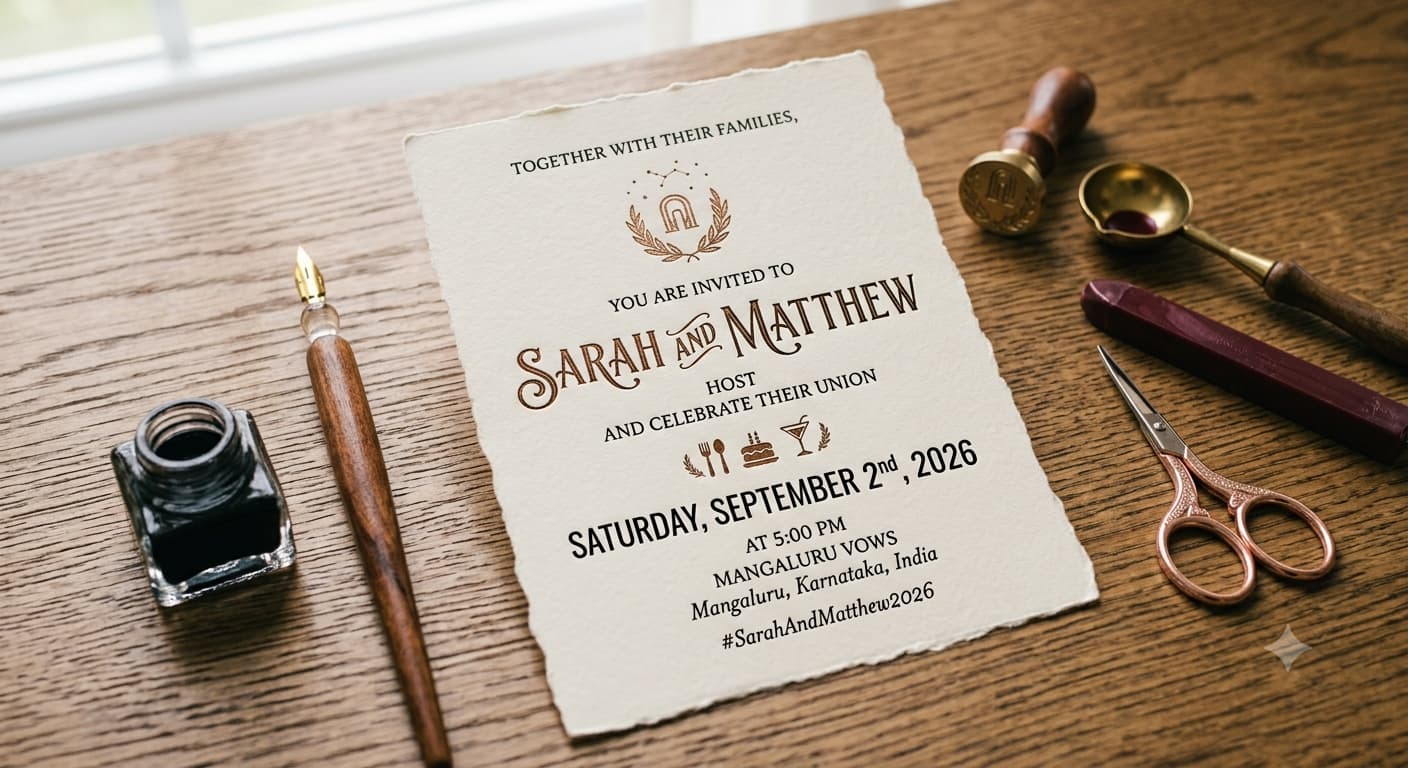
Wedding Invitation Wording When You're Hosting: 25 Examples That Work
Your mum just asked, very casually, whether her name is going on the invitation. You're paying for 80% of this wedding. It is 11:40pm and you have somehow become a diplomat.
Heads up: some links in this post are Amazon affiliate links — if you buy through them, Eventic earns a small commission at no extra cost to you.
This is one branch of the bigger guide to wedding invitation wording across every hosting situation — worth reading if your family setup is more complicated than "we're paying."
Why the host line even exists
Historically the invitation came from whoever paid, which for centuries meant the bride's father. That's the entire origin of "Mr. and Mrs. David Chen request the honour of your presence." It's a receipt, dressed up in copperplate.
Which means the modern shift makes sense. When you're funding your own wedding, your names on the host line aren't a snub — they're just accurate. The awkwardness only shows up because parents read the invitation as a family status document, and you read it as logistics. Both of you are right, which is why this argument never resolves cleanly.
So pick the version that reflects reality, then tell your parents what you chose before they see it printed. That one conversation prevents most of the drama.
Option 1: Just your names (the clean version)
Best when you're paying fully, when families are complicated, or when you simply want the invitation to feel like it came from the two of you.
Amelia Chen and Jonah Patel invite you to share in the joy of their wedding Saturday, the fourteenth of June, two thousand twenty-six at half after four o'clock Ravenwood Barn, Hood River, Oregon
More versions of the same idea:
- "Amelia Chen and Jonah Patel request the pleasure of your company as they exchange vows"
- "With joyful hearts, Amelia and Jonah invite you to witness their marriage"
- "Amelia and Jonah are getting married, and it wouldn't be the same without you"
- "You're invited to celebrate the marriage of Amelia Chen and Jonah Patel"
- "Two families, one very good party — Amelia and Jonah are getting married"
- "Amelia Rose Chen and Jonah Patel joyfully invite you to their wedding day"
Option 2: "Together with their families"
The peace treaty. It acknowledges both sets of parents, names nobody as host, and takes three words.
Together with their families Amelia Chen and Jonah Patel invite you to celebrate their marriage
Variations that do the same job:
- "Together with our families, we invite you to celebrate our wedding"
- "Surrounded by the love of their families, Amelia and Jonah invite you…"
- "With the blessing of their parents, Amelia and Jonah request the pleasure of your company"
- "Together with full hearts and the families who raised them…"
- "Amelia and Jonah, together with their parents, invite you to their wedding"
That last one is the version to reach for when a parent specifically wants to be seen as part of it. It reads as shared without transferring the host line.
Option 3: Naming parents by name, without the host framing
Some families want the actual names printed. Fine — you can do it without pretending they're hosting.
Amelia Rose Chen daughter of David and Priya Chen and Jonah Patel son of Ravi and Meera Patel invite you to their wedding
This "son of / daughter of" structure is common in Indian, Filipino, and many Catholic families, and it's a genuinely elegant compromise. Parents get full billing. The invitation still comes from you.
More phrasings:
- "Amelia, daughter of David and Priya Chen, and Jonah, son of Ravi and Meera Patel, invite you…"
- "Children of David and Priya Chen and of Ravi and Meera Patel, Amelia and Jonah request the pleasure of your company"
Option 4: When one family contributed and the other didn't
The genuinely uncomfortable one. Naming only one set of parents as hosts is technically correct etiquette and socially a landmine.
The workable answer is almost always "together with their families." It's vague on purpose. Nobody can count who paid what from a line that includes everyone.
If the contributing parents insist on being named alone, Emily Post's wedding invitation guidance does support host-line accuracy — but weigh it against Thanksgiving. Etiquette rules exist to reduce friction, not to license it. If a technically correct invitation creates a two-year grudge, it failed at its actual job.
Option 5: Second weddings, older couples, and "we've been together nine years"
Nobody needs a host line at 38.
- "Amelia and Jonah invite you to celebrate the next chapter"
- "After nine years, four apartments and one very persistent cat, Amelia and Jonah are getting married"
- "Together with their children, Amelia and Jonah invite you to their wedding"
- "The wait is over. Amelia and Jonah are tying the knot."
- "Amelia Chen and Jonah Patel request the pleasure of your company at their marriage — finally"
That last one lands well with guests who've been asking since 2019. Read it out loud first; the joke has to sound like you.
The tone ladder
| If your wedding is… | Your host line should read… |
|---|---|
| Black tie, hotel ballroom | Amelia Rose Chen and Jonah Patel request the honour of your presence |
| Cocktail, garden or venue | Amelia Chen and Jonah Patel request the pleasure of your company |
| Semi-formal, barn or restaurant | Together with their families, Amelia and Jonah invite you to celebrate |
| Casual, backyard or park | Amelia and Jonah are getting married and you're invited |
| Elopement party after the fact | Amelia and Jonah already said "I do." Now for the party. |
If the wording and the venue don't match, guests get it wrong — usually by overdressing, which is the more forgivable direction, but still.
The conversation with your parents, scripted
Most of the anxiety around this isn't about wording. It's about the two-minute conversation you're dreading. So here's how to have it.
Have it before you design anything. Once you've picked a template and paid a deposit, any change your parents suggest becomes a fight about money as well as feelings. Raise it while everything is still theoretical.
Lead with the decision, not the question. "We're going with 'together with our families' so both sides are included equally" ends the conversation. "What do you think we should do about the host line?" opens a two-week negotiation you didn't want.
Name what they actually care about. Nine times out of ten it isn't the invitation — it's whether their friends will see that they're part of this. So offer the thing they want in a different form: their names in the ceremony program, a mention in your speech, a photo in the welcome sign. Those cost you nothing and land harder than a line of type.
If they push: "I know it's different from how yours was done. We're covering most of it ourselves, and this felt like the honest way to word it. Your names are on the program and I'm thanking you both properly at the reception." Then stop talking. Adding a fourth reason makes it sound negotiable.
If they're contributing financially and want the host line: that's a legitimate ask, and "together with their families" still covers it. But if they want to be named as sole hosts while you're paying half, that's a values conversation, not a stationery one, and it's worth having away from the wedding admin entirely.
One thing worth remembering: parents who make a fuss about the invitation are usually anxious about their role in the day generally. Solve the role, and the wording stops being the issue.
Three things to sort before you print
Tell your parents first. Show them the draft, don't spring it. "We're doing 'together with our families' so both sides are included" is a sentence that ends the conversation before it starts.
Decide the RSVP method at the same time. Host line and response method go on the same card, and if you're skipping a printed RSVP card, that's a real decision, not an afterthought. If you're sending digitally, Eventic's wedding templates keep the responses in one list instead of scattered across three group chats, which matters more than it sounds like it does around week two.
Proof it against the reality. With the average US guest count sitting at 117 people per The Knot's 2026 Real Weddings Study, a wording change after printing is not a small correction — it's 117 reprints.
If you are printing, one small upgrade with an outsized effect: patterned envelope liners turn a plain flat-print suite into something people photograph. Around $20 for a pack, and they hide the fact that you saved money everywhere else.

As an Amazon Associate, we may earn from qualifying purchases.
Whatever you land on, print one and stick it on the fridge for two days before you order 117 of them. Wording that felt perfect at midnight sometimes reads very differently over coffee.
People Also Asked
Explore common questions related to this blog.
No, not when you're hosting. It's only read as rude when it's a surprise — the offense is in the reveal, not the wording.
Yes, or name that parent directly. There's a gentler set of options in the guide to wording that honors a parent who has passed.
They go on separate lines, never one shared line. The divorced and remarried parent wording rules cover the ordering.
Only for a religious ceremony, and only if the rest of your invitation is formal. Otherwise it reads like fancy dress.