Writing your own Hindu wedding invitation? The hardest part is almost always the opening line — the invocation to Ganesh, the way you name both families, the phrasing that feels warm without sounding like a legal notice. Below are ready-to-use wordings in Hindi and English for every ceremony from haldi to reception, plus how to adapt them so they actually sound like your family.
You can copy any of these directly, swap in your names and dates, and you're done. But a few small choices — which deity you invoke, how you order the parents' names, whether you write in Hindi, English, or both — change the whole tone. So I'll flag those as we go.
Start With the Invocation (This Sets the Tone)
Most Hindu wedding cards open with a religious invocation before any names appear. The most common is to Lord Ganesha, the remover of obstacles, which is why so many cards carry the line ॥ श्री गणेशाय नमः ॥ at the very top.
Common opening invocations:
- ॥ श्री गणेशाय नमः ॥ — the standard, safe for almost every family
- ॥ ॐ श्री गणेशाय नमः ॥ — a slightly fuller version
- वक्रतुण्ड महाकाय — the full Ganesh shloka, used when families want something more traditional
- ॥ श्री स्वामी समर्थ ॥ — common in Maharashtrian families
- ॥ जय श्री कृष्ण ॥ or ॥ राधे कृष्ण ॥ — for families with a Krishna tradition
If your family follows a particular deity or guru, use that invocation instead — it's the one line where personal tradition matters most, and elders will notice if it's generic.
The Core Wedding Invitation
Here's the workhorse — the main wedding ceremony wording. I'll give you Hindi and English versions of the same card so you can pick one or run both.
Hindi version:
॥ श्री गणेशाय नमः ॥
सादर निमंत्रण
आपके आशीर्वाद एवं शुभकामनाओं की कामना के साथ
हमारे प्रिय पुत्र / पुत्री[दूल्हे का नाम]
(सुपुत्र श्री [पिता का नाम] एवं श्रीमती [माता का नाम])के शुभ विवाह
[दुल्हन का नाम]
(सुपुत्री श्री [पिता का नाम] एवं श्रीमती [माता का नाम])के साथ [दिनांक] को [स्थान] पर सम्पन्न होगा।
आपकी उपस्थिति ही हमारा सौभाग्य है।
English version:
॥ Shree Ganeshaya Namah ॥
With the blessings of the Almighty,
Mr. & Mrs. [Groom's parents' names]
request the honour of your presence
at the wedding ceremony of their son[Groom's Name]
with
[Bride's Name]
(daughter of Mr. & Mrs. [Bride's parents' names])on [Date] at [Venue].
Your presence and blessings will make the occasion complete.
A note on whose family "hosts": traditionally the bride's family issues the wedding invitation and the groom's family issues the reception invitation, but plenty of modern couples send one joint card from both families. Either is correct — just be consistent across all your cards.
Ceremony-by-Ceremony Wording
A Hindu wedding is rarely one event. Here's short, usable wording for each function, kept lighter in tone than the main card since these are the fun ones.
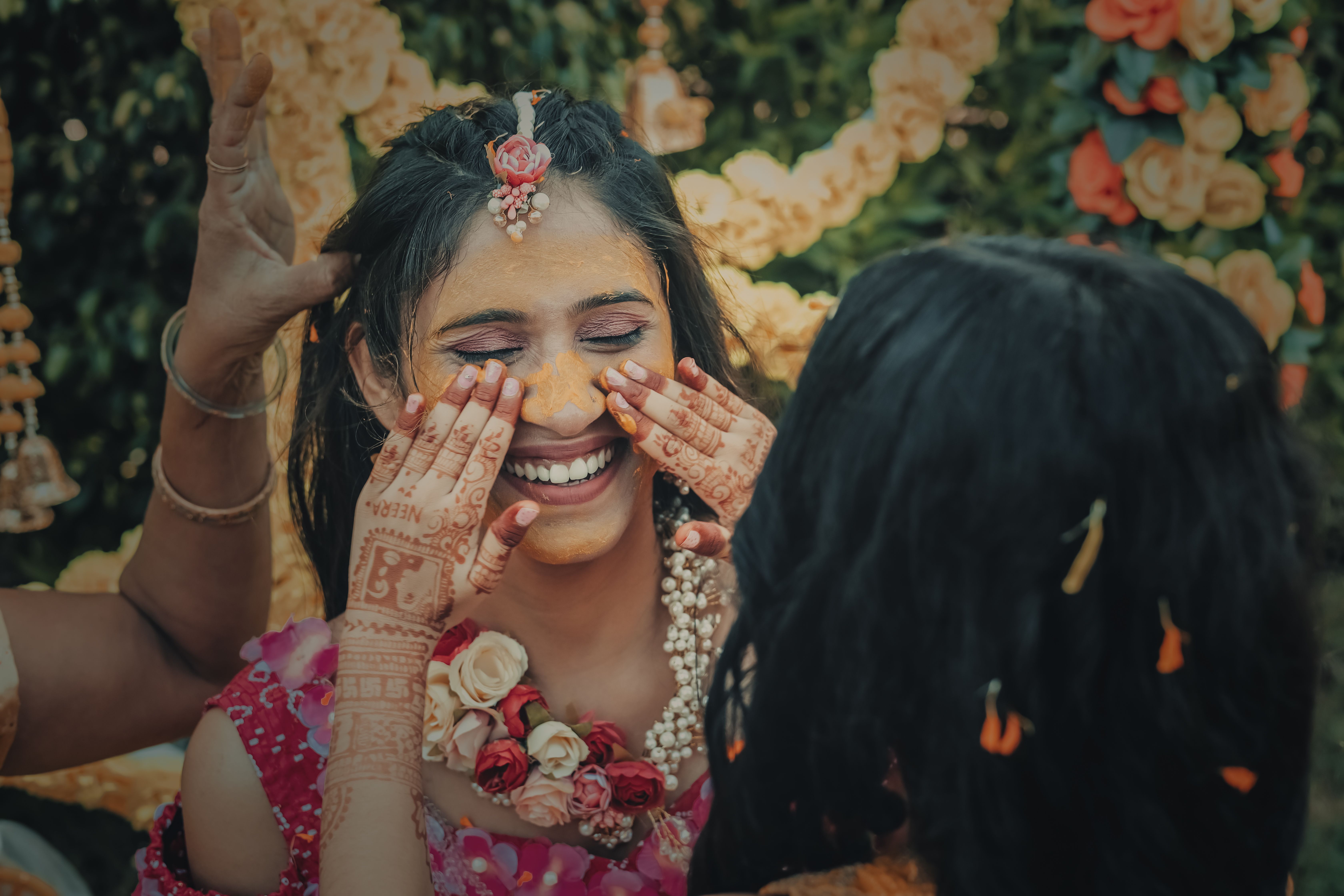
Haldi
Come add colour to our joy!
Join us for the Haldi ceremony of [Name]
[Date] · [Time] · [Venue]
(Wear yellow — you're going to get a little messy!)
Mehendi
Where there's mehendi, there's music.
You're invited to [Name]'s Mehendi ceremony
[Date] · [Time] · [Venue]
Sangeet
An evening of music, dance and dhol!
Join us for the Sangeet as we celebrate [Name] & [Name]
[Date] · [Time] · [Venue]
Reception
॥ Shree Ganeshaya Namah ॥
Mr. & Mrs. [Groom's parents] request the pleasure of your company
at the Wedding Reception of
[Groom's Name] & [Bride's Name]
[Date] · [Time] · [Venue]
Dinner to follow.
Hindi, English, or Both?
This trips people up, so here's a straight answer based on who's receiving the card:
| Your guest list | Best choice |
|---|---|
| Mostly elders and extended family | Hindi (or your regional language) as the main text |
| Mix of family and younger/urban friends | Both — Hindi invocation and headline, English details |
| Mostly friends, colleagues, destination guests | English, with the Hindi invocation kept at the top for tradition |
The most popular option for 2026 weddings is the bilingual card: the Hindi invocation and the couple's names in a decorative Hindi or Devanagari-style font, with dates, venue, and RSVP details in clean English underneath. It respects tradition and stays readable for everyone.
Small Details That Make a Card Feel Right
- Order of names: elders' names usually come before the couple's, and by convention the father's name precedes the mother's — though many families now list both parents together as equals. Do what feels true to your family.
- "Sa-parivar": adding सपरिवार (with family) after the guest's name is a warm, traditional way to invite the whole household.
- RSVP line: if you want headcounts, add a simple line — "Kindly confirm your presence by [date]." Digital cards make this easier because guests can tap to confirm instead of calling; most invitation platforms, Eventic included, build the RSVP button straight into the card.
- Muhurat vs. reception time: if your wedding has a specific muhurat (auspicious time), print it — but consider adding a friendlier "guests requested by" time for the reception, since muhurats can fall at 2 a.m.
People Also Asked
Explore common questions related to this blog.