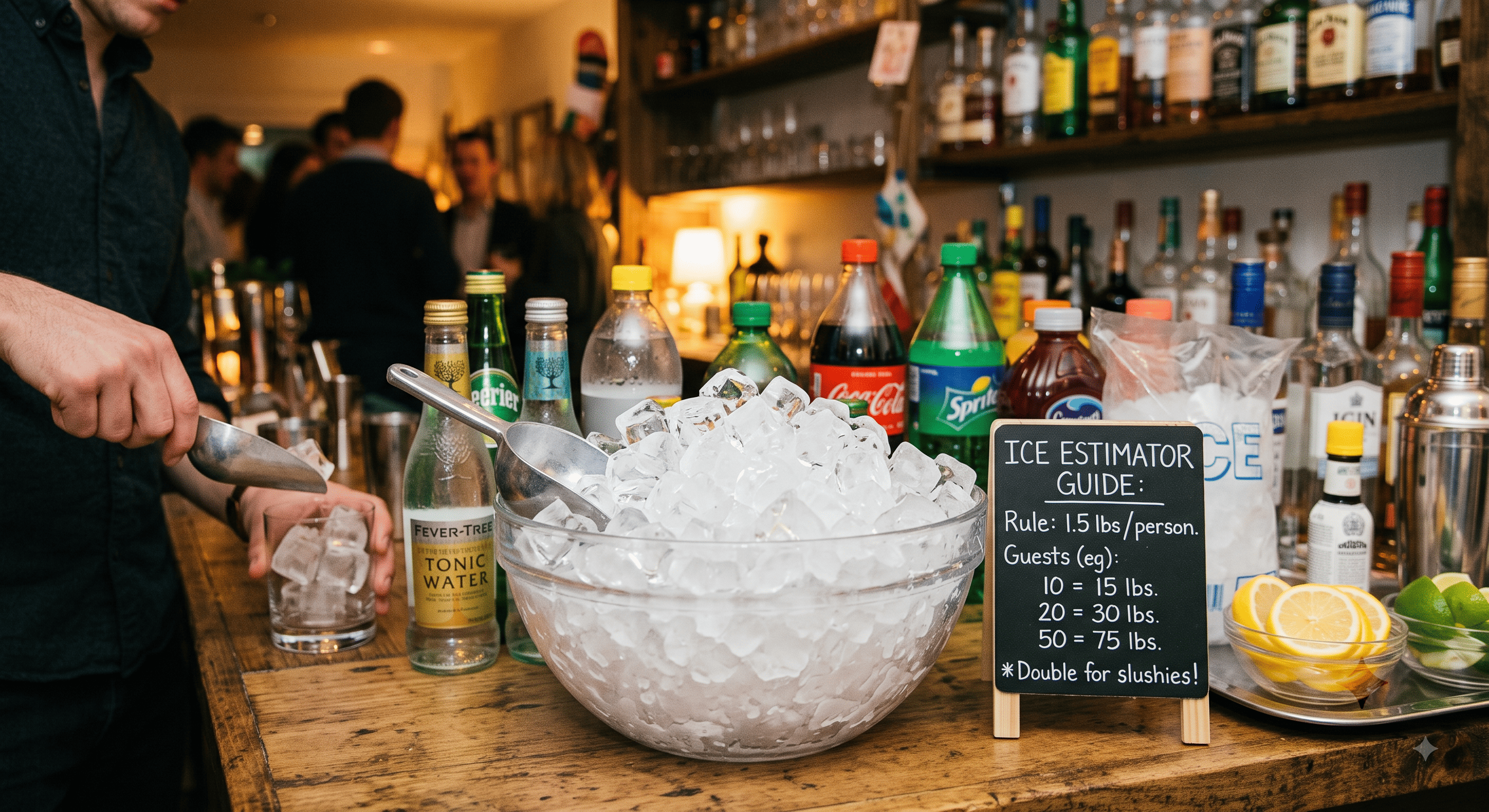
Plan 1.5 lbs of ice per person for a standard indoor party, 2 lbs per person for a summer outdoor event, and 2.5 lbs if it's all day or you have no freezer access on site.
For 50 guests that's 75 lbs. For 100 guests, 150 lbs — around 15 to 20 bags, which is considerably more than fits in a home freezer and a great deal more than most hosts buy.
Ice is the most reliably underestimated item at any party, and it's the one that sends someone to the store mid-event. The FDA notes that the average American buys four bags of packaged ice a year, 80% of it between Memorial Day and Labor Day — so most people are planning summer ice quantities from a baseline of almost no experience.
Here's how much you need, where it actually goes, and how to keep it from melting into a tub of lukewarm water by hour two. The party drink calculator includes ice alongside your drink order, and the complete alcohol guide covers everything else the bar needs.
How much ice per person
| Event type | Per person | 50 guests | 100 guests |
|---|---|---|---|
| Indoor, cool weather | 1.5 lbs | 75 lbs | 150 lbs |
| Indoor, warm weather | 1.75 lbs | 88 lbs | 175 lbs |
| Outdoor, spring/fall | 2 lbs | 100 lbs | 200 lbs |
| Outdoor, summer heat | 2.5 lbs | 125 lbs | 250 lbs |
| All-day event | 3 lbs | 150 lbs | 300 lbs |
| Cocktail-heavy bar | +0.5 lbs | +25 lbs | +50 lbs |
Why cocktails need more
A cocktail is built on ice, shaken with ice, then strained over fresh ice — roughly three times the ice of a beer or a glass of wine. If you're running a full bar rather than beer and wine, add half a pound per person before you do anything else. The same staffing and supply gap shows up in the open bar cost comparison, where mixers and ice are a meaningful part of why a full bar costs more.
Where the ice actually goes
This is the breakdown nobody thinks through, and it's why 1.5 lbs per person feels like too much until you see it laid out.
| Use | Share | 100 guests |
|---|---|---|
| Ice in drinks | 30% | 45 lbs |
| Chilling beer and cans | 30% | 45 lbs |
| Chilling wine and bottles | 20% | 30 lbs |
| Food, coolers, backup | 20% | 30 lbs |
Only about a third goes into glasses. The rest is doing the work of a refrigerator you don't have.
Chilling ratios
Coolers and tubs: a 2:1 ratio of ice to contents by volume. A 48-quart cooler filled with cans needs about 30 lbs of ice to chill them properly.
Keg tub: 40–50 lbs for a half barrel, and it'll need topping up after two or three hours.
Wine tub: about 20 lbs chills a dozen bottles.
Bag sizes and how many to buy
| Bag size | Where you'll find it | Bags for 150 lbs |
|---|---|---|
| 5 lb | Convenience stores | 30 |
| 7 lb | Most supermarkets | 21 |
| 10 lb | Supermarkets, big box | 15 |
| 16–20 lb | Big box, ice houses | 8–9 |
Buy the largest bags available — fewer trips, less packaging, and usually a lower price per pound.
For 200+ lbs, call an ice supplier
Local ice companies deliver in 20 or 40 lb bags and often supply insulated tubs. For a 150-guest event this is cheaper per pound than the supermarket and removes the transport problem entirely. Order two days out.
What it costs
| Source | Per lb | 150 lbs |
|---|---|---|
| Convenience store | $0.45–$0.70 | $70–$105 |
| Supermarket | $0.30–$0.45 | $45–$68 |
| Big box (Costco, Sam's) | $0.20–$0.30 | $30–$45 |
| Ice supplier delivery | $0.18–$0.28 + fee | $30–$60 |
Ice is cheap and the consequences of running out are annoying, so this is a place to over-buy without thinking hard about it. An extra 20% costs under $15 for most events.
Types of ice
Cubed
The default. Goes in drinks, fills coolers, does everything adequately.
Block
Melts three to four times slower than cubes because of the lower surface area. Excellent for coolers and tubs where you need cold to last, useless in a glass. A hybrid approach works best for long outdoor events: block ice at the bottom of the cooler, cubes on top.
Crushed
Only if your cocktail list calls for it. Melts fastest of all.
Dry ice
For fog effects and serious cold, not for drinks. It sits at −109°F and requires real care: insulated gloves for handling, a ventilated space since it sublimates into CO₂, and never a sealed container, which can rupture from pressure. It must never go into a drink or be swallowed — direct contact causes rapid tissue damage. If you're using it for atmosphere, keep it well away from where guests will reach.
Keeping it from melting
Store it right
Buy it the morning of. Not the day before. A home freezer holds about two bags, and the rest will start melting the moment it's stacked anywhere else.
Coolers over tubs, where possible. A sealed cooler in shade holds ice for 24 to 48 hours. An open tub in 85°F sun is down to water in three or four.
Pre-chill the cooler. A warm cooler burns through the first several pounds just cooling its own walls. Sacrifice a bag an hour ahead, dump the meltwater, then load properly.
Keep it out of the sun. Obvious, and routinely ignored. Ice under a table stays frozen dramatically longer than ice on one.
Don't drain the meltwater from a chilling tub. Counterintuitive, but ice water chills faster than ice alone, because water makes contact with the whole bottle. Drain it from a cooler holding food; leave it in a tub holding drinks.
The fastest way to chill warm bottles
Ice, water, and a generous handful of salt. Salt lowers the freezing point of the water, and a warm bottle drops to serving temperature in 15 to 20 minutes — versus two to three hours in a refrigerator. It's the single most useful thing to know when guests arrive and the white wine is still room temperature.
Separate your ice
Drinking ice and chilling ice should never mix. The ice you pack bottles into gets handled, sits in meltwater with bottle labels and dirt, and shouldn't end up in a glass.
The FDA classifies ice for consumption as a food, subject to the same handling standards as anything else you serve. In practice that means: keep drinking ice in a separate, covered container, serve it with a scoop or tongs rather than hands or a glass, and never let guests dip a used glass into the ice bin. Standard practice at any bar, and worth enforcing at home.
Ice also doesn't sterilise anything — cold slows bacteria rather than killing it, so the same food safety basics that govern your buffet apply to anything you're chilling on ice.
Quick reference: 100 guests, outdoor summer party
| Purpose | Amount |
|---|---|
| Beer cooler | 60 lbs |
| Wine and mixer tub | 40 lbs |
| Drinking ice (covered, separate) | 60 lbs |
| Food and backup | 40 lbs |
| Total | 200 lbs |
That's ten 20 lb bags, four to six coolers or tubs, and a delivery worth arranging rather than fitting into a car. The full 100-guest shopping list puts this alongside the beer, wine, and spirits so you can order everything in one pass.
People Also Asked
Explore common questions related to this blog.