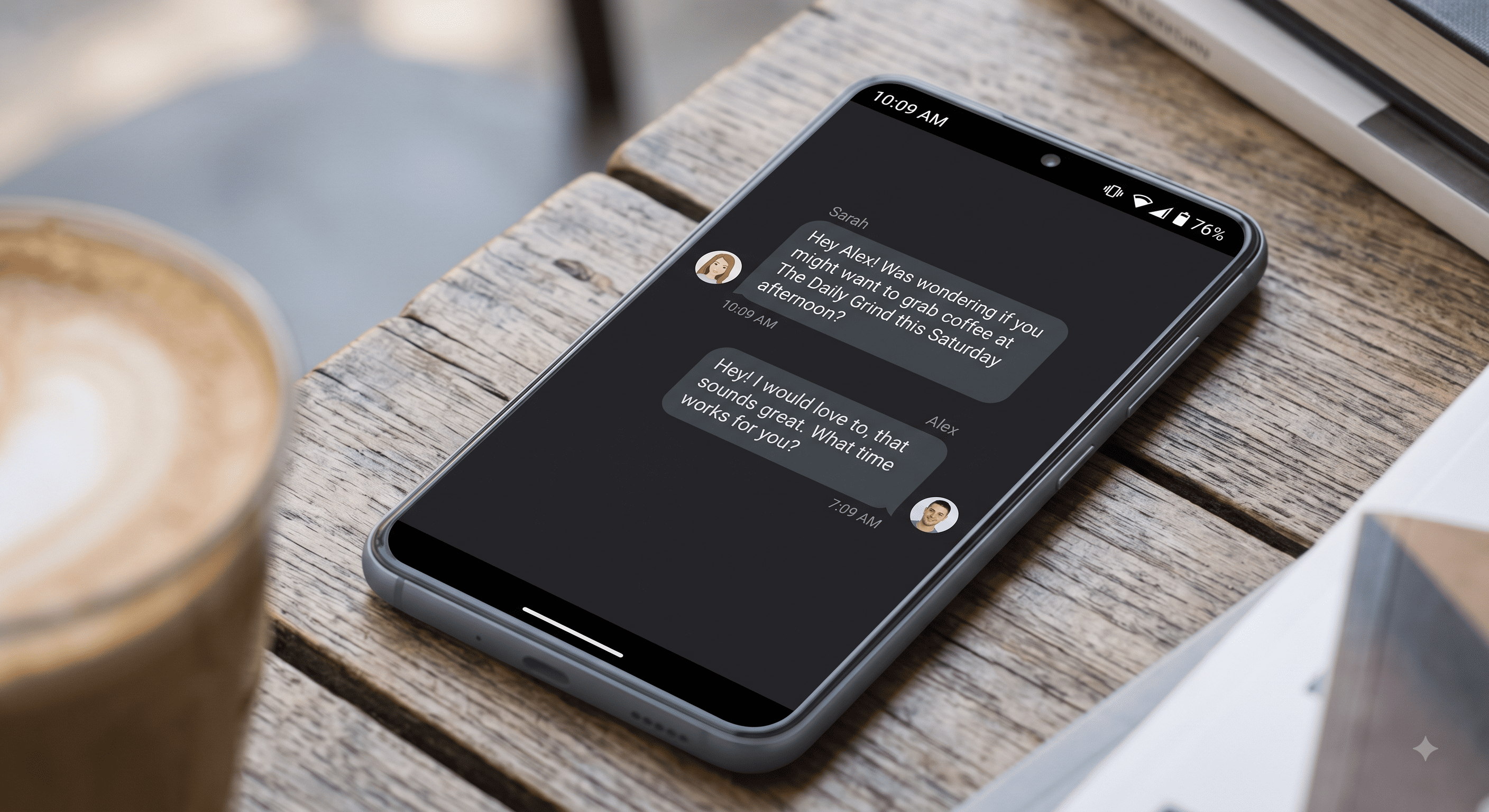
The correct response to a no is one sentence: "No worries at all — thanks for being straight with me." Then you stop.
That's genuinely the whole thing. Everything below is why it's harder than it sounds, how to ask in a way that makes a no easy to give, and what to do with yourself afterwards.
Part one: asking well
Most of the damage in these situations is done before the answer arrives. An ask that leaves someone no clean way to decline puts them in an awkward position, and awkward positions produce vague answers rather than honest ones.
Ask privately
Never in front of people. A public ask creates pressure to say yes in front of an audience, and a yes given under that pressure isn't a yes worth having. It also means their no becomes a public event, which is unkind.
This applies to group chats, workplaces, and anything filmed.
Give them an exit
Adding "no worries either way" or "just tell me straight" costs you nothing and does two things: it makes an honest answer easier, and it makes you look secure rather than invested past reason.
Be specific
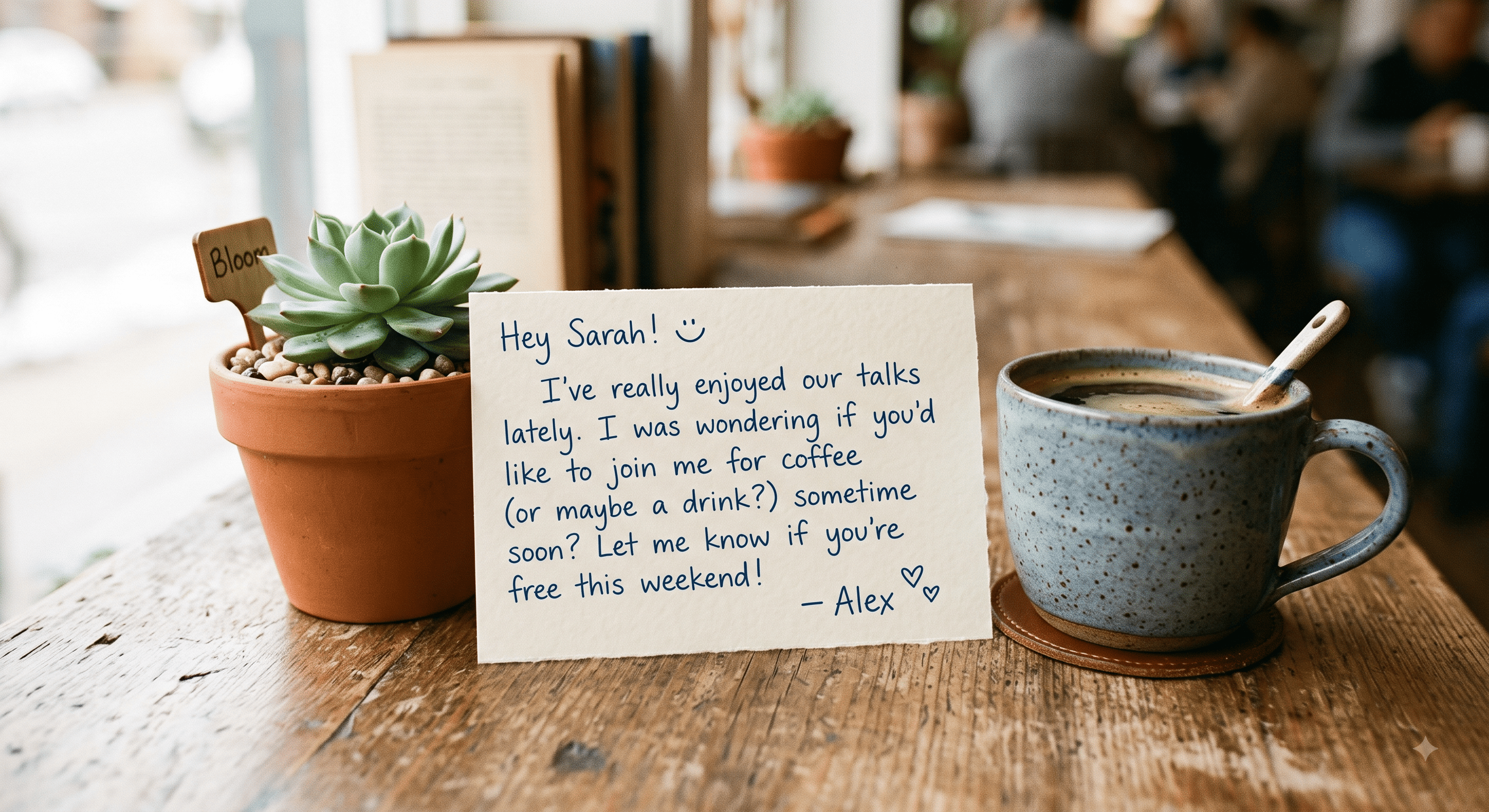
"We should hang out sometime" isn't an ask — it's an ambiguity that leaves them guessing what they're declining. Name a plan, name a day, and say the word date.
The pillar guide covers the full formula, and there are 50 ways to ask if you want something with more thought in it.
Scale the ask to the relationship
A grand gesture toward someone you've spoken to twice isn't romantic, it's pressure. The bigger the ask, the harder it is to refuse — which is exactly the problem.
Ask once
Once is asking. Twice is pushing. There is no third.
This is the rule people most want an exception to, and there isn't one. "But she said she was busy" — accept it. If someone wants to reschedule, they will say so.
Accept a soft no as a no
Not everyone can say the word. Treat all of these as a decline:
- "I'm really busy at the moment"
- "Let's see"
- "Maybe sometime"
- "I'll let you know"
- No reply after two or three days
Pressing someone to say it more clearly is asking them to hurt you precisely. Don't.
Part two: when the answer is no
What to say
"No worries at all — thanks for being straight with me."
Or:
"All good. Glad I asked."
Send it, and don't send anything else. A short, unbothered reply is the version of you they'll remember.
What not to do
| Don't | Why |
|---|---|
| Ask why | They don't owe a reason, and pressing turns a clean no into a bad memory |
| Explain what you meant | It reads as negotiating |
| Send a long message about your feelings | Puts the burden of your disappointment on them |
| Ask again later | Once is the rule |
| Say "we can just be friends?" immediately | Let it settle first |
| Go cold or dramatic | Especially if you share a friend group |
| Vent about them to mutuals | It gets back, always |
| Block them | Unless they've behaved badly, this makes a small thing large |
The single most common mistake is the follow-up paragraph — the one clarifying that you weren't that invested, or that you meant something slightly different. It's written to relieve your own discomfort, and it lands as the opposite of what it intends.
Why it hurts more than seems reasonable
Because it is, in a measurable sense, painful.
Researchers at Michigan found that when rejection is strongly elicited, brain regions supporting the sensory components of physical pain become active — the secondary somatosensory cortex and dorsal posterior insula, areas the authors noted are almost never associated with emotion alone. Comparing the activation against a database of over 500 studies, the pattern was highly diagnostic of physical pain.
The study used people recovering from unwanted breakups, so it's a stronger elicitation than a declined coffee. But the mechanism is the same one, and it explains something useful: you're not overreacting. Rejection registers in the body. Telling yourself it shouldn't sting is arguing with your own neurology.
What follows from that is practical. Treat it like a minor injury — expect it to hurt for a bit, don't poke it, and let it heal on the normal timeline rather than demanding it stop immediately.
The next few days
Expect two or three bad days. For a crush you never dated, that's roughly the shape of it. Longer if you'd built it up for months.
Don't reread the conversation. You'll find meanings that aren't there.
Don't check their profile. Mute if you need to. Muting isn't dramatic; it's maintenance.
Tell one person, not five. Saying it out loud once helps. Saying it repeatedly rehearses it.
Do something physical. Walk, gym, anything. Not as a metaphor — it genuinely helps.
Don't immediately ask someone else to prove something to yourself. It's unfair to them and it doesn't work.
What not to conclude
A no means you weren't a match for one person at one time. It doesn't mean:
- Something is wrong with you
- You shouldn't have asked
- You'll get the same answer next time
- They think badly of you
Most people's honest reason is some version of "not feeling it," which is about compatibility and isn't a judgment you can fix or argue with.
If you share a friend group or workplace
The hardest version, and the one where behaviour matters most.
Be normal. Not overly friendly, not cold. Normal.
Don't make others manage it. Asking mutual friends to pass messages or explain how you're feeling puts them in an impossible position.
Give yourself distance if you need it — skip a couple of gatherings. Just don't announce that you're doing it.
Don't bring it up again. Not after a drink, not months later, not as a joke.
Handled well, this is a thing nobody remembers in six weeks. Handled badly, it's a thing you're known for.
When you're the one saying no
Rarely covered, and worth getting right.
Be clear. "I'm flattered, but I don't feel the same way" is kinder than three weeks of vagueness. Ambiguity feels gentler and isn't.
Be quick. Don't leave someone waiting a week while you find perfect wording.
Don't over-explain. A reason invites a counter-argument. "I don't feel that way about you" is complete.
Don't offer friendship as a consolation in the same message. If you want to stay friends, let that re-emerge later on its own.
You don't owe a yes for any reason — not for effort, not for a gift, not for a public gesture, not for a long friendship. Kindness is in how you decline, not whether you do.
If they don't accept it, stop replying. You've been clear once; you don't have to be clear five times. If it continues after that, that's not persistence, and you're entitled to block, tell someone, or escalate it.
Asking again, later
Almost never. But if all of these are true, it's not unreasonable:
- Substantial time has passed — many months, not weeks
- Circumstances have genuinely changed for them
- They've shown clear interest since, unprompted
- You accepted the first no completely, with no lingering weirdness
If you're checking this list looking for permission, the answer is probably no. Wanting it badly isn't evidence.
When it's hitting harder than you expected
Sometimes a rejection lands on top of things that were already heavy — loneliness, a rough stretch, a sense that this keeps happening. If a no is bringing up feelings much bigger than the situation, or you're finding it hard to function afterwards, that's worth taking seriously rather than pushing through.
Talking to someone you trust helps more than most people expect. If it's persistent, a counsellor is a reasonable and unremarkable thing to see. And if you're having thoughts of harming yourself, please reach out to someone now — a friend, a family member, or a helpline in your country. That's not an overreaction to ask for.
Ask privately, ask once, and give them an easy way out. If the answer is no, say thanks and move on — and let it hurt for a few days without treating that as a failure.
The rest of the cluster, if you're at the earlier stage: how to ask, what to say over text, and where to actually go if the answer's yes.
People Also Asked
Explore common questions related to this blog.