You've written the host line four times. Each version either leaves your dad out completely or makes the invitation read like a memorial card. Neither one is what you want, and there doesn't seem to be a middle.
There is. It's mostly a matter of two small words and where you put them.
This is one of the harder branches of the full wedding invitation wording guide, and there's genuinely no single correct answer — only options that feel right to different families.
First, the question underneath the question
Most people asking this aren't really asking about grammar. They're asking: is it appropriate to mention my parent at all, or does it make things heavy for everyone else?
It's appropriate. It has always been appropriate. Weddings have carried the names of absent parents for as long as there have been wedding invitations, and no guest has ever received one and thought "how morbid."
What guests do notice is length. A single line reads as love. Four lines reads as a eulogy, and people don't know where to put their faces. So the constraint isn't taste — it's proportion.
Option 1: "The late" in the host or parentage line
The most traditional approach, and the least conspicuous.
Amelia Rose daughter of Priya Chen and the late David Chen and Jonah Patel request the pleasure of your company
Variations:
- "Amelia Rose Chen, daughter of Mrs. Priya Chen and the late Mr. David Chen"
- "Amelia, daughter of Priya Chen and the late David Chen, and Jonah, son of Ravi and Meera Patel"
- "Together with her mother, Priya Chen, and in loving memory of her father, David Chen"
A note on grammar that trips people: "the late" never appears in a host line, because a person who has died cannot host. Write "Mrs. Priya Chen requests the honour of your presence at the marriage of her daughter Amelia Rose, daughter also of the late David Chen" — or simply move the mention below the host line, which is cleaner and what most stationers will recommend.
Option 2: A remembrance line beneath the couple's names
My favorite of the formats, because it separates the logistics from the feeling.
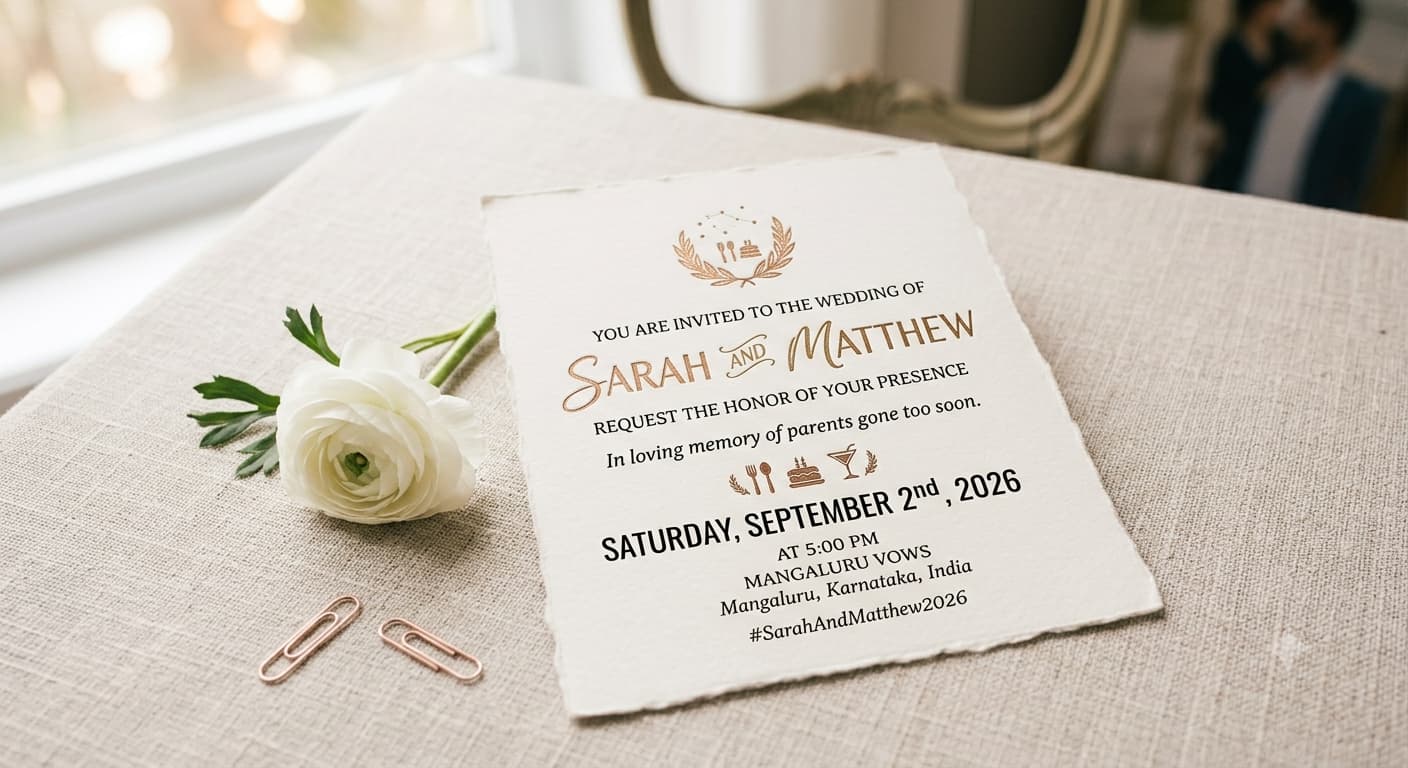
Amelia Chen and Jonah Patel invite you to celebrate their marriage lovingly remembering David Chen Saturday, the fourteenth of June
Other one-line phrasings:
- "in loving memory of David Chen"
- "with loving remembrance of her father, David Chen"
- "held always in our hearts — David Chen, 1961–2019"
- "whose love brought us here — David Chen"
- "remembering those who could not be with us today"
That last one is worth knowing about. If you've lost more than one family member, or if your partner has too, a single collective line covers everyone without turning the invitation into a list.
Option 3: Both parents have died
Amelia Rose Chen daughter of the late David and Priya Chen and Jonah Patel invite you to share in their joy
Or, with a guardian, grandparent or sibling stepping in as host:
- "Mr. and Mrs. Raj Chen request the honour of your presence at the marriage of their niece, Amelia Rose, daughter of the late David and Priya Chen"
- "Amelia Rose Chen, daughter of the late David and Priya Chen, together with her grandparents, invites you…"
Option 4: Keep the invitation clean, honor them at the ceremony
A genuinely valid choice that people forget is on the table. Not every remembrance has to be printed on the invitation.
Alternatives that carry more weight than a line of text:
- A named seat with a single flower on it
- A line in the ceremony program: "Today we remember David Chen, who is with us in every way that matters"
- Their favorite hymn or song during the processional
- A photo locket on the bouquet, or a piece of their fabric sewn into a dress lining
- A moment of silence, or their name read aloud during the welcome
- A dish they loved on the dinner menu, unlabelled, just for you
Several of these will mean more to you on the day than anything the invitation could have said. The invitation gets read once, in a hallway, next to a stack of bills.
Where a remembrance should never go
Not in the host line. As above — hosts are living people.
Not on the RSVP card. Guests are filling in a chicken-or-fish box. It's jarring.
Not on the save-the-date. Save-the-dates are logistics, sent early, often to people who don't know your family well.
Not as a long paragraph. One line. If you need more space, that's what the program is for, and a program can hold a full paragraph beautifully.
When it's a grandparent, sibling, or your partner's parent
The same formats work, with a couple of adjustments.
Grandparents. Usually honored in the program rather than the invitation, simply because the invitation's parentage line is about parents. If a grandparent raised you, though, they belong exactly where a parent would go — "granddaughter of the late Margaret Chen" reads perfectly.
A sibling. The invitation is rarely the right place. A sibling's absence is felt most at the ceremony and reception, and that's where a remembrance lands better — an empty seat, a song, a line in the program.
Your partner's parent. Follow their lead entirely. Ask once, early, in a low-stakes moment: "Do you want your dad's name on the invitation, and how would you want it worded?" Then do exactly what they say and don't revisit it. This is one of the few wedding decisions that genuinely belongs to one person.
Both partners have lost a parent. A single shared line usually reads better than two separate ones: "In loving memory of David Chen and Meera Patel." Two separate remembrance lines start to make the card feel weighted toward loss.
Check it with your family first
Show the wording to the surviving parent, or to your closest sibling, before it goes anywhere near a printer.
Not for approval, exactly. For the thing you can't see from inside your own grief: whether the phrasing sounds like your parent. Families have a shared sense of what a person would have found nice and what they'd have found overblown, and someone else in the family will know instantly whether "held always in our hearts" is right or whether your dad would have laughed at it.
That's also a genuinely lovely conversation to have while planning a wedding, which is not something you'd expect from a stationery decision.
Formality reference
| Tone of your invitation | Remembrance phrasing |
|---|---|
| Formal, traditional | daughter of Priya Chen and the late David Chen |
| Semi-formal | lovingly remembering her father, David Chen |
| Warm, modern | in loving memory of David Chen |
| Casual | thinking of Dad today |
| Multiple losses | remembering those we carry with us |
Match the register to the rest of the card. A very casual invitation with a formal Victorian remembrance line reads as borrowed, and a stiff invitation with "thinking of Dad" reads as a slip.
A practical note on proofing
Read the finished wording aloud before you print. Not silently — aloud, to your partner or a sibling.
Grief has a way of hiding inside phrasing that looked fine on a screen. Sometimes a line you wrote at midnight turns out to be unbearable to hear, and sometimes one you thought was too plain turns out to be exactly right. Reading it out is the only reliable test I know of.
If your family is spread out and you want several people to see the draft before anything's committed, a digital proof is easier than posting samples around — Eventic's wedding invitation templates let you share a live version so your mother and your aunt can read the same wording on their phones and tell you honestly whether it lands.
And give yourself more time than the schedule suggests. This particular line is not one to write in the final week before the print deadline.
What guests will actually do
They'll read it, pause for a second, and think about your parent for a moment. Some will mention it to you at the reception. Several will tell you a story about them that you've never heard.
That's the real function of a remembrance line, and it's a good one. It gives people permission to bring your parent up, which most of them have been quietly wanting to do and haven't known how.
Whatever you print, print one extra and keep it. Years from now, that card with their name on it becomes one of the objects you're glad you have.
People Also Asked
Explore common questions related to this blog.
No. Hosts are the living people inviting guests. Use "the late" in a parentage line or a separate remembrance line instead.
Same formats apply, and it's their call on the phrasing. Ask once, then follow their lead entirely.
No. Save-the-dates are short logistical notices. Keep the remembrance for the invitation, program, or ceremony.
It can be. "In loving memory of Dave" fits a casual invitation better, and there's no rule saying you must use the traditional phrasing.