Halloween Party RSVP: How to Get a Headcount People Actually Give You
Set an RSVP deadline a week before the party — Saturday 24 October for a 31 October 2026 party — and make replying a single tap rather than a form. Send one nudge to non-responders three days before the deadline, phrased as a practical reason ("doing the food shop this weekend, are you in?"). Expect 60–80% of your yeses to actually turn up and budget for a few extras who never replied. Track replies in one place; chasing forty people across texts, DMs and a group chat is what actually breaks, not the asking.
This is part of the Halloween party invitations guide, which covers the invitation itself and the full timeline.
Some links below are Amazon affiliate links. If you buy through them, Eventic earns a small commission at no extra cost to you — it doesn't change what gets recommended here.
You've invited forty people. Eleven have said yes, four have said no, and twenty-five have reacted to the message with a thumbs-up emoji, which means nothing at all.
Why Halloween RSVPs are worse than every other party's
Because the perceived stakes are low and the actual stakes are high.
Nobody thinks skipping a Halloween RSVP matters. It's not a wedding; there's no seating plan, no per-head catering charge, no dietary form. So people mentally file it as "I'll decide nearer the time" — which, for a meaningful percentage, means deciding at 7pm on the day based on the weather and whether they can be bothered with the costume.
Meanwhile you, the host, are buying food, drink and candy for a number you're guessing at. Overshoot and you've spent a hundred dollars on snacks that go stale. Undershoot and you run out of drink at half nine.
Two more Halloween-specific factors:
Costume anxiety causes silence. A surprising share of non-responders aren't undecided about the party — they're undecided about the costume, and replying "yes" feels like committing to an effort they haven't figured out yet. Lowering the costume bar in your nudge message genuinely converts some of these.
Everyone has multiple options. Halloween 2026 is a Saturday. Your guests are quite possibly holding two invitations and waiting to see which one sounds better, which is unflattering but true, and which means a vague invitation loses to a specific one.
The four things that actually improve response rates
Not more messages. These:
1. A deadline with a reason attached. "RSVP by 24 October" gets ignored. "Let us know by 24 October so we know how much punch to make" gets replies, because it explains what your knowing is for. People respond to being needed, not to being asked.
2. One tap to reply. Every extra step costs you responses. A form with name, email and dietary requirements for a house party is where RSVPs go to die. A yes/no button, or a message you can answer with one word, is the whole design brief.
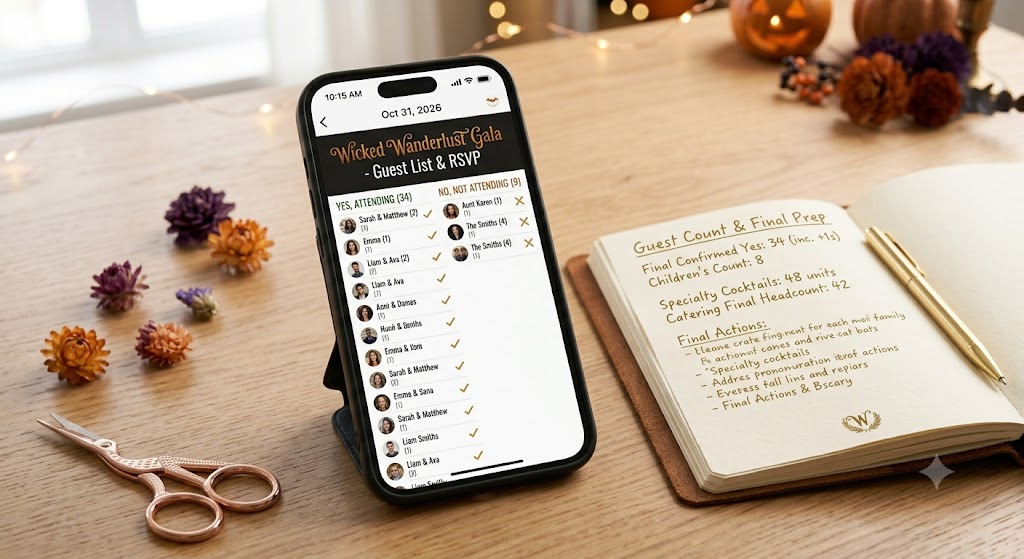
3. All replies in one place. This is the part hosts underestimate. The asking isn't hard — the counting is. When four people reply in the group chat, six by text, three on Instagram and two in person at work, you don't have a headcount, you have a research project. A digital invitation with RSVP tracking exists precisely because this is the thing that breaks, and it's the difference between knowing your number and estimating it.
4. A start time that sounds like a plan. "8pm onwards" gets fewer commitments than "8pm, costume contest at 10." Specificity signals that the party is real and organised, which makes committing feel safer.
The RSVP timeline for Halloween 2026
| Date | Action |
|---|---|
| 3–10 October | Send the invitation with the deadline visible on it |
| 17 October | Checkpoint — note who's silent. Don't chase yet |
| 21 October (Wed) | One nudge to non-responders only |
| 24 October (Sat) | RSVP deadline. Count. Add your buffer |
| 25–28 October | Shop for the real number |
| 29 October (Thu) | Reminder to everyone who said yes — address, time, parking |
The full version of this with the save-the-date and reminder timings is in when to send Halloween party invitations.
Two things to notice. First, there's only one nudge. A second and third chase teaches people that your deadlines don't mean anything, and it makes you the host who nags. Second, the deadline sits a full week before the party, not two days — because the entire point of a headcount is to shop with it, and shopping on the 29th means the good stuff is gone.
The nudge message that works
Short, practical, and aimed only at the people who haven't replied.
"Hey! Doing the food and drink shop this weekend for Saturday — are you in? Just need a yes or no, no hard feelings either way."
Why this works: it gives a concrete reason for needing to know, it explicitly permits a no, and it asks for the smallest possible response. "No hard feelings either way" does more work than anything else in the message — it removes the social cost of declining, and a clear no is worth as much to you as a yes.
Variants for specific situations:
For the costume-anxious: "Quick one — are you coming Saturday? And don't stress about the costume, half the people coming are wearing a hat and calling it a day."
For the serial maybe: "Putting you down as a maybe unless I hear otherwise — just shout if that's wrong. Either way is completely fine." This flips the burden without pressure, and it usually produces an actual answer.
For a large or group-chat invitation: "Doing numbers tomorrow — if you haven't replied yet, a thumbs up or down on the invite is all I need. 🙏"
What not to send: anything that reads as guilt. "Still waiting to hear from a lot of you!!" makes people less likely to reply, not more, because now replying means acknowledging they were rude.
What the numbers actually mean
Your RSVP list is not your headcount. It's an input to your headcount.
Realistic conversion, based on how house parties actually behave:
| Reply | Roughly what turns up |
|---|---|
| Yes | 70–85% |
| Maybe | 25–40% |
| No reply at all | 5–15% |
| No | ~0%, but occasionally somebody's plans fall through |
So a party with 30 yeses, 8 maybes and 12 silent people lands somewhere around 25 to 30 actual humans. The variance is wide, and it's driven mostly by weather and by whether a competing party exists.
The planning number to use: total your yeses at 80%, add a third of your maybes, then add five. The plus-five is the friend-of-a-friend, the partner nobody mentioned, and the neighbour who saw the decorations. They are not a hypothetical.
For turning that number into a shopping list, Halloween party food and punch amounts has the seasonal quantities, and the party food calculator and drink calculator do the arithmetic for any headcount. If you're also answering the door to trick-or-treaters, that's an entirely separate number — the candy calculator handles it, and it's almost always more than people guess.
Handling the awkward RSVP situations
The plus-one nobody asked about. Prevent it on the invitation: "this invite is for you and a plus-one" or "spaces are tight so it's just you this time." If it happens anyway, let it go on the night — the party is not the moment to enforce it.
"Can I bring my kids?" at an adults-only party. Answer once, warmly, without making an exception; the adults-only wording guide has the exact reply that works and explains why one exception becomes four.
Someone says yes and then goes quiet. Treat the 29 October reminder as their exit ramp. A lot of soft cancellations happen at that point, which is exactly what you want — better on Thursday than an empty gap on Saturday.
Someone cancels on the day. It's Halloween, not a wedding. Say "no worries, next time" and mean it. Hosts who make cancellation costly get fewer honest RSVPs the following year, which is the actual long-term price.
Nobody's replying at all. Usually a signal that the invitation lacked specifics — no end time, no costume rule, no reason to reply. Send a shorter, sharper follow-up with the details firmed up, and treat it as information for next time rather than a personal slight.
Should you use a form, a group chat, or an invitation page?
Depends entirely on size, and the threshold is lower than people think.
| Guests | Best method | Why |
|---|---|---|
| Under 15 | Group chat or individual texts | You can count in your head; a form is overkill and feels formal |
| 15–40 | Digital invitation with RSVP | The counting breaks here. This is the range where hosts lose track |
| 40+ | Digital invitation, non-negotiable | Manual tracking at this size is a genuine part-time job |
| Community / school event | Sign-up sheet with a headcount field | You need names and often volunteers, not just numbers |
The 15-guest line is where most people get caught out. They've always done group chats, the party grows a bit each year, and one October they realise they're scrolling back through 200 messages trying to work out whether Dan said yes. That's the point to switch — you can build a Halloween invite with RSVPs attached in Eventic's templates and paste one link into the same group chat you were already using.
Two things that help on the night itself
An RSVP count gets you to the door. After that, two cheap objects do more for a party than most people expect.
A guest book or sign-in board sounds like a wedding thing, and at a Halloween party it's much better — people sign it in character, and you end up with a genuine record of who actually came, which is the headcount data you'll want next October. It's the closest thing to a real attendance figure you'll ever get.

As an Amazon Associate, we may earn from qualifying purchases.
The other is reusable drink markers or cup tags. At a party where a third of the room is in a mask, people abandon drinks constantly and then pour new ones, and you burn through glassware and drink at roughly double the rate you planned for. Markers cut that noticeably, which means your carefully calculated punch quantity survives contact with reality.

As an Amazon Associate, we may earn from qualifying purchases.
Set the deadline a week out, give it a reason, nudge once, and count in one place. That's the entire system, and it turns a guessing game into a number you can shop with.
People Also Asked
Explore common questions related to this blog.
A week before — Saturday 24 October for a 31 October 2026 party. That gives you time to send one nudge and then shop with a real number. Deadlines set two or three days out leave you buying on the 29th, when the good candy has already sold out.
Send one message, to non-responders only, with a practical reason and explicit permission to decline: "Doing the food shop this weekend — are you in? No hard feelings either way." One nudge, not three. Repeated chasing lowers response rates rather than raising them.
Yes, though it's the most-forgiven version of it, because the occasion feels casual. As a host, the fix is structural rather than moral: give a reason for the deadline, make replying one tap, and accept that a small number of people will always leave you guessing.