Wedding Card Printing Cost by City: Delhi, Mumbai, Bengaluru & More
Heads up: some links in this post are Amazon affiliate links — if you buy through them, Eventic earns a small commission at no extra cost to you.
The same wedding card — 300 GSM, gold foil, three inserts, matching envelope — was quoted to two friends of mine last season. One in Chandni Chowk, one in a Bengaluru mall showroom. The Delhi quote was ₹95. The Bengaluru quote was ₹210.
Identical card. Same month. That gap is the whole reason this article exists.
Wedding card printing in India is a wholesale market pretending to be a retail one, and where you buy changes the price more than what you buy. Here's the city-by-city picture for 2026, and when it's worth ordering from a city you don't live in. For the wider budget context, this sits under our full guide to invitation costs in India.
City-by-city rate card, 2026
Rates are per card for a mid-range order: 250–300 cards, 250–300 GSM, one motif in gold foil, two inserts, printed envelope.
| City | Standard card | Premium card | Notes |
|---|---|---|---|
| Delhi (Chandni Chowk / Chawri Bazaar) | ₹35–₹70 | ₹90–₹180 | Cheapest in the country. Wholesale hub — most other cities buy from here |
| Ahmedabad | ₹40–₹75 | ₹100–₹200 | Strong printing base, good foiling work |
| Jaipur | ₹45–₹85 | ₹120–₹250 | Best for traditional Rajasthani motifs and handmade paper |
| Kolkata (College Street area) | ₹40–₹80 | ₹100–₹190 | Excellent Bengali bilingual typesetting |
| Mumbai | ₹60–₹110 | ₹180–₹380 | Retail markup is real; small shops in Dadar beat showrooms |
| Lucknow / Kanpur | ₹35–₹70 | ₹90–₹170 | Underrated. Good Urdu/Hindi calligraphy work |
| Hyderabad | ₹50–₹95 | ₹140–₹280 | Strong for bilingual Telugu-English and Islamic designs |
| Pune | ₹55–₹100 | ₹150–₹300 | Marathi typesetting readily available |
| Chennai | ₹55–₹100 | ₹150–₹300 | Tamil typesetting standard; traditional formats well handled |
| Bengaluru | ₹65–₹120 | ₹190–₹400 | Highest retail rates of the big cities |
| Tier-2 (Indore, Nagpur, Coimbatore, Bhubaneswar) | ₹30–₹65 | ₹80–₹160 | Often the best value if a local shop does good work |
Two things jump out. Delhi and the tier-2 cities are roughly half of Bengaluru and Mumbai. And "premium" in one city costs less than "standard" in another — which is why comparing quotes without comparing specifications is meaningless.
Why the gap is so wide
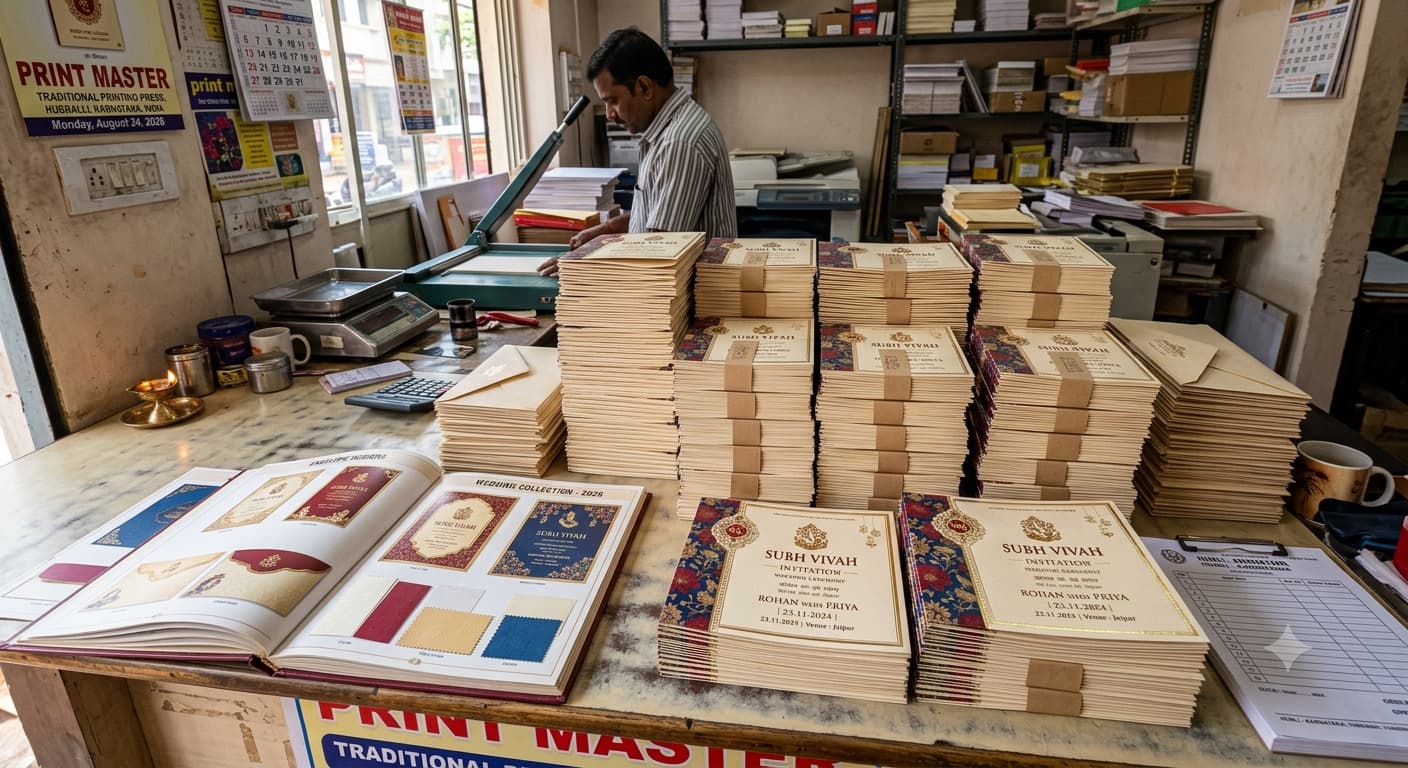
Rent, mostly. A Chandni Chowk shop is 200 square feet with fifty years of trade behind it. A Bengaluru wedding-card showroom is air-conditioned retail space in a mall, and that lease is in your card price.
Wholesale distance. A huge share of India's wedding card stock is printed in and around Delhi and Sivakasi, then distributed. Every step away from the press adds a margin.
Design charges bundled differently. Metro showrooms often include "design consultation" in the rate whether you use it or not. Wholesale markets charge separately, and only if you ask.
Order minimums. Wholesale markets want 200+ cards. Showrooms will do 80. If your list is small, that convenience costs you per unit.
When ordering from another city makes sense
The savings are real but so is the risk. Rough rule: if you're ordering 250+ cards and the per-card gap is ₹40 or more, ordering remotely is worth it. Below that, shipping and hassle eat the difference.
For a 300-card order at a ₹60 gap, that's ₹18,000 saved against maybe ₹2,500 of transport. Easy call.
What to insist on before paying an advance to a shop you can't walk into:
- A physical sample couriered to you first. Screenshots lie about paper weight and foil colour. This costs ₹200–₹400 and it is not optional.
- A PDF proof with your exact text, checked by two people in your family. Name spellings are the #1 reprint cause.
- Payment split — 40% advance, 60% after you approve the proof. Never 100% upfront.
- Written delivery date, plus a buffer of at least 10 days before you need to start distributing.
- Transport quoted separately in writing. "Shipping extra" with no number is how ₹3,000 appears at the end.
The specification checklist that makes quotes comparable
Ask every shop for the same six things and the prices become readable:
| Spec to ask | Why it matters |
|---|---|
| Paper GSM | 250 vs 300 GSM changes price 20–30% and guests notice the difference |
| Number of inserts | Each extra function card adds ₹12–₹40 |
| Foiling: full or partial | "Foiled" can mean a small motif or the whole border |
| Envelope: printed or plain | Printed envelope with names costs more but looks finished |
| Quantity slab | Printers price per 100 — 310 cards often costs what 400 does |
| Design charge included? | ₹3,000–₹15,000 for custom illustration, often quoted separately later |
Take a photo of that table into the shop. Getting quotes on identical specifications is the single highest-value hour of the entire process.
Costs that show up after the print bill
Printing is not the invitation budget. Add:
- Courier for outstation guests: ₹40–₹120 per card. India Post speed post is the cheapest reliable option; private couriers are roughly triple for the same envelope.
- Hand delivery: four days of someone driving around with a bag of cards. Real cost: ₹2,000–₹8,000 in fuel and time.
- Reprints: budget ₹5,000. Something will be wrong. It's always a surname or a time.
- Extra cards: the list grows after printing. Every time. Order 10% over your final count — mid-run reprints cost far more per card than the original slab.
A ₹300 card holder box is worth buying before distribution starts, mostly because loose cards in a car door pocket arrive with bent corners and that undoes the ₹200 you spent on paper quality. And if you're addressing envelopes by hand, a metallic gel pen set at ₹150–₹250 makes plain envelopes look deliberately styled instead of unfinished.

Worison 9pc White Gold Silver Fine Point Highlight Gel Pen for Drawing
View on Amazon
Gold Scroll Glass Box for Wedding Invitations & Jewelry, 9x2.1x2.1 Inches (23x5x5 Cm), Pack of 1
View on AmazonAs an Amazon Associate, we may earn from qualifying purchases.
The move that beats every city comparison
Print fewer cards.
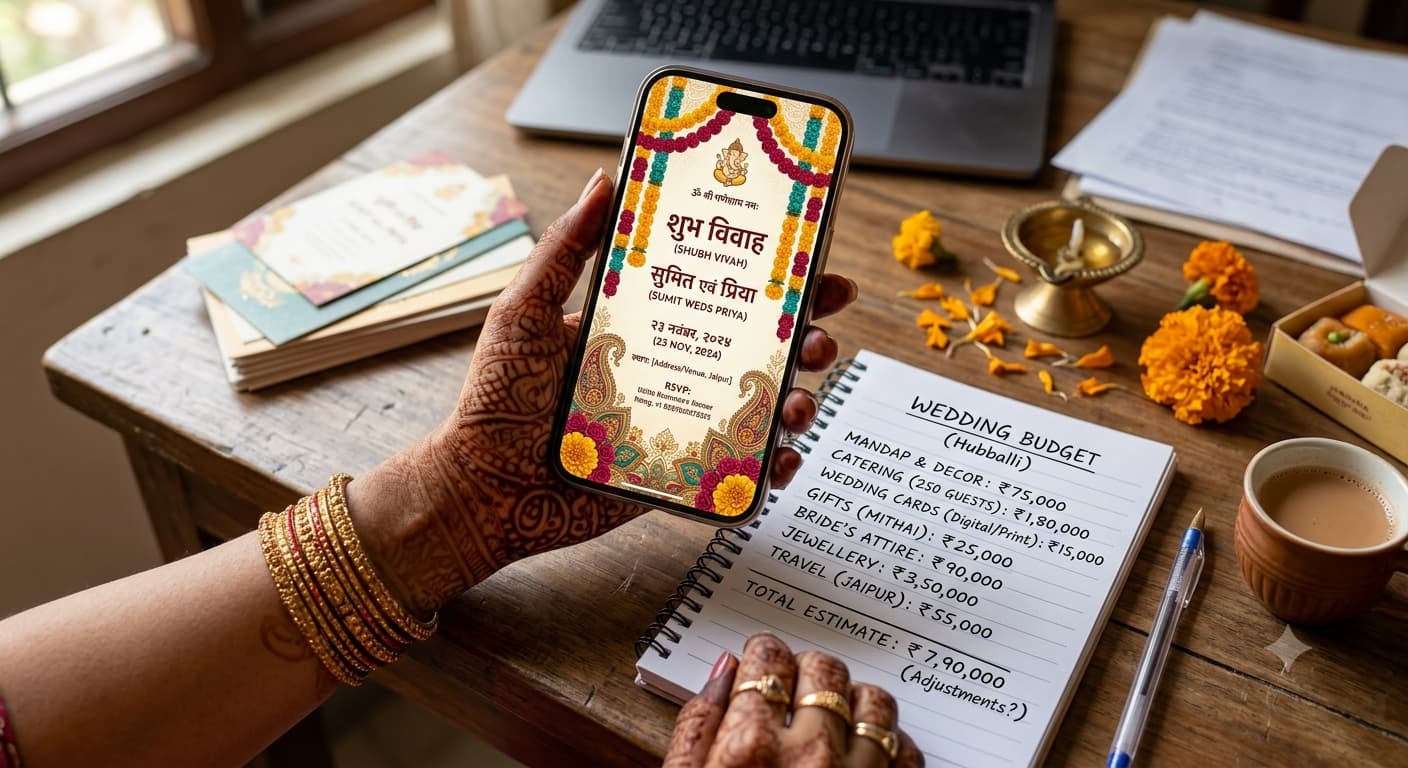
Not zero — fewer. The families I've seen manage this best print 50–80 cards for the people who genuinely expect one in hand, and send everyone else a digital invite. Suddenly you're buying premium cards at Bengaluru showroom rates and still spending less than a wholesale order for 300.
Run your numbers through the wedding budget calculator with both scenarios before you commit to a quantity — the invitation line usually has more slack in it than any other part of the budget, and this is the least painful place to find ₹30,000. If you want to see what the digital half of that hybrid looks like across mehendi, haldi and reception, the wedding template gallery is free to browse.
Timing: when to place the order
Work backwards from your first function, not the wedding day.
| Task | When |
|---|---|
| Finalise design and text | 12–14 weeks before |
| Place print order | 10–12 weeks before |
| Receive and check cards | 8–9 weeks before |
| Start distribution | 6–8 weeks before |
| Courier to outstation guests | 6 weeks before |
During peak season — the November-to-February muhurat run, which you can check against Drik Panchang's marriage dates — printers are booked solid and turnaround stretches from 7 days to 20. Add two weeks to everything above if your date falls in that window.
One last thing that costs nothing: get the final print file emailed to you as a PDF and a JPEG before you settle the bill. You'll want the digital version for WhatsApp, and asking three weeks later is how people end up paying a second designer to recreate a card they already own.
People Also Asked
Explore common questions related to this blog.