Heads up: some links in this post are Amazon affiliate links — if you buy through them, Eventic earns a small commission at no extra cost to you.
Hot take to start: most couples overpay for video invitations, and the ones who overpay the most are the ones who ordered a custom caricature animation nobody watched past the eight-second mark.
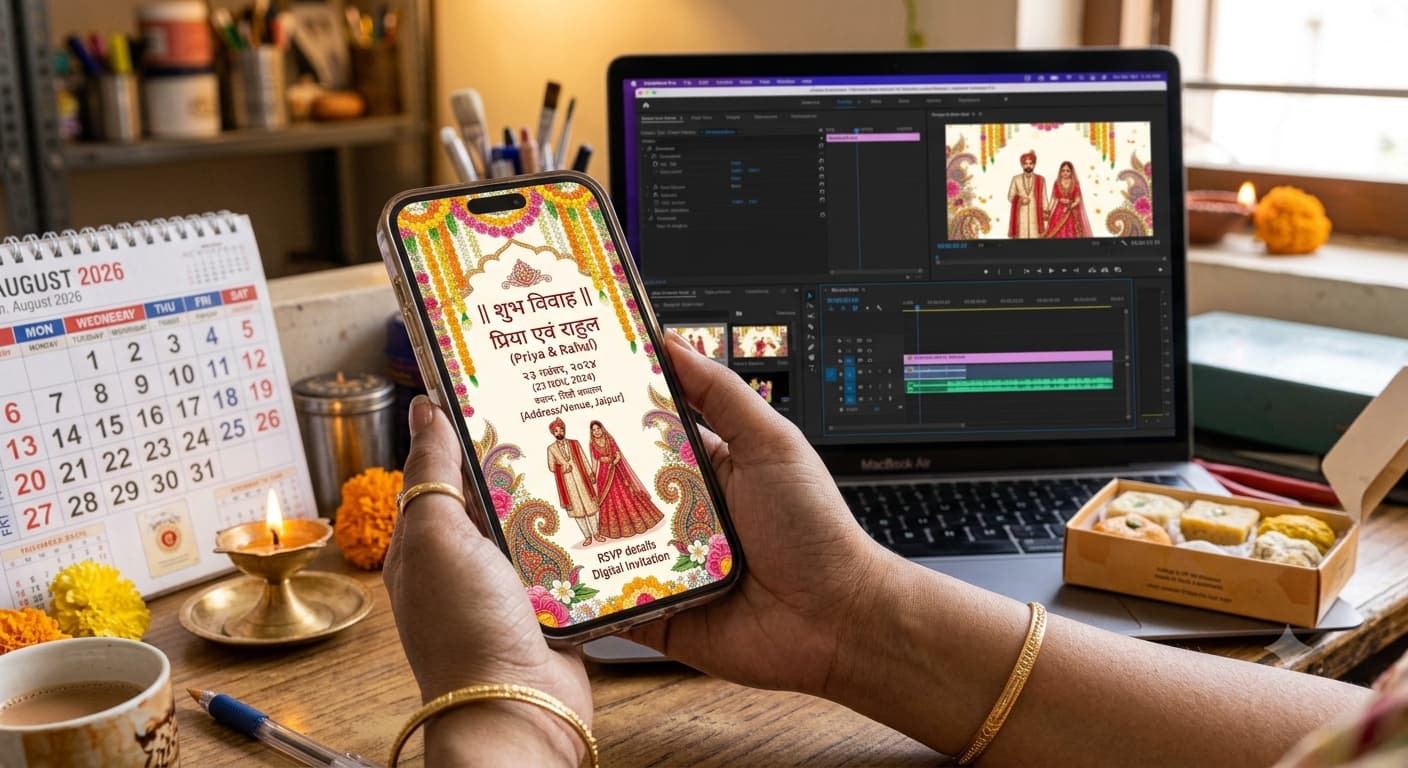
That's not an argument against video invites. They're the most forwarded thing in any Indian wedding's WhatsApp ecosystem — full filmy, and the family loves them. It's an argument for knowing what the tiers cost before you agree to an advance. This piece sits under our complete invitation cost guide for India, and if you're still deciding on length and structure rather than budget, start with the video invitation format guide.
The 2026 rate card
| Type | Cost | Turnaround | What you get |
|---|---|---|---|
| DIY (free apps/templates) | ₹0 | 1–2 hours | Stock template, your text, watermark on some free tiers |
| Basic template video | ₹1,500–₹3,500 | 2–4 days | Studio drops your details into an existing animation, 20–30 sec |
| Premium template + photos | ₹3,500–₹6,000 | 3–6 days | Your photos integrated, music choice, 30–45 sec |
| Custom caricature animation | ₹8,000–₹15,000 | 10–15 days | Characters resembling the couple, custom scenes |
| Full custom animated film | ₹15,000–₹25,000+ | 15–25 days | Original storyboard, voiceover, multiple functions, 60–90 sec |
| Live-action shoot invite | ₹20,000–₹60,000 | 3–4 weeks | Actual filming with the couple, crew, edit |
Prices hold roughly steady across cities for video, unlike printing — it's a remote-delivery service, so a Jaipur studio and a Mumbai studio compete on the same WhatsApp. That's good news: you can shop nationally without any of the sample-couriering hassle printed cards involve.
What separates ₹2,000 from ₹12,000
Three things, and only three:
1. Whether a human draws anything. Template videos swap text and photos into pre-built animation. Custom work means an illustrator drawing your grandmother's house, the couple's faces, the dog. That's labour, and labour is the price.
2. Number of scenes. A template gives you 4–6 scenes. Custom work gives you 10–15, often one per function. If you're inviting people to five events, the extra scenes have a real job to do.
3. Revisions. Template packages usually include one round of text corrections. Custom packages include 2–3 rounds of actual creative changes. Ask which you're getting — "revisions included" often means "we'll fix typos," which is not the same thing.
Everything else — music, voiceover, "HD delivery," a portrait version for status — should be standard at every tier above ₹1,500. If a studio charges extra for a vertical crop, that's a flag.
What most couples should actually buy
The ₹3,500–₹6,000 premium template tier, and I'd argue this fairly strongly.
At that price you get your own photos, decent animation, music that matches the mood, and a 30–45 second runtime that people will actually finish. The custom tier buys artistry that's real but largely invisible on a phone screen at 40% brightness in a moving auto.
Where custom genuinely earns its money: destination weddings where the invite doubles as a travel announcement, weddings with an unusual story worth telling, or when the video will play on screens at the sangeet as part of the event itself. Then you're buying content, not just an invitation, and the maths changes.
DIY: what ₹0 gets you
Real option for small weddings. Canva's video templates are free and better than most paid work from 2020. Phone editing apps do the rest.
Budget 2–3 hours and expect these limits: watermarks on some free tiers, music library restrictions, and templates that a lot of other people are also using this season.
If you're shooting your own clips to drop in — the couple laughing at the roka, the house being decorated — a phone tripod with a ring light at around ₹800–₹1,500 does more for the final quality than any editing app will. Shaky handheld footage is the single thing that makes a DIY invite look DIY.
The second thing worth ₹1,500–₹3,000 if you're filming anything that moves: a phone gimbal stabiliser. Walking shots through a decorated house look expensive; the same shot handheld looks like a WhatsApp status. Skip it if you're only doing static clips — a tripod covers that fine.
Hidden costs and the ones to refuse
Legitimate extras:
- Additional language version (Hindi + English): ₹800–₹2,000
- Separate versions per function: ₹500–₹1,500 each
- Rush delivery under 72 hours: 25–50% surcharge
Extras you should push back on:
- "HD delivery charge." HD is the baseline.
- Per-revision fees on typos the studio introduced.
- Charging for a vertical/status crop of a video you already paid for.
- "Source file" charges above ₹2,000 for template work — there isn't much of a source file to hand over.
Get the deliverables listed in writing before the advance: runtime, number of scenes, file formats, aspect ratios, and how many revisions. One WhatsApp message with that list, confirmed by the studio, prevents nearly every dispute I've seen.
The file size problem nobody warns you about
Your beautiful 90-second, 120 MB video invitation will get compressed into mush by the time it's forwarded four times.
WhatsApp caps media sharing well below what a studio typically exports, and every forward degrades it further. Practical fixes:
- Ask for a WhatsApp-optimised version under 15 MB alongside the full-quality file. Any competent studio will provide this without extra charge.
- Keep runtime under 45 seconds. Smaller file, higher completion rate, both.
- Put the critical details — date, venue, time — in the first 10 seconds and again at the end. If compression ruins the middle, the information survives.
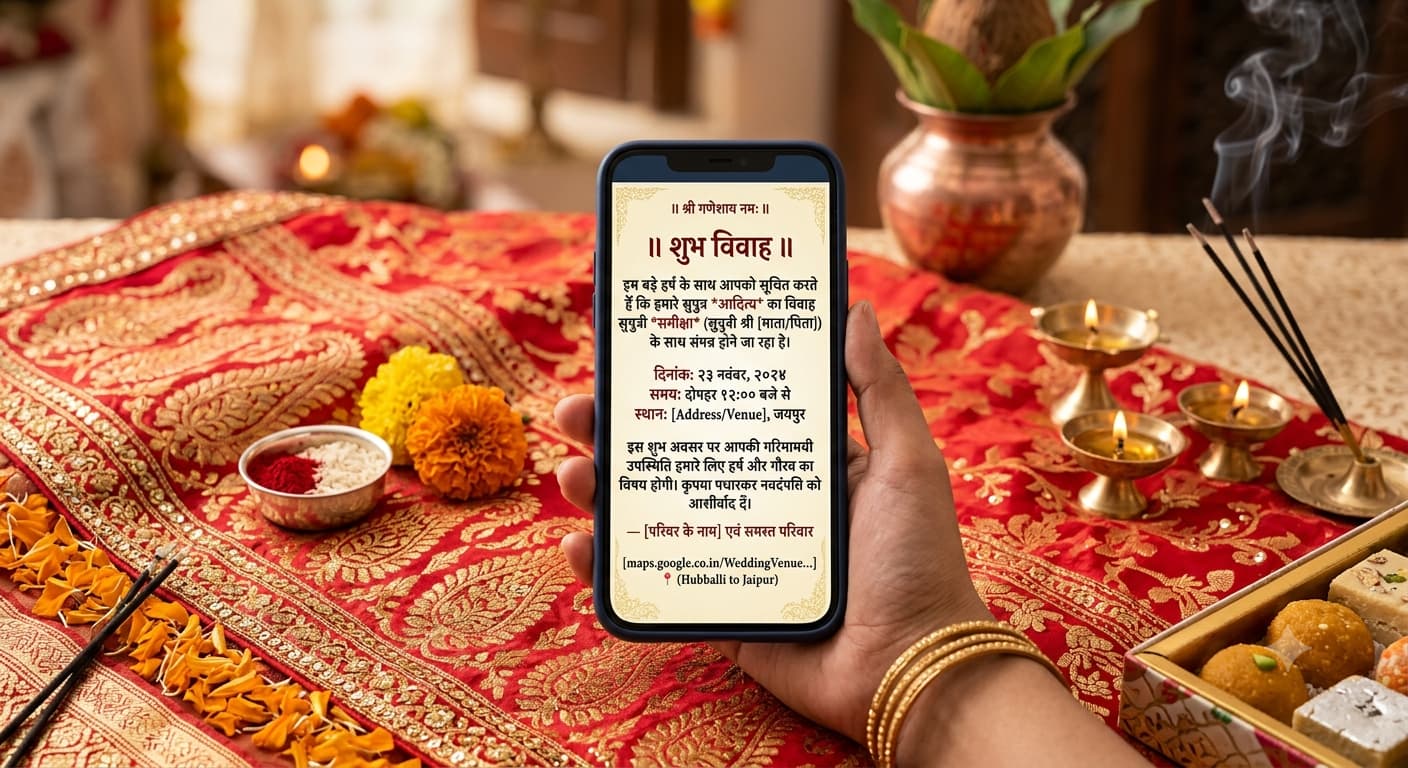
- Send a static image or hosted link alongside the video for anyone over 65. Video autoplay off, weak signal, small storage — it fails more often than you'd think, and the details need a backup.
That last point matters more than the production quality. A video invite is a lovely thing that gets watched once; the actual details need somewhere permanent to live. That's usually a digital invite page with the schedule and RSVP that the video links to, so the video does the emotion and the page does the logistics. Costs for that side are broken down in our digital invitation pricing guide.
Timeline before you book
| When | Task |
|---|---|
| 10–12 weeks before | Shortlist studios, request portfolios and quotes |
| 9 weeks before | Book, pay advance, send photos and final text |
| 7 weeks before | First draft received, revisions requested |
| 6 weeks before | Final delivery, both full and compressed versions |
| 5–6 weeks before | Send to guests, with the digital invite link alongside |
During peak muhurat season, studios book out 3–4 weeks ahead and rush charges become the norm rather than the exception. Book before the season, not during it — that's where the ₹1,500 surcharge disappears.
Small thing that saves a lot of grief: send the finished video to your own parents first and watch them open it. If your father can't find the date without asking, the video needs another pass — and you'll have caught it before three hundred people see it.
People Also Asked
Explore common questions related to this blog.