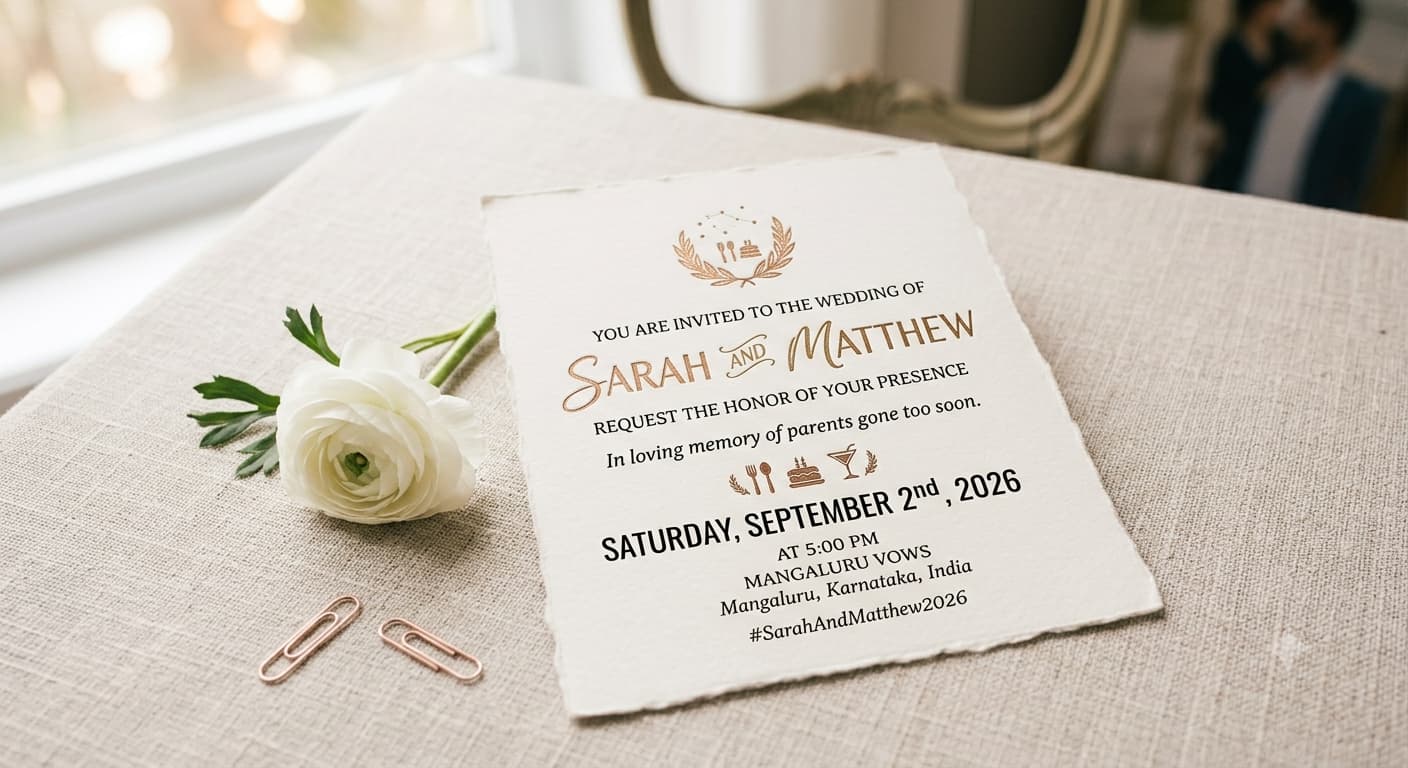
Adults-Only Wedding Invitation Wording: 22 Ways to Say No Kids Politely
How do you tell 117 people that their children aren't invited, in four words, without one cousin deciding to make it a whole thing?
Heads up: some links in this post are Amazon affiliate links — if you buy through them, Eventic earns a small commission at no extra cost to you.
If you're still building the rest of the card, the full wedding invitation wording guide covers the host line, date formats, and where each piece of information belongs.
The 22 lines, sorted by how firm you need to be
Warm and soft
- We respectfully request an adults-only celebration.
- We love your little ones, but this celebration is for grown-ups.
- Adults only, please — we hope you'll take the night off.
- Please join us for an adults-only evening.
- While we adore your children, we've reserved this evening for adults.
- An adult reception will follow the ceremony.
Neutral and clear
- Adults only.
- This is an adults-only event.
- Kindly note this is an adults-only celebration.
- We have reserved seats for adult guests only.
- Due to venue capacity, we are only able to accommodate adult guests.
- Adult reception to follow.
Firm, when soft hasn't worked before
- Our celebration is adults only. Thank you for understanding.
- We are unable to accommodate children at this event.
- No children, please. We hope you'll still be able to join us.
- Only guests named on your invitation can be accommodated.
- Our venue is licensed for adults only.
- Names on the envelope indicate who is invited.
Playful, if it matches your tone
- Let's raise a glass — and let the kids have a night in.
- Bring your dancing shoes, leave the diaper bag.
- Consider this your permission slip for a night off.
- 18 and over — it's giving open bar, not soft play.
That last set only works if the rest of your invitation is casual. A playful no-kids line on a black-tie invitation reads as a mixed signal, and mixed signals are exactly what causes someone to show up with a toddler.
Where the wording goes (this matters more than the wording)
Never on the main invitation card. That card is for the ceremony details, and a restriction sitting next to your names reads harsher than the same words placed elsewhere.
| Placement | Verdict |
|---|---|
| Main invitation card | Avoid — too prominent, reads cold |
| Details / information card | Best option, alongside dress code and parking |
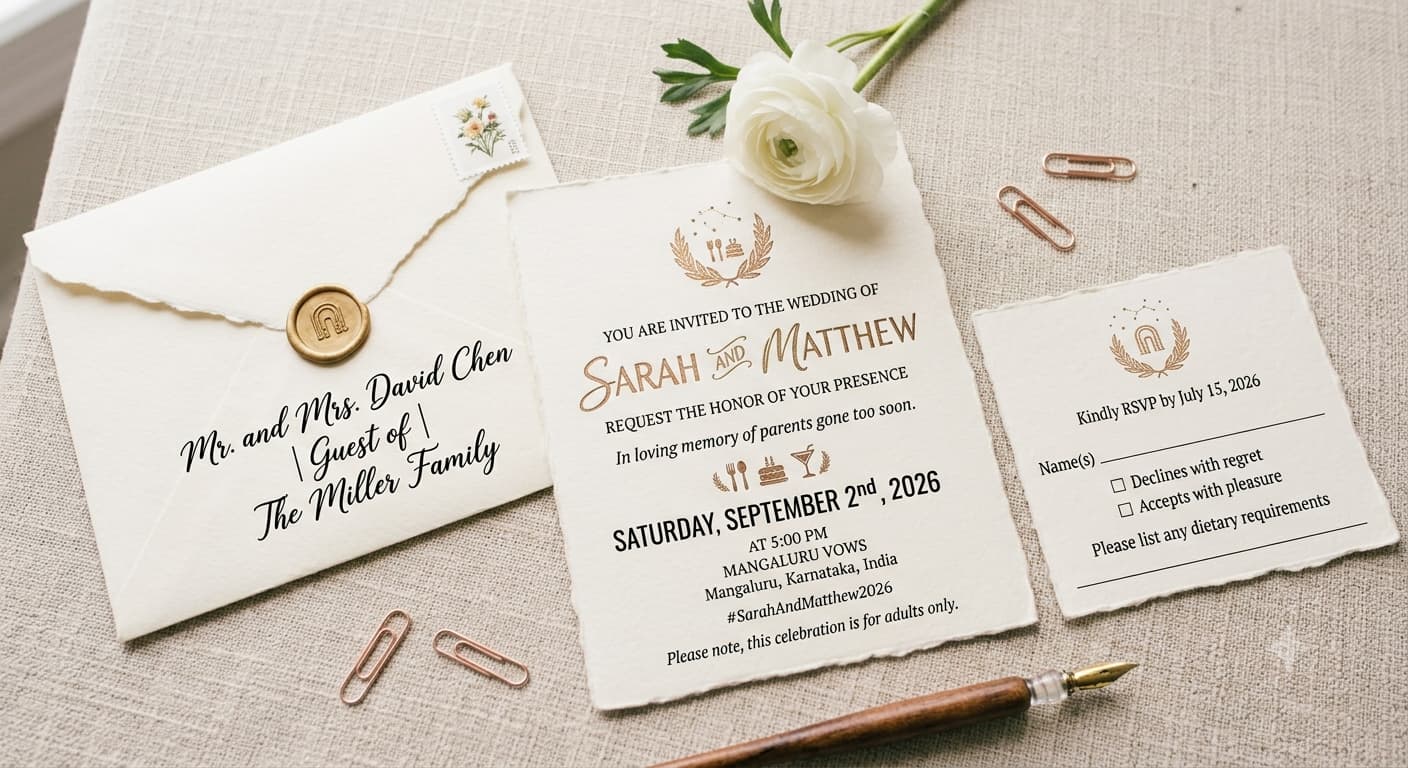
| RSVP card | Very good, next to the reserved-seats line |
| Wedding website FAQ | Essential, with a short explanation |
| Envelope addressing | The actual enforcement mechanism |
The Emily Post Institute's invitation guidance has held for decades that the guest list is communicated by the envelope, and that's still the practical truth — the printed line is a courtesy reminder, not the rule itself.
The envelope is doing the real work
Here's the mechanism most modern couples skip, and then wonder why the policy didn't hold.
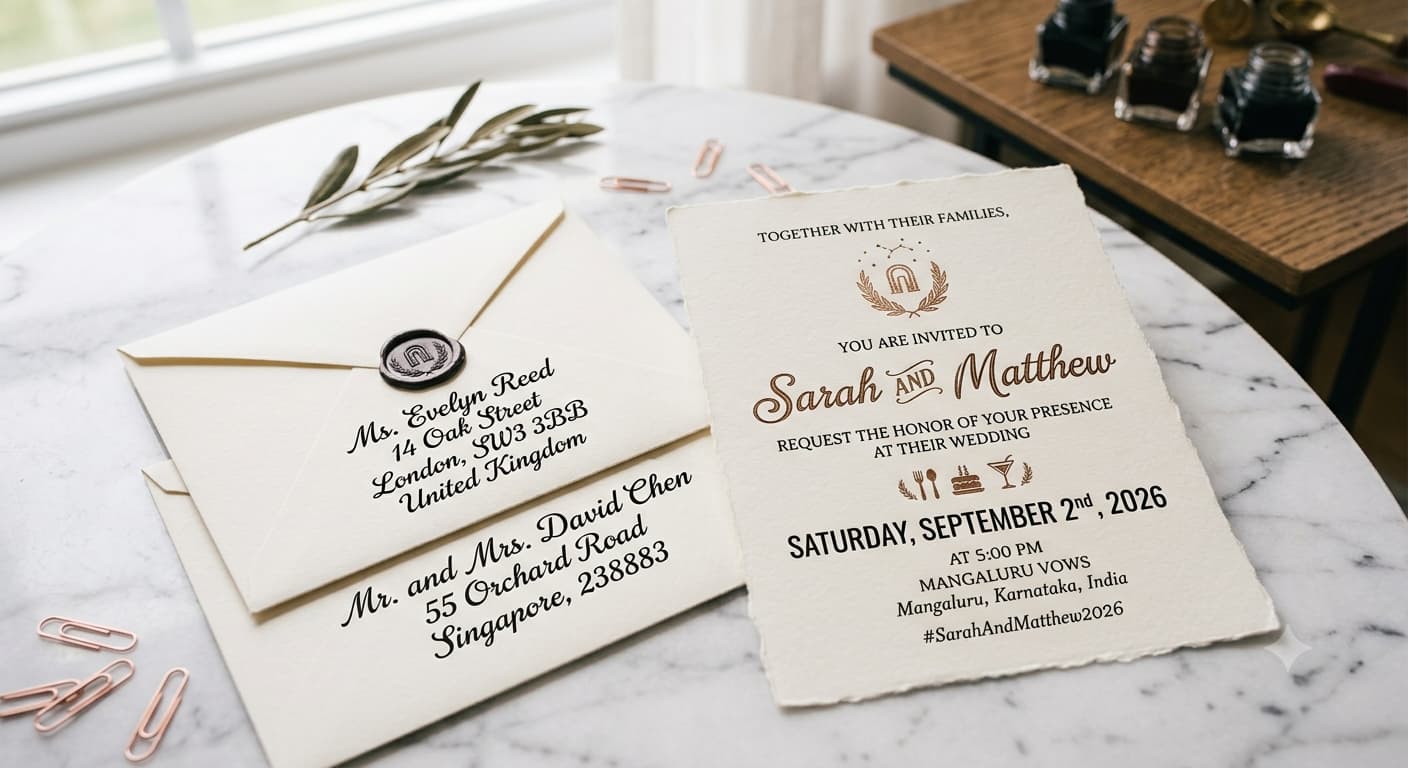
Traditional suites have two envelopes. The outer one carries the mailing address. The inner envelope names exactly who is invited: "Mr. and Mrs. Chen" means two people, full stop. If children were invited, they'd be named on that inner envelope too. That's the whole system.
If you're doing single-envelope or digital invitations, you can still replicate it. Address the invitation to the specific names — "Priya and David Chen", not "The Chen Family". That one word, "family," is an open invitation to bring everyone, and people read it exactly that way.
Two related notes:
- Send a separate invitation to any adult child over 18 living at home. Lumping them in creates confusion in both directions.
- If you're doing printed suites, a set of inner envelopes or a name-addressing stamp is around $15 and does more for your headcount than any wording you'll write. It sounds fussy until the RSVPs come back correct.
As an Amazon Associate, we may earn from qualifying purchases.

The RSVP card line that ends the ambiguity
We have reserved ___ seats in your honor. Kindly reply by the first of May.
Fill in the number by hand before mailing. "2" written in your handwriting on a card addressed to two adults is unambiguous in a way no sentence is.
If you're collecting responses digitally, set the guest count per invite rather than leaving it open — Eventic's RSVP tracking locks the number to each invitation so a guest can't quietly add three, which is the single most common way an adults-only wedding turns into a not-quite-adults-only wedding. Without that cap, you find out at seating-chart stage, when it's expensive.
Handling the pushback
Someone will push back. Usually one person, usually by text, usually starting with "I totally understand, but…"
A script that works:
"We'd love to have them, but we've had to keep it adults-only across the board — we couldn't make exceptions without going over on numbers. Hope you can still make it, we'd really miss you."
Three things that make this work. It's warm. It cites a constraint rather than a preference, which is harder to argue with. And "across the board" quietly closes the exception door before they ask.
What not to do: make one exception. The moment one child is at the wedding, every parent who arranged a sitter finds out, and that's a genuinely fair thing for them to be annoyed about. Flower girls and ring bearers are the understood exception, and everyone accepts that without explanation.
If you want a middle path
Not every wedding has to be all-or-nothing. Options that work:
- Kids at the ceremony, adults at the reception. Word it as "Children are welcome at the ceremony; the reception will be adults only."
- Immediate family children only. Harder to enforce, but honest: "We're keeping the guest list to adults, with the exception of our nieces and nephews."
- On-site childcare. A booked sitter in a side room turns the whole conversation around. It costs a few hundred dollars and removes every objection at once.
- Under-2s welcome. Some couples exempt babies in arms, since they're not taking a seat. Say so explicitly or you'll get questions.
The middle paths need more explanation on your website, which is fine — that's what the website is for. Put a short FAQ answer there and link it from the details card.
The website FAQ that does the heavy lifting
Your details card gets four words. Your website gets a paragraph, and the paragraph is where you actually change minds. Here's a template:
Can we bring our children? We've had to keep our wedding adults-only — our venue caps us at 120 and we couldn't stretch it far enough to include everyone's little ones without cutting adults we love. We know that makes things harder for some of you, and we're really grateful to anyone arranging a sitter to be there. If you're travelling in and childcare is a problem, message us and we'll do what we can to help sort something.
Three things are working there. A specific constraint, rather than a preference. An acknowledgement that it's inconvenient. And an open door for the guests for whom it's genuinely difficult, which costs you almost nothing because very few people will take you up on it.
Skip the phrase "we love your children, but." Everyone knows what comes after "but," and the compliment doesn't survive it.
Booking childcare turns the whole thing around
If a meaningful chunk of your guest list has young kids, this is worth pricing before you commit to a flat no.
A sitter or two in a side room at the venue, or a partnership with a nearby hotel's childcare service, runs a few hundred dollars and eliminates every objection at once. Parents get the evening. You get the adults-only reception you wanted. Nobody has a conversation about it.
Practical notes if you go this route: name the arrangement on your website with the provider's details so parents can vet them, ask for the count at the RSVP stage rather than assuming, and be clear about the cut-off time. And check with your venue first — some have insurance restrictions on under-18s on site regardless of supervision, which is a genuinely useful thing to find out before you promise anything.
Common mistakes
- Writing "no kids" on the main card. Too blunt, too prominent.
- Addressing envelopes to "The Chen Family." Undoes your own policy in three words.
- Explaining at length. A paragraph of justification invites negotiation. One line closes it.
- Announcing it only on the website. Half your guests won't visit the site until the week before.
- Making an exception. See above. One exception is a policy change.
- Leaving the RSVP count blank. Guests will fill it in optimistically.
May your dance floor be full and your reception be entirely free of anyone who needs a nap at 8pm.
People Also Asked
Explore common questions related to this blog.
No. It's an extremely common choice, usually driven by venue capacity or per-head cost. Guests overwhelmingly understand it — some of them are relieved.
Details card or RSVP card. Reinforce it on your website and, critically, in how you address the envelopes.
Universally understood as an exception. No explanation needed, though it helps to mention on your website that they're the only children attending.
Number the RSVP seats by hand, address envelopes to individuals, and reply to any "can I bring…" message the same day with a warm no. Same principle applies to unexpected partners — the no plus-one wording guide covers that version of the conversation.