Disclosure: This post contains an affiliate link. Eventic makes digital invitations, so we have an obvious commercial interest in this comparison — which is why every figure below is sourced and the conclusion is more qualified than you'd expect.
A paper invitation suite has a carbon footprint of roughly 40–80 g CO₂e. A digital one is roughly 1–5 g. For a 100-guest wedding, that's about 5 kg of CO₂e saved by going digital.
Five kilograms is roughly one 20-mile car journey. Meanwhile, a single guest flying in for your wedding emits somewhere around 500 kg.
So digital invitations are genuinely lower-impact — by a factor of ten or more — and the decision matters far less than almost anyone writing about it implies. Here's the actual math.
First, the myth that's distorting this whole debate
Nearly every article comparing digital and paper cites a figure of around 4 g CO₂e per email. It gets used to argue that digital isn't as clean as it looks.
That number comes from the 2010 edition of Mike Berners-Lee's How Bad Are Bananas? — and Berners-Lee himself has publicly pushed back on how it's been used, stating that the carbon footprint of sending an email is trivial and that a UK government campaign had misapplied his older estimate.
His revised 2020 figures put the range at between 0.03 g and 26 g depending on the type of email, partly because devices and data centres have become considerably more efficient since 2010.
A wedding invitation email with an image sits toward the lower-middle of that range. Call it 1–5 g.
Paper: the actual math
Production
The best available US data comes from a North Carolina State University life-cycle study of 252 American mills, which found that one metric ton of paper produces an average of 942 kg CO₂e, ranging from 608 to 1,978 kg depending on the grade.
That's about 0.94 g of CO₂e per gram of paper.
A typical invitation suite:
| Component | Weight |
|---|---|
| 5×7 invitation, heavy cardstock | ~6 g |
| Outer envelope | ~5 g |
| RSVP card | ~3 g |
| RSVP envelope | ~3 g |
| Total | ~17 g |
Production: ~16 g CO₂e per suite.
Printing
Roughly 1 g CO₂e per printed page for typical electricity mixes. Across a suite, call it 2–4 g.
Shipping and mailing
This is the least certain number and the largest one. Printer to you is one leg; then 100 individual pieces enter the postal system.
Published estimates for a single mailed letter vary widely, and the honest position is that the marginal emissions of adding one letter to a route the mail carrier is already driving are small. A reasonable working range is 20–60 g CO₂e per mailed piece, and we'd treat anyone quoting a precise figure here with suspicion.
Total
40–80 g CO₂e per paper invitation suite, with mailing accounting for more than half of it.
Digital: the actual math
| Component | CO₂e |
|---|---|
| Sending the invitation email | 1–5 g |
| Hosting the invitation page | negligible per guest |
| Guest device use to view it | ~0.2 g per view |
| Reminder emails (2–3) | 2–10 g |
Total: roughly 3–15 g per guest, once you count reminders.
Note that this is not zero, and articles claiming digital has "no footprint" are wrong. Data centres, networks, and devices all draw power. It's simply an order of magnitude smaller than paper.
Head to head, 100 guests
| Paper | Digital | |
|---|---|---|
| Per guest | 40–80 g | 3–15 g |
| 100 guests | 4–8 kg CO₂e | 0.3–1.5 kg CO₂e |
| Save-the-dates too | 8–16 kg | 0.6–3 kg |
| With thank-you cards | 12–24 kg | — |
Digital saves roughly 4–7 kg of CO₂e on invitations alone, or 10–20 kg across a full stationery suite including save-the-dates and thank-yous.
The context nobody includes
Here's the part that makes this comparison honest.
| Wedding element | Approximate CO₂e |
|---|---|
| One guest flying round-trip domestic | ~500 kg |
| One guest driving 100 miles round-trip | ~40 kg |
| Beef main course, per serving | ~15 kg |
| 100 paper invitation suites | 4–8 kg |
| 100 digital invitations | 0.3–1.5 kg |
A single guest's flight outweighs your entire paper invitation decision by about 100 to 1. One beef entrée is worth roughly three invitations.
This isn't an argument for printing. It's an argument for proportion. If sustainability genuinely matters to you, the levers that move the number are guest travel, venue choice, and menu — not stationery. Switching to digital invitations is a real improvement, and it's a small one relative to the day as a whole.
Anyone selling you paper as an environmental catastrophe, or digital as an environmental achievement, is overstating their case. We'd rather say so.
What actually reduces stationery impact, ranked
- Send fewer pieces. One invitation per household, not per person. Skip save-the-dates entirely, or send those digitally and print only the invitation.
- Go digital for most of the list, printing a handful of keepsakes for the people who need or want them. This captures most of the saving.
- Skip embellishment. Foil, glitter, lamination, and plastic-lined envelopes make paper unrecyclable, which roughly doubles its end-of-life impact.
- Use recycled stock. Recycled paper runs about 0.7 kg CO₂e per kg versus 1.2 for virgin — a saving of roughly 40%.
- Print locally. Shipping is a meaningful share, and a local printer beats a "carbon-neutral" one 2,000 miles away.
- Choose lighter stock. Heavy cardstock feels premium and weighs three times as much. The footprint scales directly with grams.
If you're printing yourself, 100% post-consumer recycled cardstock is the meaningful upgrade — look for the stated PCW percentage rather than "eco" branding, which means nothing.
Where digital genuinely wins, beyond carbon
The carbon case for digital is real but modest. The practical case is much stronger:
- RSVP tracking that updates itself, instead of a pile of returned cards and a spreadsheet
- Free or near-free, versus $300–$700 for 100 printed suites
- No address collection, which is the single most tedious task in wedding planning
- Changes after sending — a venue change or time shift doesn't mean reprinting
- No lost mail, no delivery delays, no guests who never received it
Honestly, the RSVP tracking alone is worth more to most couples than the carbon saving. It's also what makes the rest of your planning work — accurate headcounts are what every catering and bar calculation depends on.
When paper is still the right choice
- Small guest lists. At 20 guests the difference is under 1.5 kg. Print something you love.
- Guests who aren't online. Excluding a grandparent to save a kilogram of carbon is a bad trade.
- Cultural contexts where a physical invitation carries real weight.
- You want a keepsake. Print a few. The footprint of five invitations is negligible.
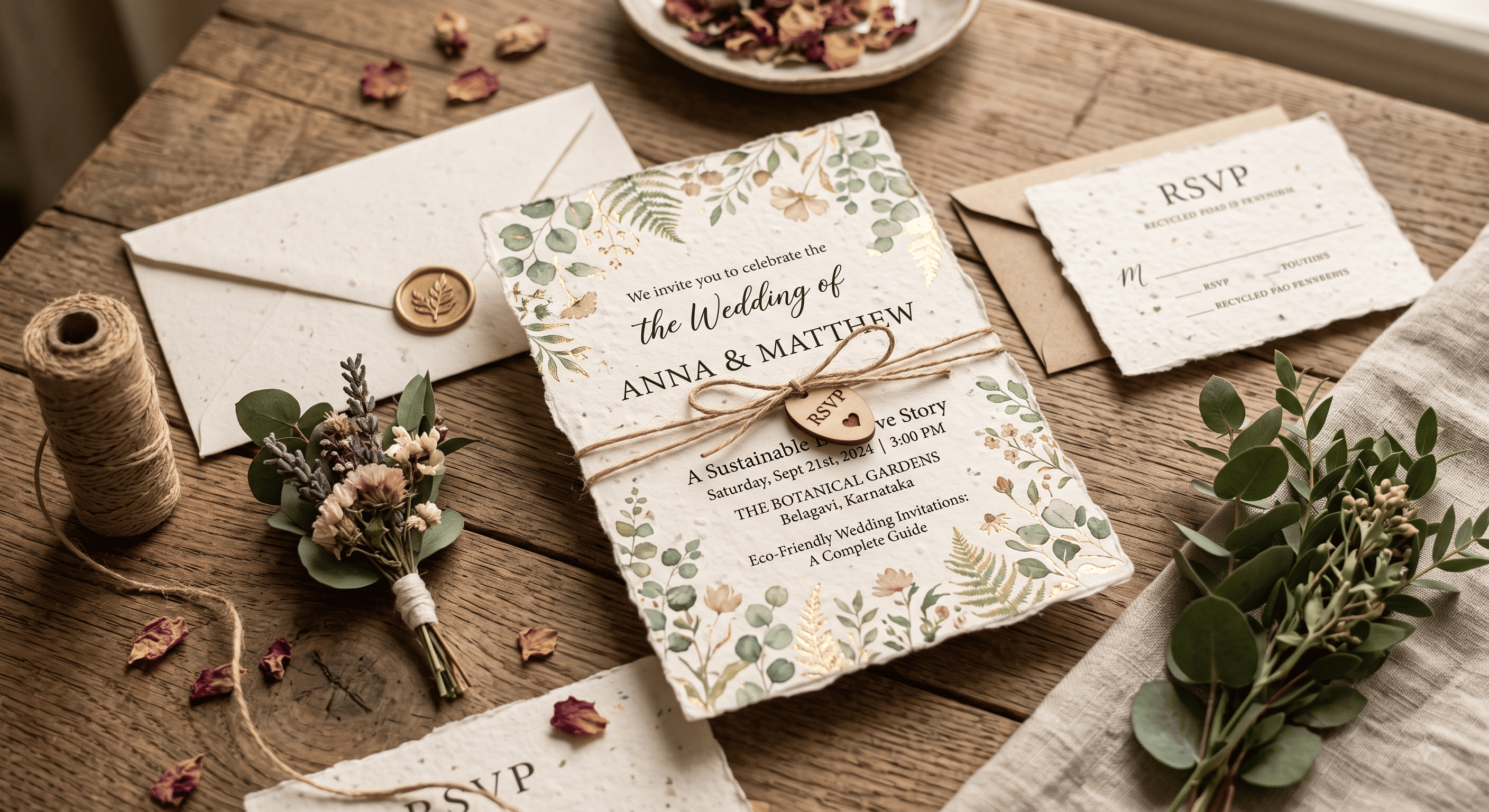
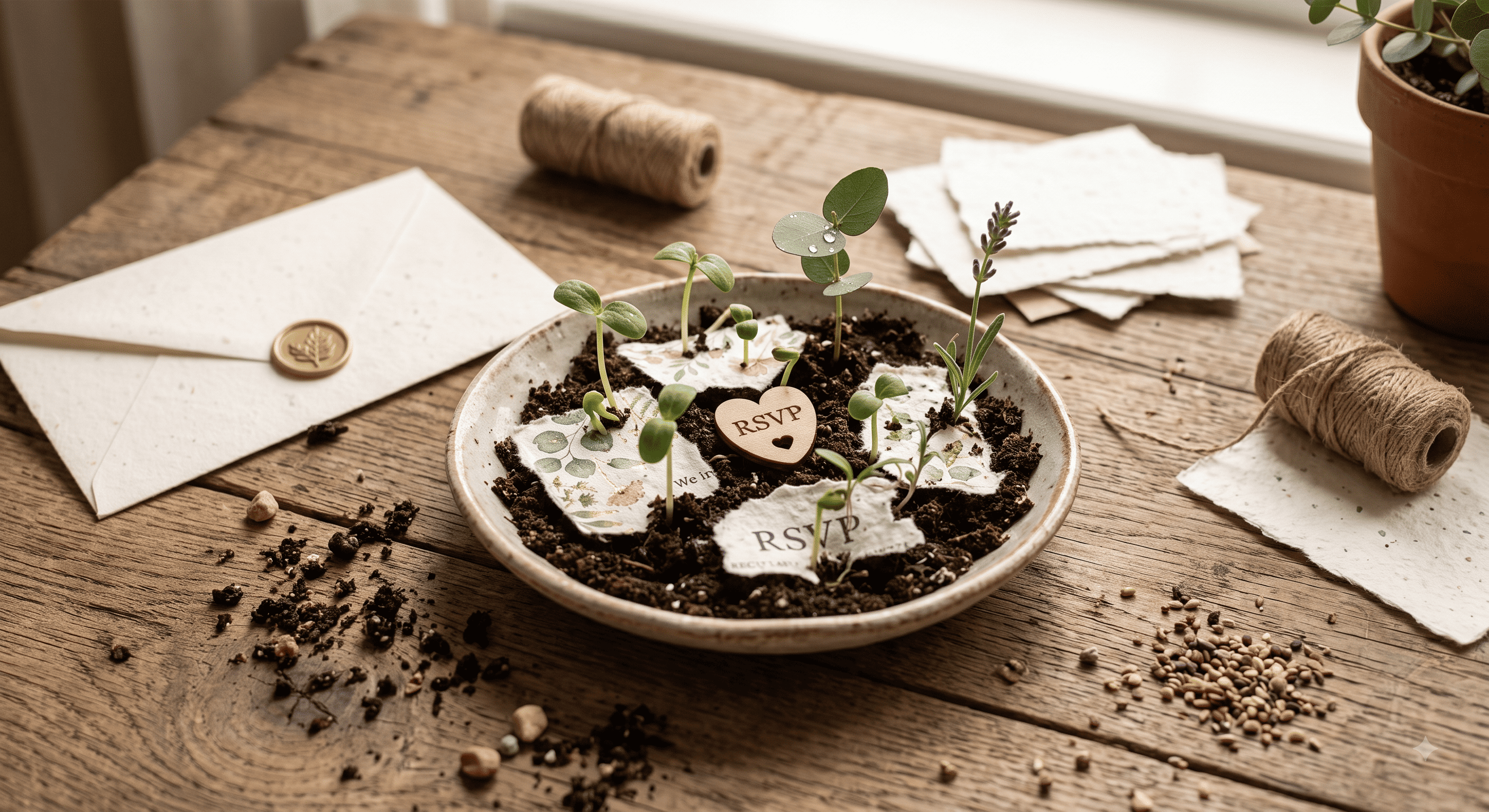
For the full comparison of paper options — recycled, seed paper, letterpress — see the eco-friendly invitation guide. And if you're considering seed paper specifically, the germination and cost breakdown covers what it does and doesn't achieve.
People Also Asked
Explore common questions related to this blog.