The short answer: 6 pieces per person if dinner follows, 10–12 pieces per person if appetizers are the meal, plus 2 more per person for every hour past the first. For a 3-hour cocktail party with 40 guests and no dinner, that's roughly 560 pieces — a number that sounds absurd until you've watched a tray of bacon-wrapped dates vanish in four minutes.
That's the formula. Everything below is how to adjust it for your specific party, because the piece count shifts significantly based on timing, alcohol, and what kind of bites you're actually serving. If you'd rather skip the arithmetic, the party food calculator runs these numbers against your guest list and menu, and the broader guide to how much food per person covers the rest of the meal.
The baseline numbers
By event type
| Situation | Pieces per person, first hour | Each extra hour |
|---|---|---|
| Cocktail party, no meal | 10–12 | +2 |
| Full dinner follows | 6 | +2 |
| Light lunch follows | 4–5 | +2 |
| Pre-dinner drinks (under 1 hour) | 3–4 | — |
| Open house, guests come and go | 8 | +1 |
These line up with what caterers work to, and America's Test Kitchen lands in the same range in its party appetizer planning guidance — one to three appetizers at three to four pieces each when dinner is close behind, and ten to twelve pieces across five or six options for a cocktails-only gathering.
By guest count
Assuming a two-hour event with dinner to follow (8 pieces per person total):
| Guests | Total pieces | Number of different appetizers |
|---|---|---|
| 10 | 80 | 3 |
| 25 | 200 | 4 |
| 50 | 400 | 5–6 |
| 75 | 600 | 6–7 |
| 100 | 800 | 7–8 |
For the same 50-guest party without dinner, you're at 1,000–1,200 pieces. That's the jump that catches hosts out, and it's why the 50-guest food breakdown treats "are appetizers the meal?" as the first question rather than a detail.
How many different appetizers should you serve?
More variety is not better past a certain point. Every additional item is another shopping list, another oven slot, another thing to plate while guests are already in your kitchen.
The rule that works: guest count ÷ 10, rounded, with a floor of 3 and a ceiling of 8.
Why more dishes doesn't mean more food
Here's the part most guides get wrong. If you serve 6 different appetizers instead of 3, you don't need double the total. Guests sample across options rather than eating a full portion of each, so the total climbs but the per-item count drops sharply.
For 50 guests needing 400 pieces total:
| Different appetizers | Pieces of each |
|---|---|
| 3 | 133 |
| 4 | 100 |
| 5 | 80 |
| 6 | 67 |
| 8 | 50 |
Make 50 of something and it looks like a lot on your counter. It isn't, spread across a room of 50 people. This same sampling effect applies to every course — it's why serving three mains doesn't triple your protein, and why three starches on one table needs about half of each individual amount.
Balance the mix
For a spread of five appetizers, a reliable split:
- Two substantial, hot items — sliders, meatballs, skewers, stuffed mushrooms
- One cold, make-ahead item — shrimp cocktail, caprese skewers, deviled eggs
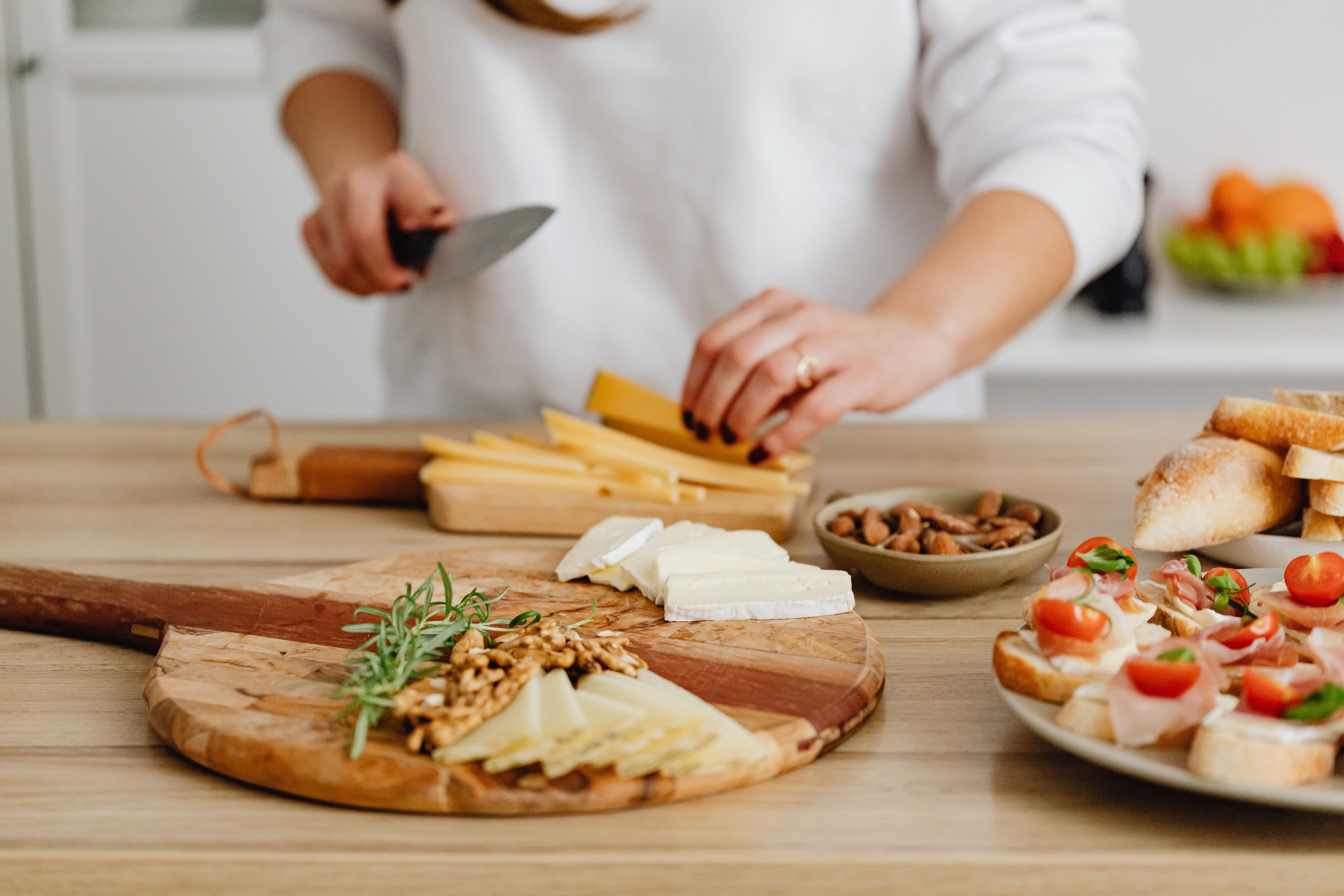
- One board or dip — cheese, charcuterie, hummus and crudités
- One vegetarian item that isn't an afterthought — and yes, the board counts as your fifth, but not as your vegetarian option
Adjustments that actually move the number
Alcohol adds 1–2 pieces per person
Drinking guests eat more, and they eat for longer. If it's an open bar or a wine-forward evening, take the top of every range rather than the middle. Worth planning both at once — the drink quantities and the appetizer count are driven by the same guest list and the same event length.
Time of day
Evening parties run hungrier than afternoon ones. A 2pm baby shower will leave food on the table; the same guest count at 7pm won't. Shift down 20% for early-afternoon events, up 15% for anything that starts after 6pm.
Passed versus stationary
Passed trays slow consumption because guests can only take what comes past. A stationary table invites grazing, and people take more when it's sitting there. Self-serve spreads run about 15% higher than passed service for the same crowd.
Your crowd
A room of 25-year-olds eats considerably more than a room of retirees. Mixed groups average out. If you're hosting a college graduation party, plan high and don't be clever about it.
Bite size
Small canapés
Tiny bites — canapés, single-shrimp skewers, crostini — get eaten in higher numbers. Plan 12–15 per person for a cocktail party rather than 10–12.
Heavy bites
Sliders, mini quiches, stuffed pastries. These fill people up fast. Drop to 6–8 per person even at a cocktail party. Two sliders is functionally a meal.
Boards and dips don't count in pieces
A cheese board or a dip isn't measured in bites, so use weight instead:
| Item | Per person |
|---|---|
| Cheese (as part of a spread) | 2 oz |
| Cheese (as the main appetizer) | 3–4 oz |
| Charcuterie / cured meat | 2 oz |
| Dip | ¼ cup |
| Crackers or bread for a board | 4–5 pieces |
| Crudités | 3 oz |
If a board is on the table, it counts as roughly two of your per-person pieces. Reduce the rest accordingly.
Timing and keeping it safe
Put out about 60% of your appetizers when guests arrive and hold the rest back. Two reasons: the buffet still looks intentional at hour two rather than picked over, and you stay inside food-safety limits.
The USDA's food safety basics for buffets is clear on this — perishable food shouldn't sit out more than two hours, dropping to one hour above 90°F, with hot items held at 140°F or above and cold items at 40°F or below. Shrimp cocktail sitting on melting ice for three hours is the single most common way a party makes people sick.
Practical setup: chafing dishes or slow cookers for hot items, serving bowls nested in ice for cold ones, small platters replaced often rather than one enormous tray topped up throughout.
What this costs
| Appetizer type | Cost per piece (homemade) | Cost per piece (catered) |
|---|---|---|
| Vegetable / dip-based | $0.20–$0.40 | $1.50–$2.50 |
| Cheese and crackers | $0.50–$0.80 | $2–$3 |
| Chicken skewers, meatballs | $0.60–$1.00 | $3–$4 |
| Sliders | $1.20–$2.00 | $4–$6 |
| Shrimp, crab, seafood bites | $1.50–$3.00 | $5–$8 |
A 50-guest cocktail party with 1,000 pieces costs roughly $600–$900 to self-cater and $3,000–$5,000 catered. That gap is why appetizer-only receptions are usually pitched as the budget option and then quietly aren't — the budget calculator is the honest way to check that assumption before you commit.
If you take one number from this page: 6 pieces with dinner, 12 without. Adjust from there for hours, alcohol, and how heavy your bites are, and put out only part of it at a time.
Also explore what cake size do you need for 100 guests by clicking here.
People Also Asked
Explore common questions related to this blog.