How to Make a Wedding Hashtag That Isn't Already Taken (2026 Guide)
The fast version: take one surname, find the word hiding inside it, add a wedding verb, and check it's free. #ForWhomTheBellsWed. Four minutes, done. The part most guides won't tell you is that Instagram quietly changed what a hashtag does since the last wedding you went to — so before you pick one, it helps to know what you're actually building.
Heads up: some links in this post are Amazon affiliate links — if you buy through them, Eventic earns a small commission at no extra cost to you.
What a wedding hashtag is actually for now
It used to be a discovery tool. People followed hashtags, your #SmithWedding2019 got seen by strangers, and there was some vague sense that this was good.
That's over. Instagram removed the ability to follow hashtags in December 2024, Adam Mosseri has said outright that hashtags don't improve a post's visibility, and the platform now caps posts at around five tags instead of thirty. Reach comes from the caption, the content, and whatever the algorithm decides about you.
So why bother? Because a wedding hashtag was never really a growth hack. It's a collection point. One search term, typed once, that pulls three hundred guest photos into a single feed you didn't have to ask anyone to text you. Your photographer gives you 400 curated images in six weeks. The hashtag gives you the blurry ones from the dance floor at 11pm, and honestly those are the ones you'll look at more. If you want the longer argument on whether it's still worth the effort at all, we went through the case for and against it here.
Ten minutes of work for a decade of blurry dance-floor photos. Fine trade.
The six formulas that actually work
Almost every good wedding hashtag is one of these six. Find which one your names fit and you're most of the way there.
| Formula | How it works | Example |
|---|---|---|
| Surname mashup | Both last names, smashed together | #MillerMeetsMoreno |
| Word-in-the-name pun | A real word hides inside a surname — use it | Bell → #ForWhomTheBellsWed |
| Alliteration | Repeat the first sound of the surname | #ParkerPartyOfTwo |
| First names + a wedding verb | Skip surnames entirely | #SamAndPriyaSaidYes |
| Surname + year | The boring one. It always works. | #Rivera2027 |
| Inside joke | The thing your friends already call you | #TheGreatTacoWedding |
Two of those are safe and two are memorable and you probably want one of each — a short official one for signage, and nothing else. Don't run two hashtags. Guests will use neither.
A quick honesty check on the pun formula: it only works if the pun is findable. Names like Bell, Long, Wolf, Price, King, Bright, Post and Fielder are pun goldmines. Names like Krzyzewski are not, and forcing it produces something nobody can spell at a bar at midnight. If your surname refuses to cooperate, the alliteration and first-name routes are covered with a hundred-odd worked examples by letter.
The five-minute method
- Write both surnames and both first names on one line. Say them out loud. The winner is usually audible before it's visible.
- Run all four through a generator to break your own tunnel vision. Twenty minutes of staring at your own name produces nothing; a list of thirty options produces one good one. Eventic's hashtag generator is free and doesn't ask for an email, though any of them will do the same job — the point is volume, not the tool.
- Shortlist three. One safe, one funny, one wildcard. If you want the funny one to land instead of curdle, there's a difference between punny and secondhand-cringe and it's mostly about whether the joke is on you or on your guests.
- Check each one is free. Non-negotiable, and it takes ninety seconds — here's how to check properly across Instagram, TikTok and Google, including what to do when the tag technically exists but has four posts on it from 2016.
- Send all three to the group chat. Not to your mother. The group chat will tell you the truth about which one sounds like a divorce law firm.
- Post one photo with the winner today. The engagement photo, a ring shot, anything. An empty hashtag looks broken when the first guest taps it.
Six rules that keep it usable
Capitalise every word. #TheMeadowsWedding, not #themeadowswedding. It's easier to read at a glance and screen readers handle camel case far better than one long lowercase blob. This is the single most-skipped rule and it costs nothing.
Keep it under about 22 characters. People type this on a phone, one-handed, holding a drink. Every character is a chance to typo.
Do the say-it-out-loud test. Run the letters together and listen for the accidental word. Plenty of real couples have printed a sign, and only at the reception discovered what their two surnames spell when they're touching. Read it aloud to someone who isn't invested.
Avoid spellings that split people. If half your guests will type "Mc" and half will type "Mac," you've got two hashtags and neither of them has your photos.
Skip numbers unless it's the year. #2Become1 is a 1996 Spice Girls single, not a hashtag.
One hashtag. Just one. A ceremony hashtag plus a reception hashtag plus a bachelorette hashtag is how you end up with photos scattered across three tags and none of them complete.
Where the hashtag goes (and where it really doesn't)
It does not go on a formal invitation. Traditional etiquette keeps the invitation itself to the who, what, where — everything else lives on an insert card or your wedding website, and that convention exists because a formal invitation reads badly with a social handle stamped across it.
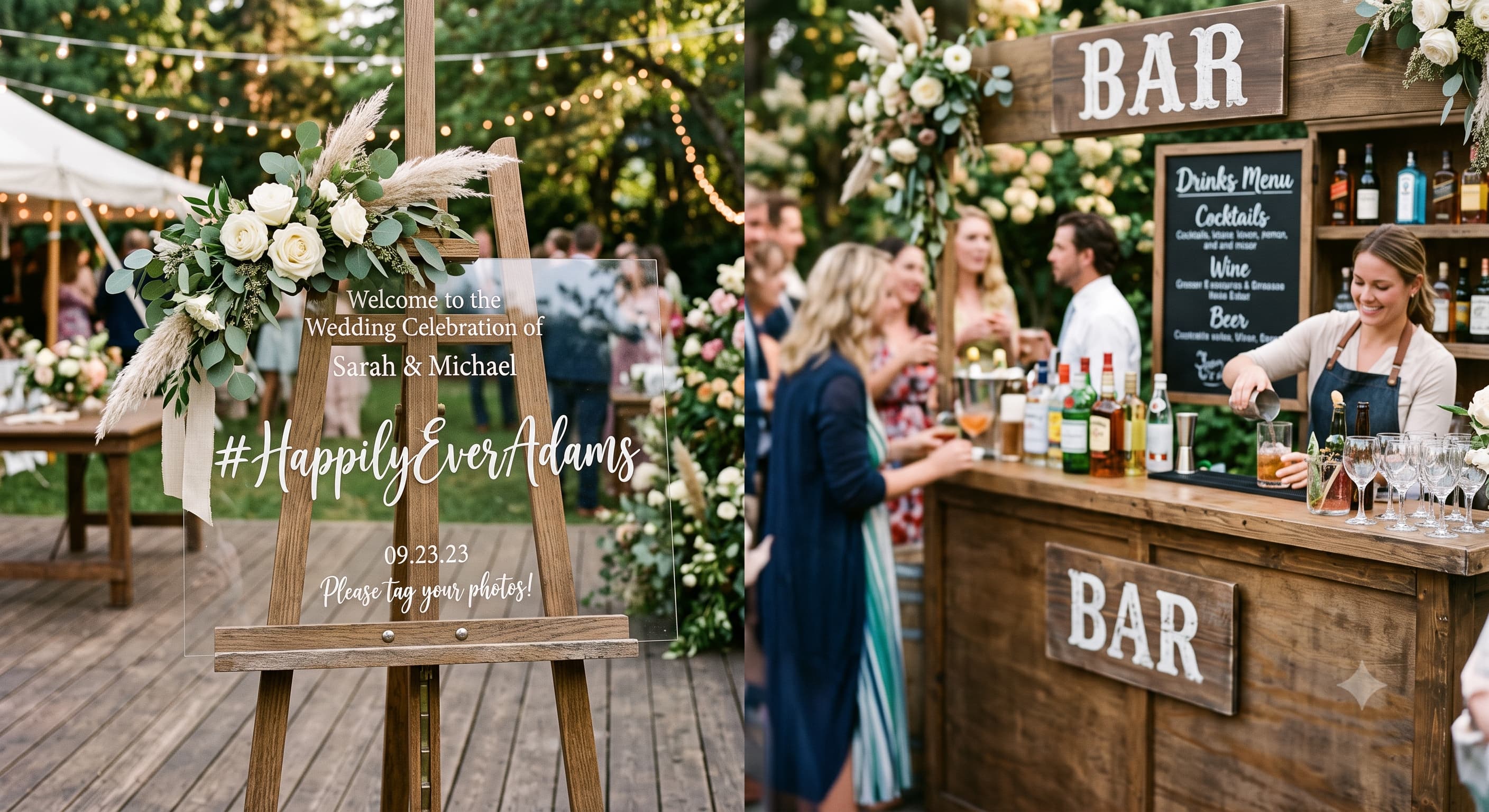
Everywhere else is fair game: save the dates, the website, a welcome sign, the bar, cocktail napkins, the photo booth, the ceremony program, the MC's mouth at 9pm. The full list of eleven placements and the ones that actually generate posts is here — the short answer is that signs at the entrance get ignored and signs at the bar get photographed.
For digital save the dates and invitation inserts, most invitation builders let you drop the hashtag into the design and the guest's phone does the rest — Eventic's wedding templates have a spot for it in the details block, and Canva works fine if you'd rather build from scratch.
If you want one physical piece, make it an easel sign near the bar. A basic acrylic wedding hashtag sign runs about the price of two centrepieces and photographs well against almost any backdrop — get it in a size people can read from four feet, not two.

As an Amazon Associate, we may earn from qualifying purchases.
Getting guests to actually use it
Nobody uses a hashtag because it's on a sign. They use it because someone told them to, out loud, at a moment when their phone was already in their hand.
So: have the MC say it once before dinner and once before the dancing. Put it on the thing guests are holding — napkins, table cards, the drinks menu — rather than on a wall behind them. And post with it yourself during the weekend, because guests copy what they see in the tag, not what they read on a placard.
Realistic expectation, because The Knot's 2026 Real Weddings Study put the average US wedding at $34,000 across roughly 2 million weddings last year and almost none of that budget is going toward making guests behave: you'll get maybe a third of your guest list posting. That's still a hundred photos you didn't have to chase.
One last thing: pick it early. The couples who leave the hashtag until the week of the wedding end up with whatever's left, printed on a sign that nobody reads, and forty photos in the tag instead of three hundred.
People Also Asked
Explore common questions related to this blog.