Quick answer: A Madhubani wedding invitation uses Mithila folk painting, usually Kohbar motifs, which were traditionally painted on the wall of a newly married couple's room. Fish stand for fertility and good luck, the lotus and bamboo for the bride and groom and a growing family, parrots for love, and the sun and moon for a lasting marriage. Pick two or three motifs, keep the double-line borders the style is known for, and ideally commission a real Mithila artist. It's Sita's region's own wedding art, so it doesn't get more on-theme than this.
Fun fact your printer won't tell you: the fish on that pretty Madhubani card isn't decoration. It's a fertility blessing. So is half the stuff around it.
Mithila painting is wedding art at its roots, and it comes from Sita's own region, which is why it's such a natural fit for a Ramayana themed wedding invitation. Here's what the motifs mean, so you pick them on purpose.
What is a Kohbar painting?
In Mithila, the room where the newly married couple spends their first nights is called the Kohbar ghar, and the women of the family traditionally painted its walls for the wedding. Those paintings, called Kohbar, are dense with symbols of love, fertility and a long marriage. A Vajiram and Ravi explainer sums up the themes as love, fertility, prosperity and marital harmony.
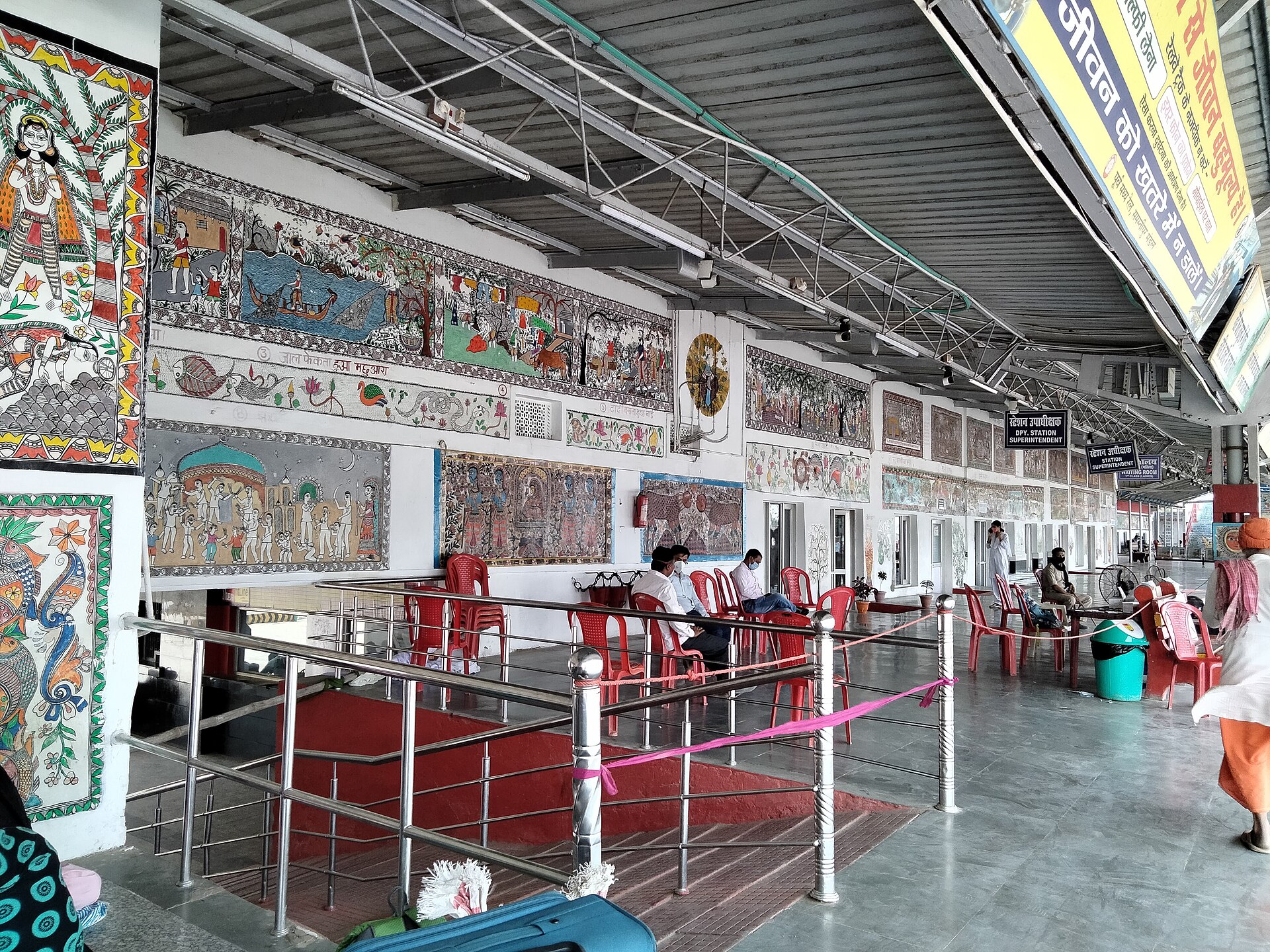
How seriously do Maithil families take it? Enough that a book excerpt on ThePrint argues the Kohbar painting matters more in a Maithil wedding than the horoscope. Mithila art also carries a local story: that King Janaka had the town painted for Sita's wedding. Lovely if true. Lovely legend either way. You can still see the tradition in public today, too. Madhubani railway station, pictured at the top of this page, has its walls covered in Mithila paintings.
Header photo: Madhubani paintings at Madhubani Railway Station by Sntshkumar750, CC BY-SA 4.0, via Wikimedia Commons.

What do the Madhubani motifs mean?
| Motif | Common meaning | Where to use it on the invite |
|---|---|---|
| Fish (often a pair) | Fertility, good luck, abundance | Around the couple's names |
| Lotus | The bride, purity, feminine energy | Top centre or behind the date |
| Bamboo grove | The groom, a growing lineage | Side borders |
| Parrots | Love and courtship | Function cards, the mehendi insert |
| Sun and moon | A marriage that lasts as long as they do | Top corners |
| Tortoise and snakes | Stability and protection in older Kohbars | Usually skipped on modern cards |
Readings vary by artist and family, and not every interpretation is settled. The lotus-and-bamboo pairing in particular is read differently by different scholars, as Memeraki's guide to Madhubani symbols explains. If you're inviting conservative elders, fish, lotus, parrots and sun-moon are the safe, sweet set.
Which of the five styles suits a wedding card?
- Bharni: bold, filled-in colour. Rich and festive, best for the main card.
- Kachni: fine line work, often only one or two colours. Elegant and minimal, great on ivory.
- Tantrik: religious and ritual imagery. Beautiful, but heavier than most couples want on an invite.
- Godna: tattoo-inspired repeating patterns. Good for borders.
- Kohbar: the wedding chamber paintings themselves. The obvious, perfect choice.
Our pick for a modern card: Kachni line work in one colour, with a single Bharni-filled Kohbar panel. Calm, very readable and still unmistakably Mithila.
Madhubani colours and how to use them on a card
Traditional Mithila painting used natural colours: turmeric yellow, red from flowers or kumkum, black from soot, green from leaves and the off-white of the wall or paper itself. That palette is a gift for invitations, because it's warm, festive and instantly recognisable.

On a card, use the off-white as your background, black for the double-line borders and lettering, and only two of the bright colours as fills. Red and yellow is the classic wedding pair. Swap in a deep green if you want it to feel calmer. Don't use all five colours at full strength on a small card. On a phone screen it turns into a kaleidoscope, and the date gets lost somewhere between a fish and a parrot.
How to get Madhubani art for your invitation
Step by step
Find a Mithila artist
Look for artists from the Madhubani and Darbhanga belt through craft councils, artist collectives and verified marketplaces.
Brief the motifs, not the layout
Tell them the names, the motifs you want and the mood. Let them compose it. That's what you're paying for.
Pay fairly and credit them
Put the artist's name on the back of the card or in the digital invite's credits. Small thing, means a lot.
Get a high-resolution scan
So the same art can work on the printed card, the digital invite and the decor backdrop.
Printing hand-painted art does push costs up, so check what wedding invitations cost in India before you decide on print runs.
Printed, digital or both?
Madhubani looks gorgeous on handmade paper with a bit of texture, so if you're printing, print a small run for elders and close family on good paper, and skip the foil and glitter. Mithila art was never shiny, and gold foil fights with it.
For everyone else, digital makes more sense. The line work stays crisp on a phone, you can add a map and RSVP, and nobody ends up with a stack of cards they feel guilty about throwing away. A good middle path: one painting, scanned once, used for a short printed run and the digital invite and the haldi backdrop. Pay the artist once, get three uses.
Taking the art beyond the card
The same Kohbar painting can become the haldi backdrop, the welcome board and the mehendi cushions. We've put together decor ideas for a Sita Ram wedding that use Mithila art for the daytime functions.
If you're going digital, Eventic's Mithila invitation draws its function section with Kohbar-style fish and lotus line work along a river. Credit where it's due: it's inspired by the tradition, and nothing beats a painting by a Mithila artist if you can get one.
May your Kohbar be full of fish, your lotus always bloom, and your bua not ask what the bamboo means at the dinner table.
People Also Asked
Explore common questions related to this blog.
Get trusted event guides in your Google feed.