The wording that works is short, warm, and gives people something to do instead. "Your blessings are the only gift we need" lands well. "Strictly no gifts" does not.
But there's something worth knowing before you pick a line: a meaningful share of your guests will bring something anyway. Around a third to half, in most Indian families. Planning for that gracefully matters more than the exact wording.
Here are the lines, where to put them, and how to handle the guests who ignore them.
First, the etiquette conflict
Traditional Western etiquette is firm that gifts shouldn't be mentioned on an invitation at all. The Emily Post Institute's guidance states that there is never any mention of gifts — not even "no gifts, please" — on the invitation or its enclosures, because the invitation should focus solely on the hope that the guest can attend.
Indian practice diverges here, and reasonably so. Gift-giving at a birthday, particularly a first birthday or a milestone, is close to automatic. Saying nothing doesn't mean guests arrive empty-handed; it means they arrive with something they felt obliged to buy. For many families, a gentle line is more considerate than silence.
So: the Western rule is to say nothing. The Indian reality is that a warm line saves your guests money and effort. Pick based on your guest list, not a rulebook.
Wording that works
Warm and blessing-focused
Best for first birthdays and family-heavy guest lists.
- Your blessings are the only gift we need. 🤍
- Your presence is the only present we want.
- Come with your love and blessings — nothing else needed.
- No gifts, please. Just come and bless our little one.
- आपका आशीर्वाद ही सबसे बड़ा उपहार है।
- आपकी उपस्थिति ही हमारे लिए सबसे बड़ा तोहफा है।
- कृपया उपहार न लाएं — बस अपना स्नेह और आशीर्वाद साथ लाइए।
Light and casual
For adult birthdays and friend groups.
- No gifts please — just bring yourself and an appetite.
- Your company is enough. Save your money for the next round.
- Gifts optional, attendance mandatory. 😄
- Please don't bring anything. Seriously. We're running out of space.
- No presents — just come hungry.
Practical and clear
When you want the message to actually be followed.
- We'd genuinely prefer no gifts. Your presence is what matters.
- We have everything we need — please don't bring anything.
- No gifts, no flowers, just you.
For kids' parties
- [Child's name] has plenty of toys — please, no gifts. Just come and play.
- No gifts needed! If you'd like to bring something, a book would be lovely.
- Please skip the gifts — we're keeping it simple this year.
That "a book would be lovely" framing is the single most effective line on this page for children's parties. It gives the guest a clear, low-cost, hard-to-get-wrong option, which is what most people actually want.
Redirect instead of refuse
Guests find "bring nothing" harder than "bring this instead." A redirect satisfies the impulse to give while removing the guesswork.
To a cause
- In lieu of gifts, we'd be grateful for a small contribution to [cause].
- If you'd like to give something, please consider a donation to [organisation] instead.
- उपहार के स्थान पर, यदि आप चाहें तो [संस्था] को छोटा सा योगदान दे सकते हैं।
- We're collecting books for [school/NGO] instead of gifts — bring one if you'd like.
Name a specific organisation. "A charity of your choice" produces nothing, because it hands the decision back to the guest. A named cause with a line about why it matters to your family produces actual donations.
To something small and useful
- If you'd like to bring something, a plant or a book would be perfect.
- No gifts please — but a story book for [Child's name] is always welcome.
- Skip the toys. A sapling would make us very happy.
To an experience or fund
- No gifts, please. If you'd like to contribute to [Child's name]'s education fund, details are on the invite.
- We're saving for [goal] — a contribution would mean more than anything wrapped.
To food or the party itself
- No gifts — but if you bake, bring dessert. 😄
- Nothing needed. Just come early and help us set up.
Where to put the line
On a digital invite: at the bottom, after the RSVP, in a smaller size. It's an aside, not a headline.
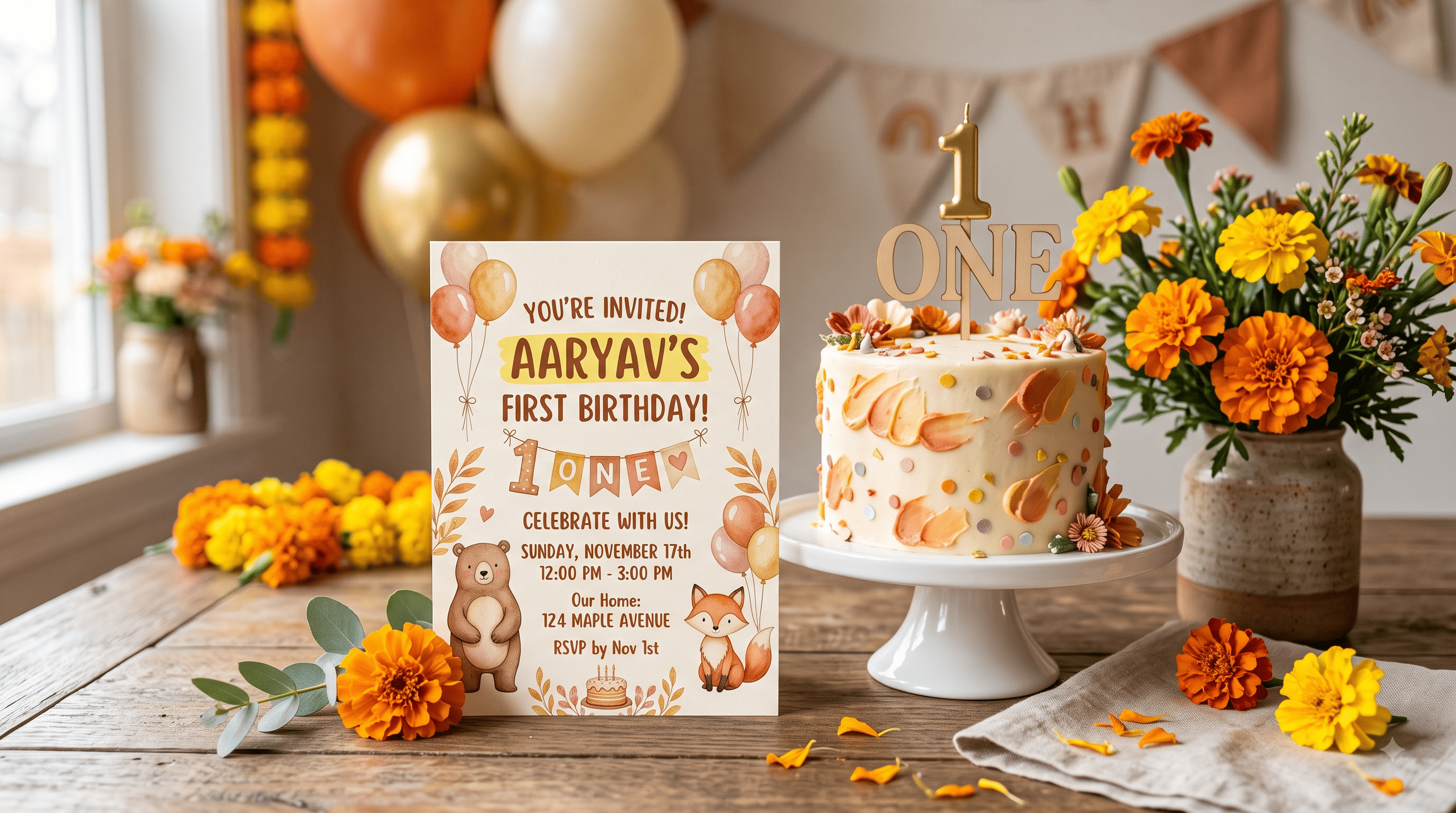
On a printed card: on the details insert, never on the main card face.
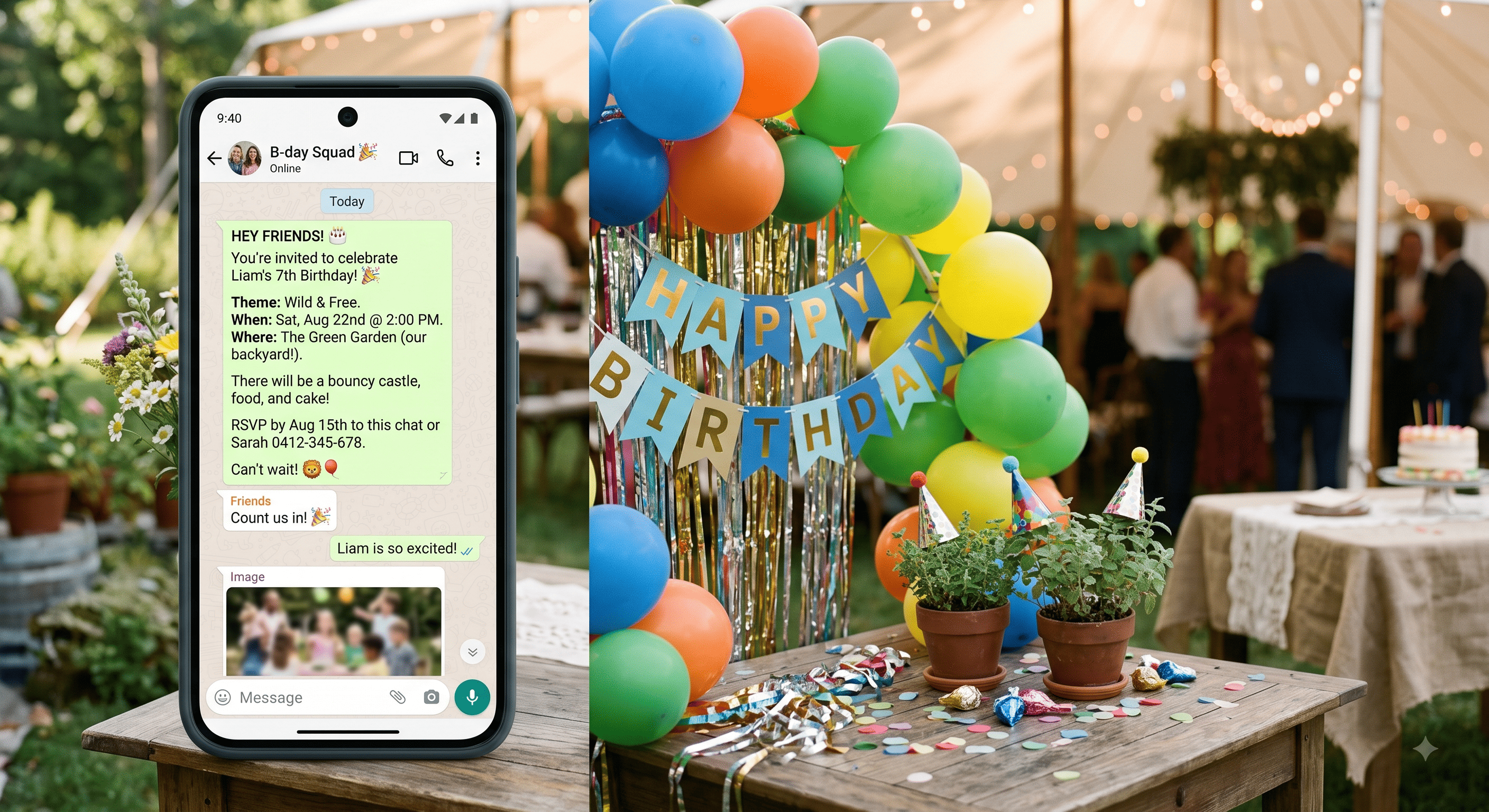
On a WhatsApp message: the last line before the RSVP.
Never: in the first three lines, in bold, or in capitals. The more prominent it is, the more it reads as a rule rather than a kindness.
One line, once. Repeating it across the invite, the reminder, and the group chat turns a gracious note into a campaign, and guests notice.
Words to avoid
| Don't write | Why |
|---|---|
| "Strictly no gifts" | Reads as a rule. Guests feel scolded |
| "No gifts allowed" | Same problem, worse |
| "We don't need anything from you" | Sounds cold |
| "Absolutely no presents!!!" | The exclamation marks do the opposite of what you intend |
| "No boxed gifts" | Widely read as "cash preferred," which is the opposite of no gifts |
| "Gifts not necessary but appreciated" | Contradicts itself. Guests will bring gifts |
That second-to-last one matters in India specifically. "No boxed gifts" has become shorthand for expecting an envelope, so if you genuinely want nothing, avoid the phrase entirely.
The no-gifts line and the reply line sit next to each other on most invitations, and both get written badly. Here's the RSVP half.
What about shagun and cash envelopes?
If you'd rather not receive cash, say so directly but gently — and expect elders to hand it over regardless.
- No gifts and no shagun, please — your blessings are enough.
- Please, no envelopes. We really do just want your company.
Realistically, older relatives will give shagun to a child on a first birthday no matter what the invitation says. It's an expression of blessing rather than a transaction, and refusing it at the door will cause more awkwardness than accepting it warmly. Accept, thank them properly, and let it go.
When guests bring gifts anyway
They will. Plan for it rather than being caught out.
Accept it warmly. Never say "but we said no gifts." The guest chose to give something; the only gracious response is thanks.
Don't open gifts at the party if you asked for none. Opening them publicly makes the guests who followed your request feel they got it wrong.
Have a quiet corner — a side table where things can be left without ceremony.
Thank each person individually afterwards, specifically. A message naming what they gave, with a photo from the party, does more than a generic group thank-you and costs you nothing.
Don't feel guilty. Asking for no gifts is not a failed instruction if some people give anyway. It reduced the total, which was the point.
Should you say anything at all?
Say something if: it's a child with plenty already, you're keeping the party small, you're redirecting to a cause, or you genuinely don't want the clutter.
Say nothing if: it's a formal milestone where elders would find the mention odd, your guest list is mostly close family who'll give regardless, or the wording would need so much softening that it stops meaning anything.
For a formal 60th or 75th with a traditional guest list, silence is often the better call — the Emily Post logic applies more here than at a five-year-old's party.
Return gifts, the other half of the equation
If you're asking guests not to bring gifts, it's worth thinking about what you're sending home with them. Indian birthday parties often hand out return gifts that are plastic-wrapped, briefly used, and binned — which somewhat undercuts a no-gifts request.
A single well-chosen item beats a bag of small ones. That's covered properly in the guide to eco-friendly return gifts, alongside options that don't create the same waste.
The same logic applies to the invitation itself — asking for less stuff while posting 40 printed cards is a mixed message. The eco-friendly invitation guide covers the digital-plus-keepsake split most families land on.
Sample invitations with the line included
WhatsApp, kids' party
[Child's name] is turning [age]! 🎈
📅 [Date] | ⏰ [Time]
📍 [Venue]
Games, cake, and a lot of noise.
No gifts please — just bring your little one.
RSVP: [number]
First birthday, formal
With hearts full of gratitude, we invite you to celebrate the first birthday of our son/daughter, [Name].
[Day, Date] | [Time]
[Venue]
Your blessings are the only gift we need.
— [Parents' names]
Adult birthday, casual
Turning [age] and doing very little about it.
[Date], [Time] onwards at [Venue]
No gifts — just come and eat.
Let me know if you're in.
More formats across kids', milestone and surprise parties are in the WhatsApp invitation samples, and the invitation wording generator will build one with the no-gifts line already placed.
People Also Asked
Explore common questions related to this blog.