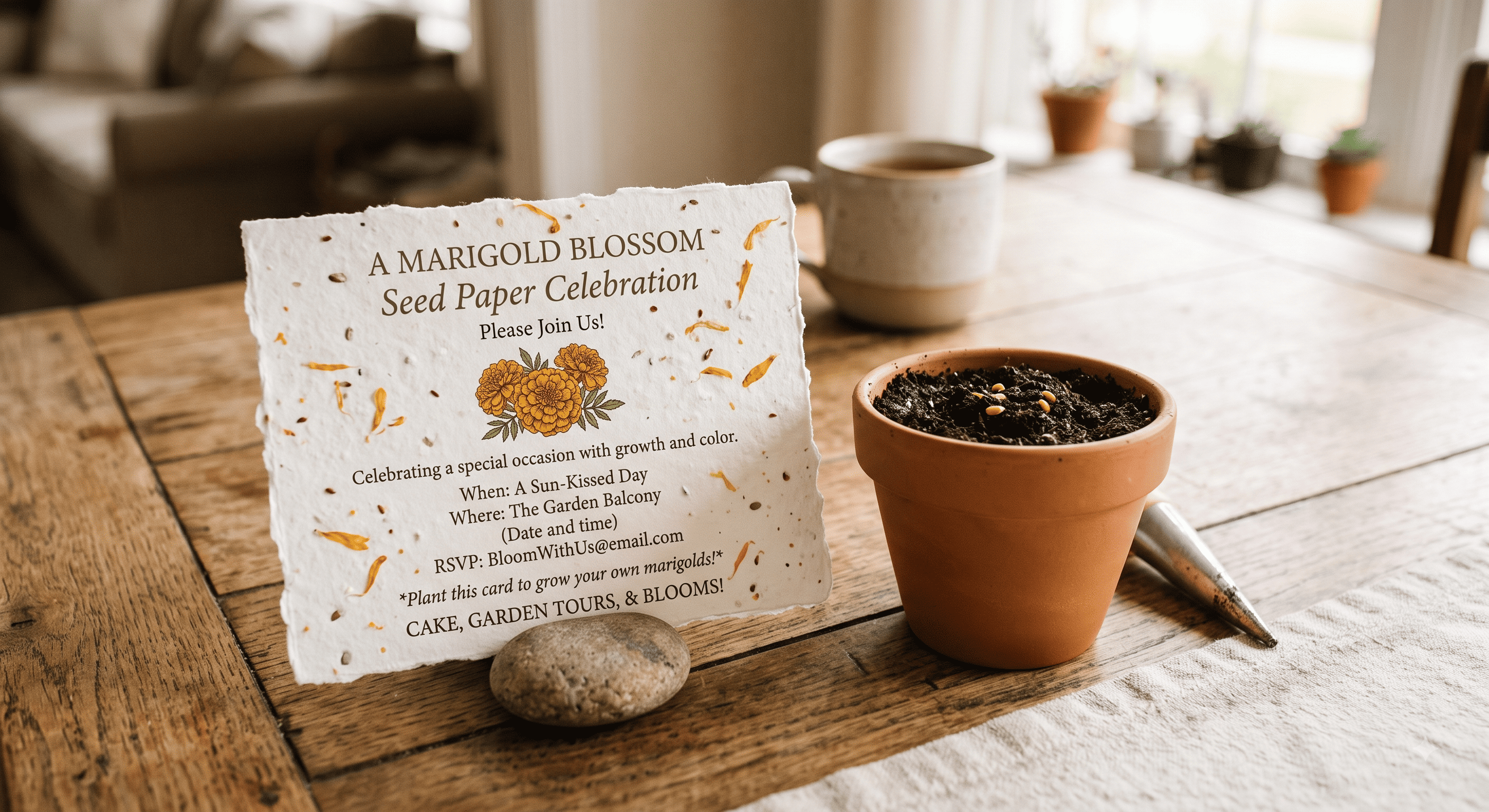
Yes — and generally better than they do in colder countries, provided they're planted at the right time of year. Indian seed paper is usually embedded with marigold, tulsi, coriander or mint, all of which germinate readily in Indian conditions within 7 to 10 days.
The catch isn't the climate. It's that most cards carry planting instructions written for a European spring, and that most guests never plant them at all.
Here's what actually happens to a seed paper invitation in India, and how to make yours work.
Do they germinate?
Yes. Indian manufacturers typically report sprouting in 7–10 days with proper moisture and light, which matches what home gardeners see with the same seeds sown directly.
What the paper needs:
- Soaked overnight, or watered heavily on the first day
- Planted under a thin layer of soil — roughly ¼ inch, no deeper
- Kept consistently moist for the first 10 days
- Bright light, ideally 4+ hours of sun
- Reasonable soil, not construction-site dirt in a plastic cup
Miss the ten-day moisture window and nothing happens. It's the single most common reason a card fails, and it's the instruction most often left off.
One thing to treat with mild scepticism: several Indian sellers advertise seeds that "germinate in all weather." That's a marketing line, not a horticultural fact. Which brings us to the part that actually matters here.
The timing problem nobody mentions
Most seed paper planting instructions say "plant in spring." That advice is imported and it doesn't map onto Indian conditions.
| Season | Months | Verdict |
|---|---|---|
| Monsoon | June–September | Best. Consistent moisture, warm soil, ideal germination |
| Post-monsoon / autumn | October–November | Very good in most of India. Avoid in North India — young seedlings won't survive the December cold |
| Winter | December–February | Fine in South and West India. Poor in the North |
| Late winter / early spring | February–March | Good — marigold sown now flowers around Holi |
| Summer | April–May | Worst. Balcony pots dry out in hours at 40°C+. Seedlings cook |
The monsoon is the window. Warm soil, daily rain, and no need for anyone to remember to water — which conveniently removes the ten-day step people forget.
This has a practical consequence for your invitation. If the birthday is in April or May, a guest who plants the card immediately will very likely watch it fail. Better to print "plant with the first rains" than "plant immediately," and let the card sit in a drawer until June.
Seed paper stays viable for roughly 18 months to two years, so a few months' wait costs you nothing.
Which seeds actually work here
Indian seed paper makers typically offer marigold, tulsi (holy basil), coriander, mint, sunflower and aster — chosen because they're hardy in Indian conditions rather than for looks.
| Seed | Germination | Suitability |
|---|---|---|
| Marigold (genda) | 5–7 days | Excellent. The default for a reason — tough, fast, flowers in 6–8 weeks |
| Tulsi | 8–14 days | Excellent, and culturally meaningful. Needs 4+ hours sun, won't survive North Indian cold as a seedling |
| Coriander (dhania) | 7–10 days | Very good. Guests actually use it |
| Mint (pudina) | 10–14 days | Good, spreads readily once established |
| Sunflower | 7–10 days | Good, but needs a real pot — not a balcony teacup |
| Mixed wildflower | Variable | Least reliable. See below |
Avoid generic "wildflower" mixes
A wildflower blend sold across the country can't be right for every region, and Indian mixes frequently contain non-native ornamentals. Research on commercial wildflower seed mixes elsewhere has repeatedly found packets containing species that were invasive in the buyer's region and contents lists that didn't match what was inside.
The safe move is simple: choose a single named seed rather than a mix. Marigold or tulsi is a better card than "assorted wildflowers," and you can tell guests exactly what they're growing.
Tulsi is the strongest choice for an Indian birthday card
It germinates reliably, grows in a pot on any balcony, carries genuine cultural weight, and gets used. A guest who grows tulsi from your child's birthday invitation will actually mention it to you a year later, which is more than can be said for a wildflower that never sprouted.
The honest problem: most guests won't plant it
This is the part sellers don't lead with.
At a typical birthday party, guests read the invitation, put it aside, and get on with their week. The share who soak it overnight, find a pot and soil, and water it daily for ten days is small — realistically a handful out of forty.
So the environmental case for seed paper largely reduces to "it's recycled paper that biodegrades." True, and fine — but also true of plain recycled card at a third of the price.
Buy seed paper because it's a lovely gesture, not because you're planting a garden. There's a way to improve the odds, though.
How to actually get them planted
Print instructions on the card itself. Not a separate slip. One line on the back:
Soak overnight → plant under ¼ inch soil → keep moist 10 days → sun.
Say when, not just how. For a summer birthday: "Plant with the first monsoon rains." This one change probably doubles your success rate.
Name the plant. "Marigold seeds inside — plant me!" is far more likely to be acted on than "plantable card."
Make it the return gift instead of the invitation. Guests hold on to invitations; they take return gifts home and unpack them. A seed paper card tucked into the return gift bag with a small pot of soil is the version that actually gets planted — and it doubles as a low-waste alternative to plastic-wrapped toys, which is covered in the guide to eco-friendly return gifts.
Send the invitation digitally and print two. One for the memory box, one for a grandparent who gardens. That's the split most families end up at anyway.
Printing on it is harder than expected
Indian plantable sheets are typically A4 at around 280 GSM — thick, textured, and inconsistent.
Practical warnings:
- Most home and small office printers jam on it. Feed sheets one at a time.
- Use inkjet, not laser. Laser fusing heat can damage the seeds.
- Test one sheet before running fifty. A failed print run wastes more paper than the whole exercise saves.
- Hand-writing or a rubber stamp often looks better than home printing on this stock, and sidesteps the problem entirely.
- Don't laminate. Don't foil. Don't add glitter. It stops being plantable and stops being recyclable.
What it costs
| Format | Price |
|---|---|
| Blank A4 plantable sheets | ₹15–₹40 per sheet (cheaper in packs of 50–100) |
| Pre-printed seed paper invitation | ₹40–₹90 per card |
| Plain recycled card, printed | ₹15–₹60 per card |
| Digital invitation | ₹0 |
For a 40-guest party, seed paper invitations run ₹1,600–₹3,600 versus ₹600–₹2,400 for ordinary printed cards. You're paying roughly ₹1,000–₹1,500 extra for the seeds and the texture.
That's reasonable for something you like. It's worth being clear it's an aesthetic and sentimental upgrade rather than a meaningful environmental one over plain recycled paper.
If you're printing your own, marigold seed paper in packs of 50 or packs of 100 are the common A4 options, both at 280 GSM. Check the manufacture date if it's listed — older stock germinates less reliably.
When seed paper is the right call
Good fit: small guest lists, first birthdays where you want a keepsake, monsoon or post-monsoon party dates, return gifts, families who garden.
Poor fit: guest lists over 40 where the cost multiplies, April–May parties, anyone choosing it primarily for environmental reasons, and anyone planning to print fifty at home on an office printer.
The sensible middle is the one most families land on: send the invitation digitally, print two or three on seed paper as keepsakes. The eco-friendly invitation guide covers that split, and the invitation wording generator will handle the digital side including RSVP tracking.
If your party is in the monsoon, seed paper is a genuinely nice choice — print a few, name the plant on the card, and tell people when to sow it. If it's in April, either wait for the rains or skip it. And either way, send the actual invitation digitally: forty cards that get glanced at once are the real waste, whatever they're made of.
People Also Asked
Explore common questions related to this blog.