Quick answer: the wishbone (the bird's collarbone, or furcula) is often traced to the ancient Etruscans, who used it as a luck charm. The custom passed through the Romans to England, where it was called the merrythought, and on to America. Two people pull it apart, and whoever gets the bigger piece gets their wish.
It sits on the windowsill for a few days after the turkey is carved. Then, after the pie, someone holds it out, two people hook a pinkie each, and the whole table watches. A crack, a cheer, and one person quietly makes a wish. The wishbone is one of the oldest table traditions we still keep, and one of the first Thanksgiving rituals children learn. It's a good one to know the story of. This is part of our Thanksgiving guide.
Where the wishbone tradition comes from
The wishbone is the bird's furcula, the fused collarbone that helps it fly. Popular histories often trace the custom to the ancient Etruscans of Italy, who believed birds could foretell the future and kept the bone as a charm. Accounts differ on whether they stroked it or broke it.
The Romans are said to have picked up the custom and spread it through their empire, including to Britain. There, the bone earned a lovely name: the merrythought. The word "wishbone" itself only appears around 1860; before that, people called it the merrythought or the wishing-bone.
From England the tradition crossed to America, where it settled into Thanksgiving, the one dinner of the year when nearly every family has a large bird on the table. Much of this history comes from popular accounts rather than ancient records, so treat the details as good table conversation rather than scholarship.
Why it's called the merrythought
Nobody is entirely sure, but the name fits the idea: a small, happy thought, a hope you hold for a moment and then let go. Some families still use the old name, and it's a lovely thing to share at the table. Thanksgiving is, in a sense, one long merry thought about the people you love.
How to break a wishbone (and win)
- Save it when you carve. It sits at the front of the breastbone, where the neck meets the breast.
- Clean it and let it dry. Leave it on a windowsill or a shelf for three days. A fresh wishbone bends instead of snapping.
- Choose your opponents. Traditionally two people, often the youngest and oldest at the table, or the host and a guest of honor.
- Hook your little fingers around each end. Both people make a silent wish.
- Pull on three. Whoever ends up with the larger piece, with the top knob attached, gets their wish.
| Tip | Why it helps |
|---|---|
| Hold your end close to the base | You pull with more leverage near the joint |
| Pull steadily, don't jerk | A slow, even pull keeps your piece longer |
| Keep your wish secret | Tradition says telling it means it won't come true |
| Dry it fully | A properly dry bone snaps cleanly, and somebody actually wins |
Wishbone traditions families keep
- Youngest versus oldest. A sweet way to bring the generations together.
- The host's prize. Whoever cooked gets first claim.
- Save them all. Some families keep every year's winning half in a jar.
- Friendsgiving rules. Draw names, or let the newest friend pull it.
- No turkey? Brass and resin "lucky break" wishbones exist so vegetarian tables can play too.
Pair it with the go-around-the-table moment. Our Thanksgiving questions to ask at dinner include "who won the wishbone last year?" for a reason.
What the wishbone actually is
Biologically, the wishbone is a bird's furcula: its two collarbones fused into a single V-shaped bone at the base of the neck. It sits across the front of the chest and helps brace the shoulders, which is why it's springy and hard to break while it's fresh. Turkeys and chickens both have one, and it's part of what gives the wishbone its satisfying snap once it's dried out.
The fused collarbone is also one of the features birds share with some of their dinosaur ancestors, which is a fact that tends to delight children at the table almost as much as the wish itself.
Explaining the wishbone to kids
Kids usually love the wishbone more than anyone. A simple way to explain it: "A long, long time ago, people thought this little bone was lucky. If two people pull it and you get the bigger piece, you get to make a wish, but you have to keep it secret." Let the youngest child have a turn every year, and help them hold their end close to the bottom so they have a fair chance.
If there are several children, collect the wishbones from roast chickens through the autumn so everyone gets a go. Some families write each year's winner on a card and keep it with the holiday decorations, which turns a thirty-second ritual into a family record.
Planning the dinner around it
The wishbone only comes from a whole bird, so if you're roasting a turkey, plan for leftovers and a few days of drying. For quantities, use our guide to how much food per person. And if you're inviting people this week, our Thanksgiving invitation timeline shows how early to send it.
An invitation that starts with a wish
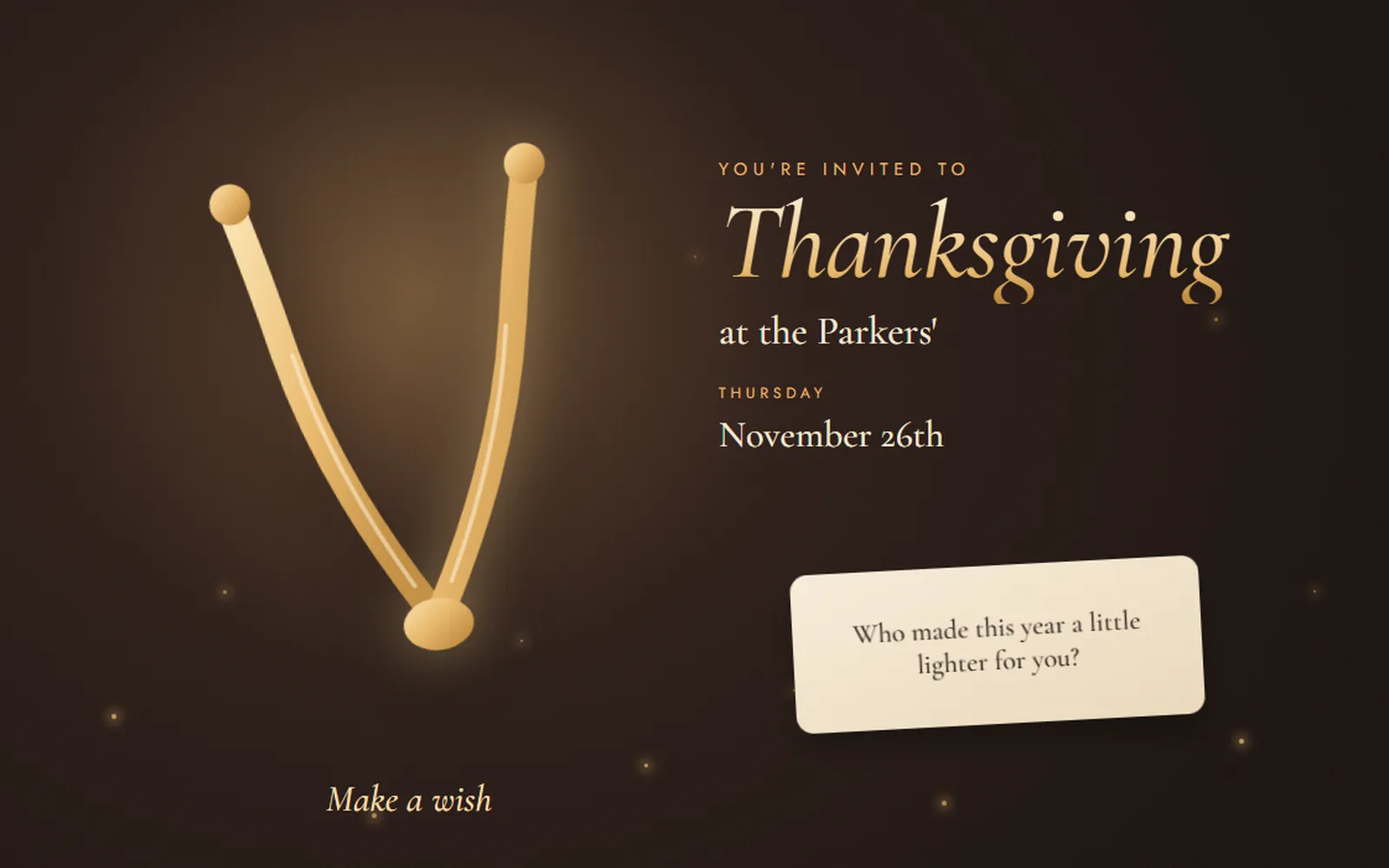
We liked the merrythought story so much that we built a Thanksgiving invitation around it. Merrythought opens with a golden wishbone on a candlelit screen. Your guests pull it apart with a finger, it snaps with a spark, and they always get the lucky break. Then the invitation opens, with gratitude cards for the questions you'll ask at the table. It's a small, playful way to tell people that this dinner is about more than the food.
People Also Asked
Explore common questions related to this blog.
Get trusted event guides in your Google feed.