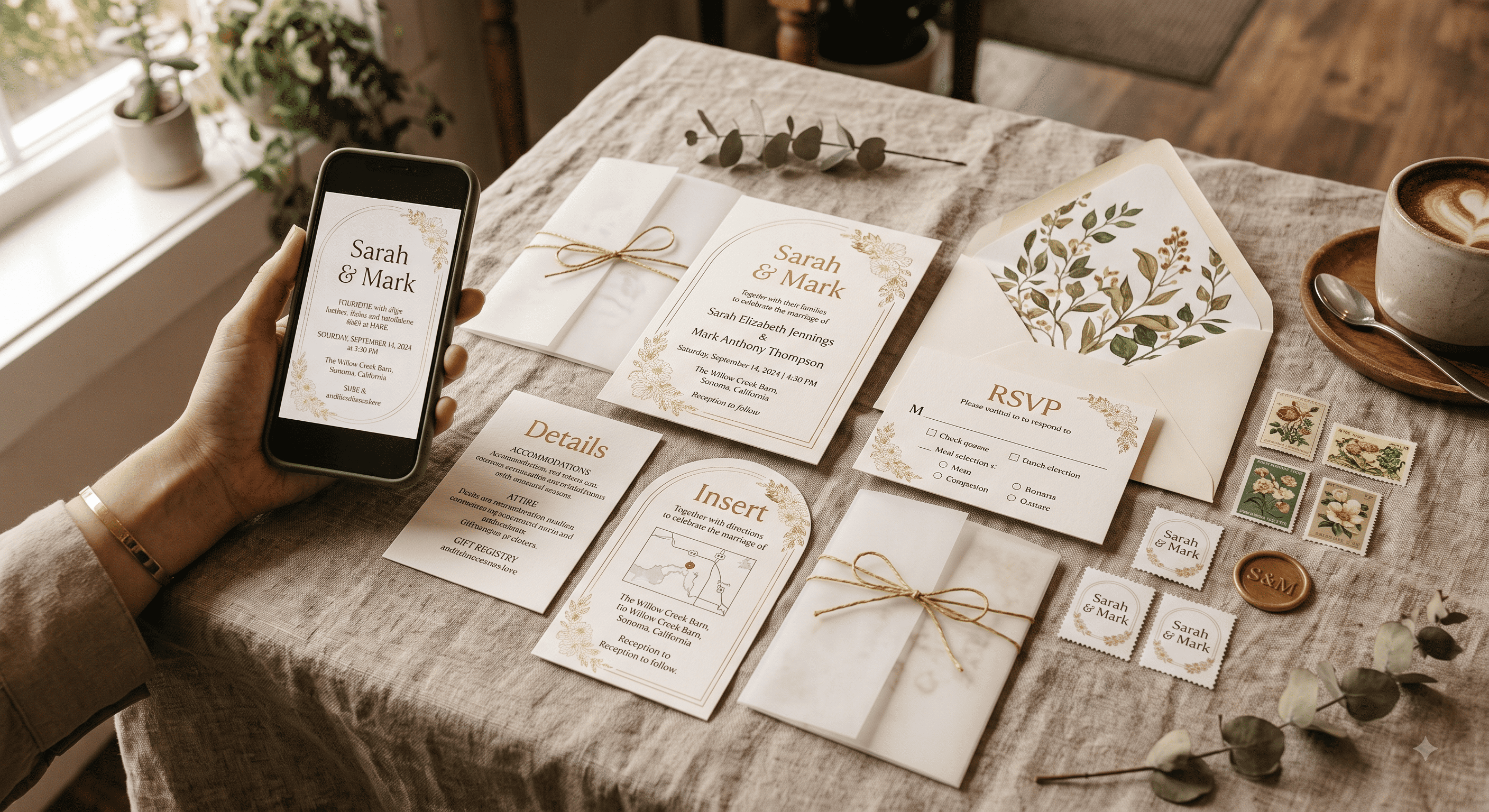
Here's the rule almost nobody tells couples: you are allowed to send different guests different things. There is no etiquette law requiring one format for the entire list. Nobody is comparing notes. Your college roommate is not calling your grandmother to check what arrived in her mailbox.
Once that lands, digital invitation etiquette stops being a philosophical debate and becomes a sorting exercise. Here's how the sorting goes.
The tier system
Sort by relationship and expectation, not by age alone — a 34-year-old cousin who's precious about tradition belongs higher up than a 68-year-old uncle who does his banking on his phone.
| Tier | Who | What they get | Why |
|---|---|---|---|
| 1 — Paper, hand-delivered | Parents, grandparents, the person who's hosting, siblings | Printed card, given in person | It's a keepsake and a gesture. This tier is about ritual, not information |
| 2 — Paper, mailed | Great-aunts, family friends of your parents, elderly relatives | Printed card with a QR code | They expect mail. It costs you almost nothing to honour that |
| 3 — Personal digital | Extended family, older colleagues, anyone you're not in regular contact with | Individual message or email with a personal line | The personal note does the work the envelope used to do |
| 4 — Direct digital | Friends, cousins your age, anyone in your regular texts | The link, sent normally | This is how you communicate with them already |
Most 100-guest weddings sort roughly 8 / 15 / 25 / 52. That's a print run of about 23 cards.
The rules that don't change just because it's digital
The format changed. The obligations didn't. Emily Post's wedding invitation guidance still holds on all of these:
One invitation per household, addressed to specific people. Digital makes it tempting to blast a list. Don't. The invitation names who's invited, which is how guests know whether the kids and the new boyfriend are included. A link sent to a group chat names nobody, and you'll spend the next month answering "can I bring someone?"
The host line stays. If the bride's parents are hosting, the invitation says so, on a screen exactly as it would on paper.
Formality signals are yours to set. Guests read dress expectations off the invitation's tone. A digital invitation with casual wording tells people to come in a sundress. If that's not your event, fix the wording.
Deadlines are real. An RSVP date belongs on the invitation, and it should be about four weeks before the wedding. Emily Post's take on the guest's side of the RSVP is worth reading before you write your reminder messages, because it'll make you feel less guilty about sending them.
What to say when someone gets the digital version
Tier 3 is where couples freeze. Here's copy-paste wording for the message that carries the link — keep the invitation itself formal, and put the warmth in the message around it.
For an extended family member:
Dear Aunt Rosemary,
Michael and I are getting married on Saturday, 16 May, and we would be so happy to have you with us. Our invitation and all the details are here: [link]. You can reply on the page, or just call me — either is perfect.
With love, Anna
For an older colleague or a professional contact:
Dear Mr. Whitaker,
I'd like to invite you and Mrs. Whitaker to our wedding on Saturday, 16 May, at the Fairmont. The invitation and RSVP are at the link below, and I've included the schedule and parking details there as well.
[link]
Warm regards, James Okafor
For a friend:
ok it's official 🥹 we're getting married May 16 and you're obviously invited. everything's here → [link], RSVP by April 18 so I can stop making spreadsheets
Notice the invitation is identical in all three cases. Only the wrapper changes.
The situations people actually ask about
A guest replies to the group with "who else is coming?" You didn't use a group message, so this doesn't happen. That's the whole reason for the rule.
Divorced parents, and one is hosting. The wording question is bigger than the format question, and it's the same on paper. Handle the host line first, then send it however you like.
Someone says they never got it. Check whether it went to an old number or an email they don't use, then resend from a different channel with a short personal line. Don't make it a thing.
A guest RSVPs for people you didn't invite. This is the cost of vague addressing, and it's fixable at the source: the invitation should name the invited guests, and the RSVP form should let people confirm rather than add names freely. Setting the guest count per household in advance — which an RSVP tracker does when you build the list first — closes the loophole before anyone finds it.
Your mother wants to hand out cards to her friends. Give her 25 and let her. It costs $70 and buys you a peaceful eight months.
Timing etiquette (unchanged from paper)
- Save the dates: 6–8 months out, or 8–12 for destination weddings.
- Invitations: 6–8 weeks out. Digital arriving instantly doesn't mean you send late — guests still need to book flights and childcare.
- RSVP deadline: 4 weeks before the wedding.
- Reminder to non-responders: 3–4 days after the deadline, individually, never as a group announcement.
The one genuinely new rule: don't send the invitation and the wedding website link separately. They're one thing now. The invitation links to the site, and the site holds everything that won't fit on the card — which is most of it. What belongs on each is laid out in the twelve things a digital invitation needs to include.
The etiquette failure that actually matters
It isn't the format. It's an invitation that leaves guests uncertain about whether they're invited, who else is, and what's expected of them. Paper invitations solved that through convention — inner envelopes, addressing style, formal wording. Digital has to solve it deliberately, by naming guests and being clear.
Do that, and you're a good host. Skip it, and no amount of letterpress saves you. If your family still needs convincing that the medium isn't the problem, the honest version of the "is digital tacky" argument has the talking points, and the broader guide to sending digital wedding invitations properly covers the mechanics.
If you're stuck on where a specific guest belongs, use this test: would it feel strange to hand this person a phone instead of a card? If yes, they're paper. It's a surprisingly accurate instinct and it takes two seconds per name.
People Also Asked
Explore common questions related to this blog.