Heads up: some links in this post are Amazon affiliate links — if you buy through them, Eventic earns a small commission at no extra cost to you.
Three weeks before her sangeet, a friend messaged me at midnight: 187 guests invited, no idea how many were coming, and a caterer asking for a number by Friday. She'd used a free invitation tool — good design, zero tracking — and had been counting replies by scrolling through WhatsApp.
She spent that night building a spreadsheet from chat history. The free invite cost her ₹0 and about six hours she didn't have.
That's the actual trade-off in this comparison, and it isn't the one people expect. Free digital invitations in India are genuinely good now. What separates them from paid ones usually isn't the design — it's everything that happens after you hit send. Here's where each option makes sense, without the sales pitch. For the broader budget picture, this sits under our invitation cost guide for India.
Side by side
| Feature | Free tools | Paid (₹500–₹3,000) |
|---|---|---|
| Design quality | Genuinely good | Genuinely good |
| Watermark | Sometimes | No |
| Multi-function sets (mehendi/haldi/sangeet) | Rebuild each one manually | Matched set, edit once |
| RSVP collection | Usually none, or a separate form | Built in |
| Guest response tracking | Manual | Automatic, in one list |
| Hosted link (not just an image) | Rarely | Yes |
| Guest limit | Often capped on RSVP | Usually unlimited |
| Custom domain / branding removal | No | Sometimes |
| Support when something breaks at 11 PM | None | Varies, but exists |
| Cost for a 300-guest wedding | ₹0 | ₹500–₹3,000 total |
Look at that table honestly and the design row is a tie. Anyone telling you free templates look cheap in 2026 hasn't opened Canva's invitation library recently.
When free is genuinely the right answer
Your guest list is under 75. RSVP tracking by WhatsApp works at this scale. Annoying, but workable.
You're hosting one or two functions. Rebuilding a design twice is fine. Five times is where it falls apart.
You already know who's coming. Small family weddings where attendance was settled over phone calls months ago don't need a tracking system.
Budget is genuinely tight. If ₹2,000 is the difference between something else being cut, use the free tool. No invitation platform is worth compromising the parts of the wedding guests will remember.
You just need one pretty image to WhatsApp. That's a legitimate use case and free tools nail it.
When paying is the obvious call
Your list crosses 150. The manual tracking maths breaks here. It's not gradual — you go from "slightly tedious" to "unmanageable" in about a week.
Multiple functions with different guest lists. Sangeet for friends, ceremony for family, reception for everyone. Managing three overlapping lists manually is where mistakes start — people invited to the wrong thing, or not invited at all.
Outstation or overseas guests. They need travel details, hotel information and a schedule that doesn't live in a JPEG. A hosted page handles this; an image can't.
You need a headcount for a caterer. This is the real one. Catering is priced per plate. A 40-guest overestimate on a ₹900 plate is ₹36,000 wasted, which makes a ₹2,000 invitation platform the cheapest insurance in the entire wedding budget.
That last point is worth sitting with. People frame this as "should I pay for an invitation," but the invitation isn't what you're buying. You're buying an accurate number, and the number is worth twenty times the price.
The hidden cost of free: your time
Nobody prices this, so let's price it. For a 250-guest wedding using free tools:
| Task | Realistic time |
|---|---|
| Rebuilding the design for 4 extra functions | 3–4 hours |
| Sending invites individually or in batches | 2–3 hours |
| Chasing non-responders across chats | 5–8 hours |
| Building the headcount spreadsheet manually | 3–4 hours |
| Re-chasing after the list changes | 2–3 hours |
| Total | 15–22 hours |
Fifteen hours, in the six weeks when you have the least of them. Against ₹2,000.
I'm not going to tell you your time is worth ₹130 an hour — that's a silly way to think about your own wedding. But be clear that free isn't free, it's just paid in a different currency, and it's the currency you'll be shortest of in the last month.
If you are going the manual route, do it properly rather than in a chat thread. A wedding guest list and RSVP register at ₹250–₹500 sounds old-fashioned and works surprisingly well — one row per household, a tick column, and both mothers can read it without asking you anything. Then once the headcount is settled, blank place cards at ₹200–₹400 for fifty are what turn that number into actual seating, which is the next thing your caterer will ask about.
What actually justifies the ₹500–₹3,000
If you're paying, these are the features worth checking are included. Anything charging for these separately isn't really in this tier:
- RSVP responses in one list, exportable. Not just a form — a list you can hand to the caterer.
- All functions covered under one price. Confirm this. Some services charge per event, which changes the maths entirely for a five-function wedding.
- No guest cap. Free tiers cap RSVPs around 50–100. Paid should be unlimited.
- A shareable link that renders properly on WhatsApp with a preview image.
- Meal or function-wise responses, if you're doing multiple events with different lists.
- The page stays live through the event and ideally past it.
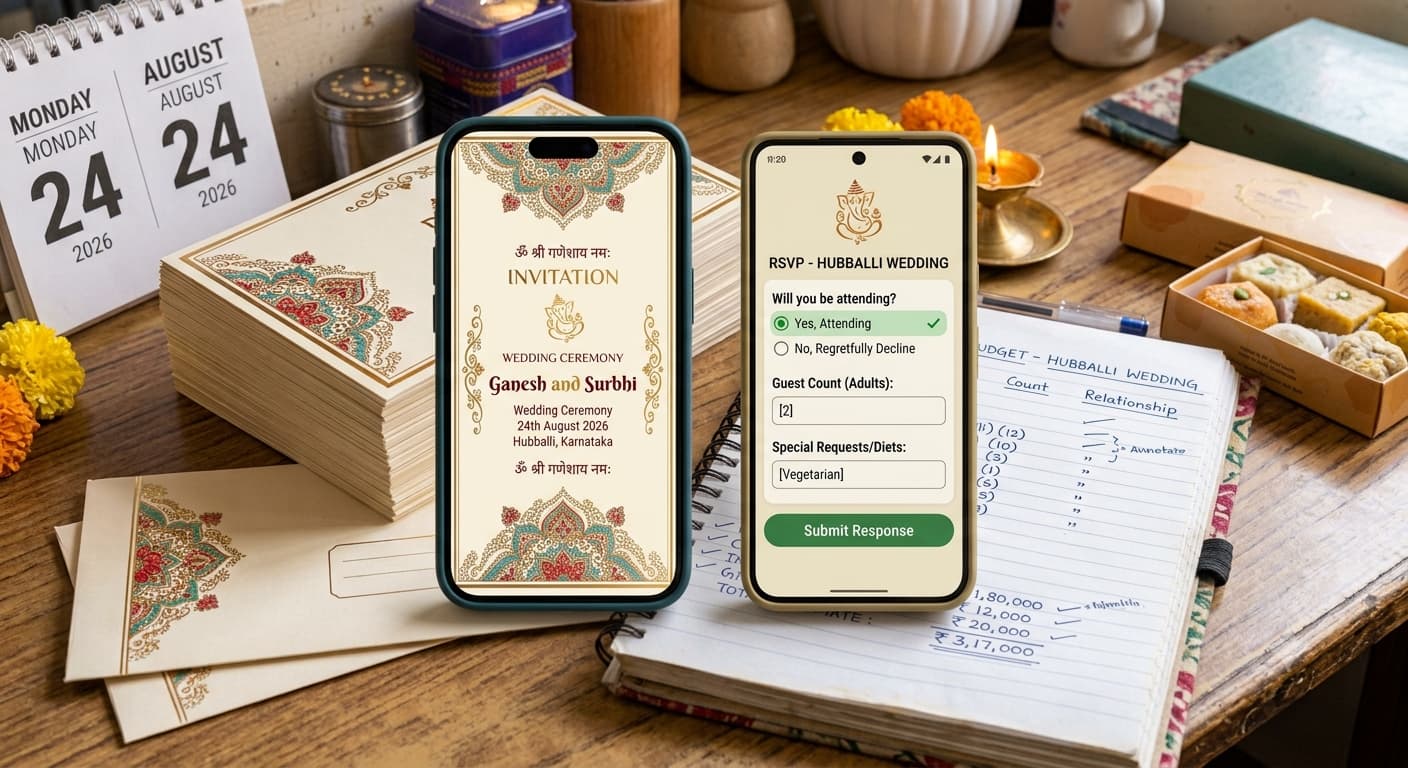
Chasing forty people across five different chats for a yes-or-no is a part-time job nobody applied for. That's genuinely what an RSVP tracker fixes — every response lands in one place instead of your DMs at midnight. And if you want to test-drive the tracking side before spending anything, several free RSVP tools are worth trying first — no reason to pay before you know the feature matters to you.
The middle path most couples actually take
Free design, paid distribution. Or the reverse. Both work:
Option A — design free, host paid. Make the invite in a free tool, then use a paid platform for hosting, sharing and RSVP. You get exactly the look you want plus the tracking.
Option B — paid template, free extras. Use a paid platform's matched multi-function set, then handle small things (a WhatsApp status version, a printed thank-you) with free tools.
Either way you're spending under ₹3,000 total and getting the thing that matters, which is a reliable headcount. When you're ready to build the actual set across mehendi, haldi and the wedding, the wedding template gallery is free to browse before any of this becomes a spending decision — and the invitation wording generator handles the text, which is the part couples usually stall on for a week.
What paying does not get you
Being fair about this, because the paid tier is oversold:
- It won't make guests reply. People ignore RSVP forms in every format known to humanity. You'll still send reminders. Around a third of guests need at least one nudge regardless of how slick the invite is.
- It won't replace phone calls to elders. No platform solves this. Some people get called, personally, by name. That's not a technology problem.
- It won't give you a unique design. Paid templates get used widely too. Uniqueness costs ₹2,000–₹8,000 for a freelance designer — that tier is covered in our digital invitation pricing guide.
- It won't make you look richer. Guests genuinely do not clock which platform an invite came from. Thinking they will is delulu, and the data on what people remember about weddings agrees.
One last practical thing: whichever route you pick, send the invite to yourself on a different phone first. Half the problems people report — broken preview, unreadable date, link opening a blank page for iPhone users — show up in ten seconds of testing and never get caught otherwise.
People Also Asked
Explore common questions related to this blog.