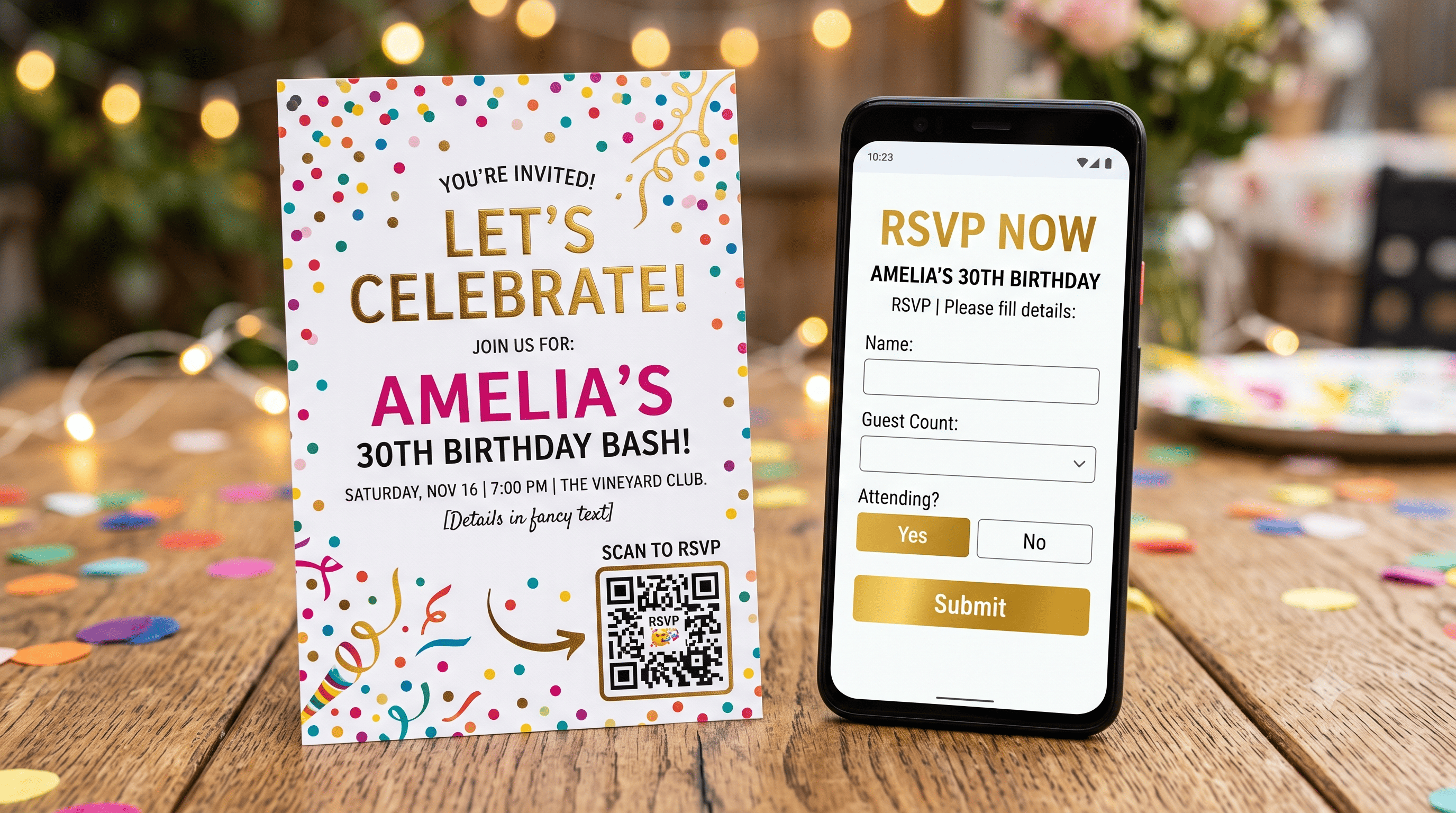
The best way to track RSVPs is to put every guest in one list, give them exactly one way to reply, and set a deadline two to three weeks before your caterer needs a number. That's the whole system. Everything below is how to actually run it without ending up with fourteen unanswered texts and a spreadsheet you're scared to open.
And look — this matters more than it sounds. The Knot's 2026 Real Weddings Study found couples spent an average of $292 per guest in 2025. Every person you can't confirm is a $292 guess. Twelve unconfirmed guests is a used car.
The five-step version
If you read nothing else:
- One list. Every invited household in one place, with a status column. Not three lists across two phones.
- One reply channel. Guests reply one way, and only one way. Mixed channels are where headcounts go to die.
- One deadline, set 2–3 weeks before your vendor's final-numbers date. Not the same day. Two to three weeks.
- One follow-up round, sent 3–4 days after the deadline, individually.
- One source of truth for meals and dietary needs, captured at the same moment they say yes.
Do those five and you'll be fine. Skip step 2 and you will absolutely lose someone's answer in a group chat.
Why RSVP tracking falls apart (it's never the guests)
Everyone blames guests for not replying. Guests are part of it — Emily Post has been saying reply within a day or two of receiving an invitation for roughly a century and people still take six weeks. But the failures I see most often are structural:
You offered too many ways to reply. Card in the mail, plus a text number, plus "or just let me know!" Now some answers are in your mailbox, some in your messages, some told to your mom at a barbecue. Nobody's tracking that. Nobody could.
Your list lives in two places. One in a spreadsheet, one in your head. The spreadsheet says 84. Your head says "oh and the Hendersons said yes."
You didn't decide what "yes" means. Does the Miller yes include their teenager? Is Sam's plus-one confirmed or theoretical? Ambiguous yeses are worse than no answer, because you'll count them and then be wrong.
You waited for people to reply. Expecting a full guest list to respond without a reminder is delulu and the numbers agree. Plan the follow-up round as part of the process, not as a failure of it.
If you'd rather not build the tracking yourself, a free RSVP link does the collecting — attending, declined and pending in three columns, exportable when you're done.
Step 1: Build the one list
Start here before you send anything. Your list is the spine of the whole thing — the invitations, the seating chart, the caterer's count, the thank-you notes, all of it points back to this.
Track by household, not by person. One row per invitation you're sending.
| Field | Why you need it |
|---|---|
| Household name | How you'll address the invite |
| Names of everyone invited | This is how you settle plus-one arguments later |
| Contact (email/phone) | For the follow-up round |
| Invite sent — date | So you know who to chase and when |
| Status | Yes / No / No reply — that third one is not optional |
| # attending (confirmed) | The number your caterer gets |
| Meal choice per person | If you're serving plated |
| Dietary notes | Allergies especially |
| Notes | "arriving Friday," "needs hotel info," "kids not invited — clarified" |
The "no reply" status is the one people skip, and it's the most important column on the sheet. It's the difference between "we have 84 yeses" and "we have 84 yeses and 31 unknowns." Those are wildly different situations.
Whether you build this in Google Sheets or inside your invitation tool doesn't matter much — what matters is that there's exactly one of it. If you're sending digital invites, the tracking usually comes attached to the invite itself, which saves you the copying step where errors creep in. If you're mailing paper, a spreadsheet is completely fine. Just don't run both.
Step 2: Pick one reply channel
This is the step that actually decides how much of your life this consumes.
| Channel | Best for | The catch |
|---|---|---|
| Online form / invite link | Most weddings and parties, any size | Needs a link on the invite, which means a QR code or a short URL |
| Reply card by mail | Formal weddings, older guest lists | Return postage is $0.82 a Forever stamp or $0.65 per postcard at current USPS rates — 100 cards is $65–82 before printing |
| Text / WhatsApp | Small casual events, under ~40 guests | Replies scatter across threads; you're the database |
| Corporate, showers, work parties | Buried in inboxes, low reply rate | |
| Phone call | Elderly relatives, small lists | Fine as a backup, unusable as a system |
For most people reading this: an online reply form is the answer, with a phone number listed as a backup for the handful of guests who won't use it. That's not a tech-bro take, it's just where the math lands — the form fills the spreadsheet for you and the card doesn't.
If you'd rather not build a whole wedding website just to collect replies, you don't have to. There are ways to collect RSVPs with nothing but a link and a phone, and for a 60-person party they work better than a website would. If you want to compare specific platforms first, we've broken down the free RSVP tools worth using separately.
Whatever you pick — put it on the invitation in one place, once, unambiguously. Two reply methods on one card is an invitation to chaos.
Step 3: Set the deadline backwards from your caterer
Don't pick a nice round date. Work backwards.
Ask your caterer or venue when they need final numbers. Subtract two to three weeks. That's your RSVP deadline. The gap is your chase window, and you will need all of it.
Typical shape for a wedding: invitations out 6–8 weeks ahead, RSVP deadline 3–4 weeks ahead, final count to the caterer 1–2 weeks ahead. Destination weddings and anything requiring flights need much longer — save-the-dates 8–12 months out, and a reply deadline that respects how long it takes people to book leave.
The full breakdown of how far ahead to close replies for different kinds of events covers destination weddings, small dinners, and the "we sent invites late" scenario, which happens to everyone.
One thing worth saying plainly: a deadline you don't enforce isn't a deadline. If you tell people October 12 and then accept replies until November 3, next time they'll wait until November 3. Print the real date and mean it.
None of this works if the deadline is set a week out. Give yourself three to four weeks and the chasing becomes leisurely instead of frantic.
Step 4: Capture meals and dietary needs at the moment of yes
Ask for the meal choice on the same form where they confirm. Not later. Later means a second round of messages to the same people who took three weeks to answer the first time.
Two rules that save the most grief:
- Ask per person, not per household. "The Chens: 2 attending, chicken" tells you nothing about which Chen wanted the fish.
- Separate preferences from allergies. "Vegetarian" is a preference. "Anaphylactic to shellfish" is a safety issue and needs to reach the kitchen, not just your spreadsheet.
There's more on the wording that gets you usable answers — and what to do about the guest who writes "no dairy, no gluten, no nightshades" — in the guide to handling meal choices and dietary restrictions.
Step 5: Run the follow-up round
Assume roughly a quarter to a third of your list won't reply by the deadline. Not because they're rude. Because they got the invite, thought "yes obviously," and put it on the counter.
The follow-up rules:
- Wait 3–4 days past the deadline. Not the day after.
- Message individually. Never a group text. A group "hey who hasn't RSVP'd??" makes everyone assume it's about someone else.
- Make it easy to answer in five seconds — give them the link again, or just ask them to reply yes or no to your message.
- Give one specific reason and one specific new date: "the caterer needs numbers Friday."
- After one follow-up and one final check, mark them no and move on. You are allowed to stop chasing.
Ready-to-send wording for all of that — including the awkward ones like a close friend who's gone silent, and the person who says "we'll try to make it" — is in the follow-up messages that actually get answers.
What to put on the RSVP itself
The reply card or form should ask for as little as possible. Every extra field costs you responses. Nothing gives guests the ick faster than a four-page form for a birthday party.
The minimum: who's replying, are they coming, how many of the invited people are attending. That's it for a casual event. Add meal choice and dietary needs for plated dinners, and a song request line if you like a party. Skip the rest.
If you're stuck on how to phrase any of it — including the M-line, "kindly reply by," and the polite ways to head off uninvited plus-ones — there are 40 RSVP card wordings you can copy directly, formal through casual.
One practical note on digital: if your invite links to a reply form, test the link on a phone before sending. Not on your laptop. On a phone, in a text message, the way your guests will actually get it. I've watched a couple send 90 invites pointing at a form that only loaded on desktop.
Tracking tells you who hasn't replied. It doesn't make them reply. That part needs a short follow-up sequence sent to people individually, because group reminders convert at close to nothing.
People Also Asked
Explore common questions related to this blog.