Somewhere in your venue contract, there's probably a line requiring every vendor who sets foot on the property to carry their own insurance. Most couples read straight past it. It's worth pausing on, because it's not the venue being difficult — it's the one piece of paperwork that quietly protects you from a mess that isn't even about your own coverage.
What a Certificate of Insurance actually is
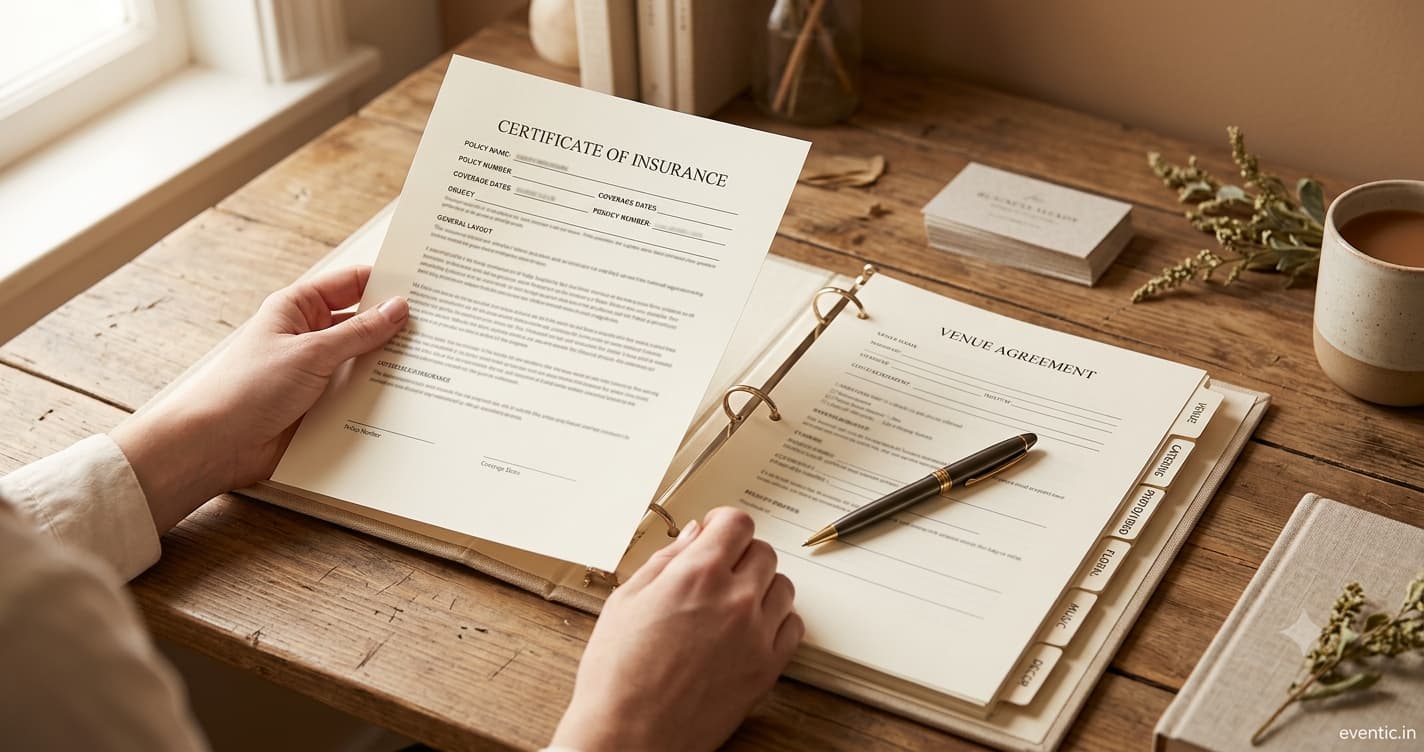
A COI is a one-page summary, issued by a vendor's insurance company, confirming what coverage they carry and at what limits. It's not the full policy document — it's essentially a receipt that proves the policy exists, listing the type of coverage, the coverage limits, the policy period, and often naming specific parties (like your venue) as an "additional insured" for the duration of your event.
Reading one takes about thirty seconds once you know what to look for: the coverage type (general liability, and ideally professional liability for anyone doing skilled work like photography or event planning), the per-occurrence and aggregate limits (commonly $1 million / $2 million for wedding-adjacent vendors), the policy dates (confirm they cover your actual wedding date, not just "currently active"), and whether your venue is listed as an additional insured if that's what your venue's contract requires.
Why this genuinely matters, not just as paperwork
If a vendor causes damage or an injury while working your wedding — a photographer's light stand falls and breaks something, a caterer's setup causes a kitchen fire, a DJ's equipment shorts out and damages the venue's electrical system — the vendor's own liability insurance is what's supposed to cover that, not yours. Without confirming they actually carry it, you're exposed to the possibility that a vendor's mistake becomes a bill that lands on you, either because the vendor genuinely has no coverage or because the coverage they claimed to have turns out to be inadequate or lapsed.
There's also a very practical reason venues require it: liability doesn't disappear just because it was a vendor's fault rather than the couple's. A venue that lets uninsured vendors operate on their property is taking on risk they'd rather not carry, which is exactly why so many venue contracts now specify that every vendor — not just the couple — must provide proof of coverage before being allowed to work the event.
The vendors most worth checking
Not every vendor carries equal risk, and not every vendor will have equally robust coverage without you asking specifically:
Photographers and videographers. Most professional photographers carry general liability insurance as standard practice, and many also carry equipment coverage (sometimes called inland marine coverage) protecting their own gear, which isn't directly your concern but is a reasonable sign of a professionally run business. If a photographer balks at providing a COI or acts like it's an unusual request, that's worth noting — established professionals are used to this question and usually have the document ready within a day.
Caterers and bartenders. These carry some of the highest-stakes liability of any wedding vendor, given food safety, alcohol service, and open flames or cooking equipment often involved. Confirm they carry liquor liability specifically if alcohol is part of their service, not just general liability — the two aren't automatically the same coverage.
DJs, bands, and entertainment. Equipment-heavy vendors carry liability risk around their gear (cables, speakers, lighting rigs) and general injury risk the same as any vendor working a crowded space.
Rental companies (tents, furniture, dance floors). These vendors are often providing the physical structure your guests interact with directly, which makes their coverage worth confirming specifically — a tent rental company's certificate should reflect coverage for structural failure, not just general liability for their staff.
Florists and decor vendors. Generally lower-risk than the categories above, but still worth a quick ask, especially if their setup involves ladders, hanging installations, or anything with real fall-risk during setup.
What to actually say when you ask
This doesn't need to be an awkward conversation. Most established vendors have handled this request dozens of times and can produce a COI within a day or two, often by email. A simple version: "Our venue requires proof of insurance from every vendor — could you send over your certificate of insurance, and if needed, have it list [venue name] as an additional insured for [wedding date]?" That's it. If a vendor pushes back hard on this, or seems genuinely unfamiliar with the request, it's worth treating as a data point about how established their business actually is, not just an annoying box to check.
The one edge case that occasionally gets messy
Every so often, a venue asks not just for general liability but for workers' compensation coverage from vendors — a requirement more suited to a vendor with employees than a solo freelancer working alone. This can create a genuinely frustrating standoff, since a one-person operation (a solo photographer, say) often can't get workers' comp coverage at all, because there's no employee to cover. If this happens, it's worth raising directly with your venue coordinator — some venues will waive the workers' comp requirement for confirmed solo operators once it's explained, but it needs a conversation rather than assuming the requirement is flexible.
What this has to do with your own insurance
Vendor insurance and your own wedding liability policy are separate things covering separate risks. A vendor's COI protects you from that specific vendor's mistakes; your own liability policy protects you from things that aren't any single vendor's fault — a guest tripping on uneven ground, general crowd-related incidents, anything that falls outside a specific vendor's scope of work. The full cost and coverage breakdown covers your own policy in detail; this article is really about making sure the vendor side of the liability picture isn't a gap you never checked.
If a vendor ever does no-show or fails to deliver what they promised, that's a different problem entirely, one your own cancellation coverage may partially address depending on the reason — how to actually file a claim covers what documentation you'd need in that specific scenario, including what to gather from a vendor situation gone wrong.
Build it into the contract, not into a last-minute email
The smoothest version of this process happens when the COI requirement is written directly into each vendor contract from the start, rather than requested as an afterthought once contracts are already signed. A simple clause — something like "vendor agrees to provide a certificate of insurance showing general liability coverage of at least $1,000,000 per occurrence, naming [venue name] as additional insured, no later than 30 days before the event date" — puts the request on the record as a contractual obligation rather than a favor you're asking for. Most professional vendors won't blink at language like this; it's standard in their industry, and many have a template response ready before you even finish asking.
If you're working with a wedding planner or coordinator, this is often a task they'll handle as part of their standard vendor-management process — worth asking directly whether COI collection is included in their services, since it can save you a genuinely tedious round of individual emails during an already busy stretch of planning.
Keep the certificates in the same place as everything else
Once you've collected COIs from each vendor, keep them in the same folder where you're already storing vendor contracts, deposit receipts, and your own wedding insurance policy documents. This matters for two reasons: your venue coordinator may ask to see them again closer to the event date, and if something ever does go wrong with a specific vendor, having their certificate already on hand — showing exactly what coverage they carried and for what period — saves real time during what's likely to be an already stressful moment. It's a small piece of organizational overhead that pays for itself completely the one time you actually need it.
What if a vendor pushes back on the request entirely
Occasionally a vendor will treat the COI request as unusual or unnecessary, sometimes framing it as "I've never been asked for that before" or "my other clients never needed this." This is worth taking seriously as information rather than dismissing as a minor friction point. An established professional in a wedding-adjacent business has almost certainly been asked for a COI before, since venues have been tightening these requirements for years — genuine unfamiliarity with the request is itself a signal worth weighing when deciding whether to move forward with that vendor at all. If your venue's contract explicitly requires vendor insurance and a specific vendor can't or won't provide it, that's a conversation to have directly with your venue coordinator before the situation becomes a last-minute crisis in the final weeks before the wedding — some venues have backup vendor lists specifically for this scenario, and it's far easier to swap a vendor months out than days out.
Nobody plans a wedding thinking about other people's insurance paperwork. But it's a fifteen-minute email per vendor that quietly closes off a whole category of "not our fault, but somehow our problem" that couples otherwise never see coming until it's too late to ask.
People Also Asked
Explore common questions related to this blog.
Size doesn't remove the risk — a small operation causing an accident is still a liability exposure, arguably a bigger one for you specifically, since a smaller business may have fewer resources to cover a claim if something goes wrong.
As soon as contracts are signed is ideal, giving plenty of time to resolve any gaps well before the wedding. Requesting it the week of the wedding, when your venue coordinator suddenly asks for it, is the stressful version of this same task.
Generally, no — your policy covers your own liability exposure as the host, not a vendor's business liability. That's specifically what the vendor's own COI is for.