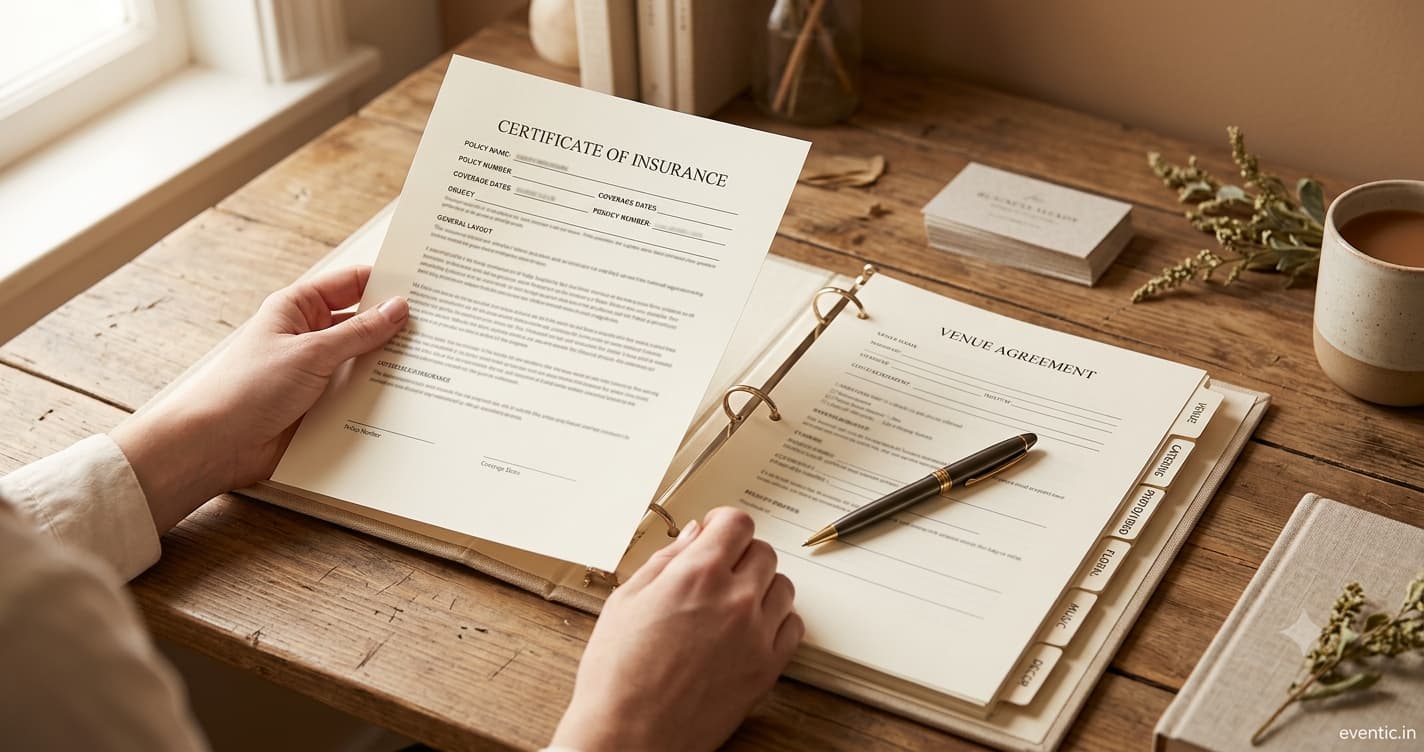
Nobody buys wedding insurance planning to use it. Which means most couples who eventually do file a claim are doing it for the first time, under stress, without any idea what the process actually looks like — and that's usually the moment small paperwork gaps turn into real delays.
Step 1: Notify your carrier as soon as reasonably possible
Most policies expect you to report a covered loss promptly — not necessarily the same day, but without unreasonable delay. Waiting weeks to see if things somehow resolve on their own, rather than reporting close to when the triggering event happened, can complicate an otherwise straightforward claim. If your wedding is cancelled due to a hurricane, a sudden illness, or a vendor going out of business, call or file online with your carrier as soon as you have a clear picture of what happened — you don't need every document in hand yet to start the process, just the basic facts.
Step 2: Gather your policy details
Have your policy number, the coverage dates, and a copy of the policy documents themselves ready. If you bought the policy months ago and haven't looked at it since, this is the moment to actually reread the specific coverage and exclusions sections rather than relying on memory of what you think it said when you bought it.
Step 3: Document what actually happened
Write down a clear, factual account: what happened, when, and how it affected your wedding. If it's a weather event, keep or find the specific advisory, warning, or state-of-emergency declaration covering your date and location — a link to a local news report or the National Weather Service alert for your area is exactly the kind of thing that supports a weather-related claim. If it's a vendor failure, keep any communication from the vendor themselves (an email announcing they're closing, a bankruptcy filing notice, or simply their failure to respond to repeated attempts to contact them, documented with timestamps). If it's illness or injury, a doctor's note or medical documentation covering the relevant dates is typically required.
Step 4: Collect every financial document tied to the loss
This is the step that determines how smoothly reimbursement goes, more than any other. Gather:
- Every vendor contract showing the deposit or payment amount and the non-refundable terms
- Receipts or bank/credit card statements showing what you actually paid
- Any correspondence with the vendor about refunds — including their refusal to refund, if that's what happened, since it shows you attempted to recover the money before filing the claim
- If the event was postponed rather than cancelled outright, documentation of any additional costs incurred in rescheduling
Most cancellation policies only reimburse costs you genuinely couldn't recover elsewhere — insurers typically expect you to have tried to get a refund from the vendor or venue directly first, and to show that attempt as part of your claim. Skipping that step and going straight to the insurer with no evidence you tried the vendor first can slow things down.
Step 5: Submit the claim and stay responsive
Once submitted, most carriers assign an adjuster or claims handler who may follow up with clarifying questions or request additional documentation. Responding quickly to these requests — rather than letting them sit — is one of the simplest ways to keep a claim moving. If something's unclear about what they're asking for, it's fine to call and ask directly rather than guessing at what they want.
What determines whether a claim gets approved
Two things matter most: whether the reason for the claim falls within a covered category (rather than an excluded one, like a change-of-heart cancellation or a pandemic-related shutdown, depending on your specific policy), and whether the loss is adequately documented. A perfectly legitimate, covered claim can still get delayed or partially denied if the documentation is thin — insurers aren't set up to take a couple's word for a dollar amount without some kind of paper trail behind it. This is exactly why understanding your policy's exclusions before you ever need to file matters: knowing what's covered and what isn't means you're not surprised by a denial for a reason that was always excluded, and you can focus your documentation energy on the parts of the claim that are actually covered.
The vendor side of a claim can get complicated
If your claim involves a vendor who failed to show up or went out of business, it's worth understanding what a vendor's own insurance situation typically looks like — because in some cases, a vendor's own liability or business insurance may be a more direct path to recovering money than your wedding cancellation policy, depending on exactly what went wrong. If you kept the vendor's certificate of insurance from before the wedding (which, per that guide, is worth doing for every vendor anyway), that document can be genuinely useful context to have on hand when you're untangling which insurer is actually responsible for which piece of the loss.
A folder, from day one, is the whole trick
The single biggest difference between a smooth claim and a frustrating one isn't the size of the loss or the specific carrier — it's whether the couple already has every contract, deposit receipt, and confirmation email organized in one place before anything goes wrong. Couples who scramble to reconstruct "what did we pay, and when, and to whom" months after the fact, under the added stress of an already-disrupted wedding, consistently have a harder time than couples who simply kept a folder (physical or a shared digital drive) from the day the first deposit went out. This costs nothing and takes maybe ten minutes total, spread out over the whole planning process — start it the same week you buy the insurance itself, and it stops being a task and just becomes something that already exists when you need it.
The most common reasons claims get denied or delayed
A handful of patterns show up repeatedly across denied or significantly delayed claims, and almost none of them are about the underlying loss being illegitimate:
The reason falls under an exclusion the couple didn't fully understand. Change-of-heart cancellations, pandemic-related disruptions, and anything tied to a risk that was already known before the policy was purchased are the most common categories here. This is entirely preventable by reading the actual exclusions section of your policy when you buy it, not after something happens.
Documentation doesn't match the claimed amount. If you're claiming reimbursement for a $3,000 venue deposit but can only produce a contract showing $2,400 and no clear record of the remaining amount, the claim will likely be processed for what can actually be documented, not what you remember paying. Bank and credit card statements are useful backup here precisely because they don't rely on memory.
No evidence of attempting to recover the money from the vendor first. Most cancellation policies expect you to have tried to get a refund directly before turning to insurance — filing a claim without any record of that attempt can result in the insurer asking for it before proceeding, adding a delay that's easily avoided by simply keeping copies of your refund request emails as you send them.
The claim was reported significantly after the triggering event, without a clear reason for the delay. Prompt reporting isn't just a formality — insurers sometimes view a long, unexplained gap between the event and the claim as a reason to scrutinize the claim more closely, even when the underlying loss is completely legitimate.
Confusion between which policy covers which loss, on a multi-policy claim. If your claim involves both your own wedding insurance and a vendor's separate business insurance — say, a caterer who both failed to show up and caused property damage — sorting out which insurer is responsible for which specific piece of the loss can slow things down if it isn't addressed clearly and early in the claims conversation with each party involved.
None of these are reasons to avoid filing a claim you believe is legitimate. They're reasons to file it well: complete documentation, a clear timeline, and realistic expectations about what your specific policy actually covers, set before you're in the middle of a stressful situation rather than during it.
The claim itself is rarely the hard part. The hard part is remembering, months after signing a dozen vendor contracts in a rush of wedding excitement, exactly what you paid and when — which is a problem solved entirely by a folder you start today, not by anything clever you do after something's already gone wrong.
People Also Asked
Explore common questions related to this blog.
It varies significantly by carrier and by how complete the documentation is at submission — well-documented, clearly covered claims tend to move faster than claims requiring back-and-forth clarification. There's no universal timeline, which is exactly why documentation quality matters so much.
Yes — it's reasonable to file and let the carrier make the determination rather than assuming in advance that something isn't covered. The worst outcome is a denial, which at least gives you a clear answer; not filing at all guarantees no reimbursement either way.
Not typically, for a standard claim — the process is designed to be handled directly between the policyholder and the carrier. If a claim gets disputed or denied in a way that seems clearly wrong given your policy's actual terms, that's a different situation worth getting advice on.
Document your attempts to reach them regardless — repeated emails or calls with no response, timestamped, still serves as evidence that you tried to recover the payment directly before filing with your insurer.